Santa Monica Planning Commissioners pressed city staff Tuesday night on the mechanics and implications of including housing at the Santa Monica airport site, as three competing visions for the 192-acre property continue to circulate through the community in advance of the airport's possible closure in 2028.
The commissioners' reflected the broad community debate of the future for the land including concerns about whether the city was adequately exploring options that wouldn't require voter approval, how housing would actually generate revenue to support park operations, water usage and the interaction with existing developments around the area.
"It's weird where we sit to be shown only one option that doesn't require a public vote," said Commissioner Shawn Landres, arguing the city should present multiple scenarios that comply with Measure LC, the 2014 voter initiative restricting airport development to parks and recreation uses. "It just feels like you're being boxed in a little bit."
Staff said every option technically complies with LC as the referendum doesn’t prevent housing from being built on the site, it just requires a public vote to do so.
Landres also raised concerns about coordinating with Los Angeles who control zoning on part of the land and said the proposals need to account for the way different uses will interact with each other.
"What steps are we taking so as not to foreclose the production of appealing housing options?" he asked, warning against placing incompatible uses like waste management facilities near potential residential areas.
Commissioner Leslie Lambert praised staff's work while acknowledging the challenge housing presents. "I first want to just compliment you so much on the work you've been doing. I don't know how you've done it, really," she said, noting housing wasn't initially part of the project scope. "I want to see some housing at the park, but I also want to see a park. I know the park is very, very important to this community."
Lambert pressed for clarity on how housing would be presented to voters, asking whether proposals would specify first-time homebuyer programs or social housing. "When you actually go to the community and you post housing as an option, how do you depict that?" she asked.
Commissioner Nina Fresco brought historical perspective, noting the airport bond passed in 1926 because residents expected aviation revenue to fund operations without burdening taxpayers. She contrasted this with failed contemporary bond measures for parkland that required direct public funding.
"100 years ago, we bought this land," Fresco said, explaining that simultaneous park-only bond measures failed because "people didn't want to pay for it out of their pockets." The airport bond succeeded because "they were going to get all this fun stuff and they weren't going to have to pay for it out of their pockets."
Fresco questioned the relationship between survey results and the three scenarios presented, finding it difficult to understand how community preferences translated into the specific options. She also noted missing historical elements, asking why the rotating beacon—one of two designated airport landmarks—didn't appear in planning documents.
Commissioner Josh Hamilton pressed for detailed financial breakdowns showing which elements would generate income versus expenses, questioning how affordable housing could realistically fund park operations. "Housing is a revenue generator that's going to support this park," Hamilton said, but added that affordable housing alone wouldn't generate significant income without market-rate units to subsidize it.
Hamilton argued for clearer presentation of revenue-generating versus expense items to help the public understand trade-offs. "Each of the different scenarios [has] mixes of each income and expense, and so it was hard to really understand, okay, to pick and choose from it," he said.
Staff said the project is in its earliest stages at the moment and the examples given so far are a long way from final. They said the idea up to this point has been to see what kind of elements the public want and there will be significant revisions before anything close to a final map is developed.
The three scenarios publicly discussed present markedly different approaches to the site's future. Scenario 1 creates an entirely park-focused design featuring a 15-acre municipal reservoir on the former runway, urban forests, community farms, sports facilities and a 2,000-seat amphitheater while preserving existing revenue-generating buildings that provide $6-7 million annually.
Scenario 2 incorporates 34 acres of urban forest around a meandering multi-use path, plus a 7-acre pond and large performing arts center accommodating 20,000 attendees. This middle option includes 32 acres designated for housing and commercial development.
Scenario 3 envisions the most ambitious transformation with a 10-acre recreational lake, botanical gardens, cultural facilities and 48 acres of new housing and commercial development designed to achieve financial self-sustainability.
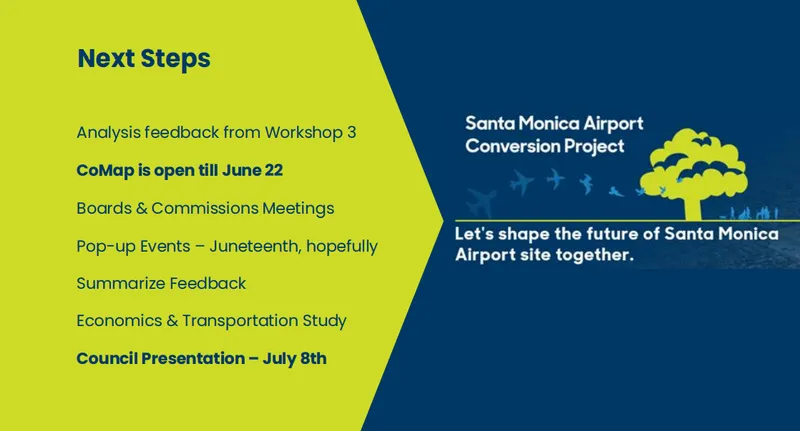
Planning staff emphasized the scenarios are "test fits" meant to gauge community preferences on specific elements rather than requiring residents to choose one complete package. Public input through the city's CoMap survey tool remains open until June 22, with results scheduled for City Council review on July 8.
The airport conversion project has evolved through three phases of community engagement since the Federal Aviation Administration agreed to close the facility. Phase 1 identified 147 potential uses that were consolidated to 94, with housing ranking as the second-least popular option. However, recent surveys show more than half of respondents now support some residential development.
"Housing remains a deeply divisive issue," acknowledged project manager Amber Richane, noting survey results split nearly evenly between supporters and opponents.
Public speakers reflected this division with speakers on all sides of the debate.
The project faces complex legal hurdles, as any housing development would require voter approval to override Measure LC. City officials are also working with state housing officials to understand how the Surplus Land Act might affect long-term ground leases.
Landres emphasized the importance of maintaining city ownership of any housing development, advocating for land trust models where residents own improvements but not underlying land. "It's extremely important that what mixes... [is] rooted in the premise of making that housing accessible and preserving the city's ownership of the underlying land and resources," he said.
A preferred scenario will be developed in Fall 2025 following community input and City Council direction, with Environmental Impact Report proceedings to follow in 2026. The timeline aims to have development plans ready before the airport's possible closure on December 31, 2028.