
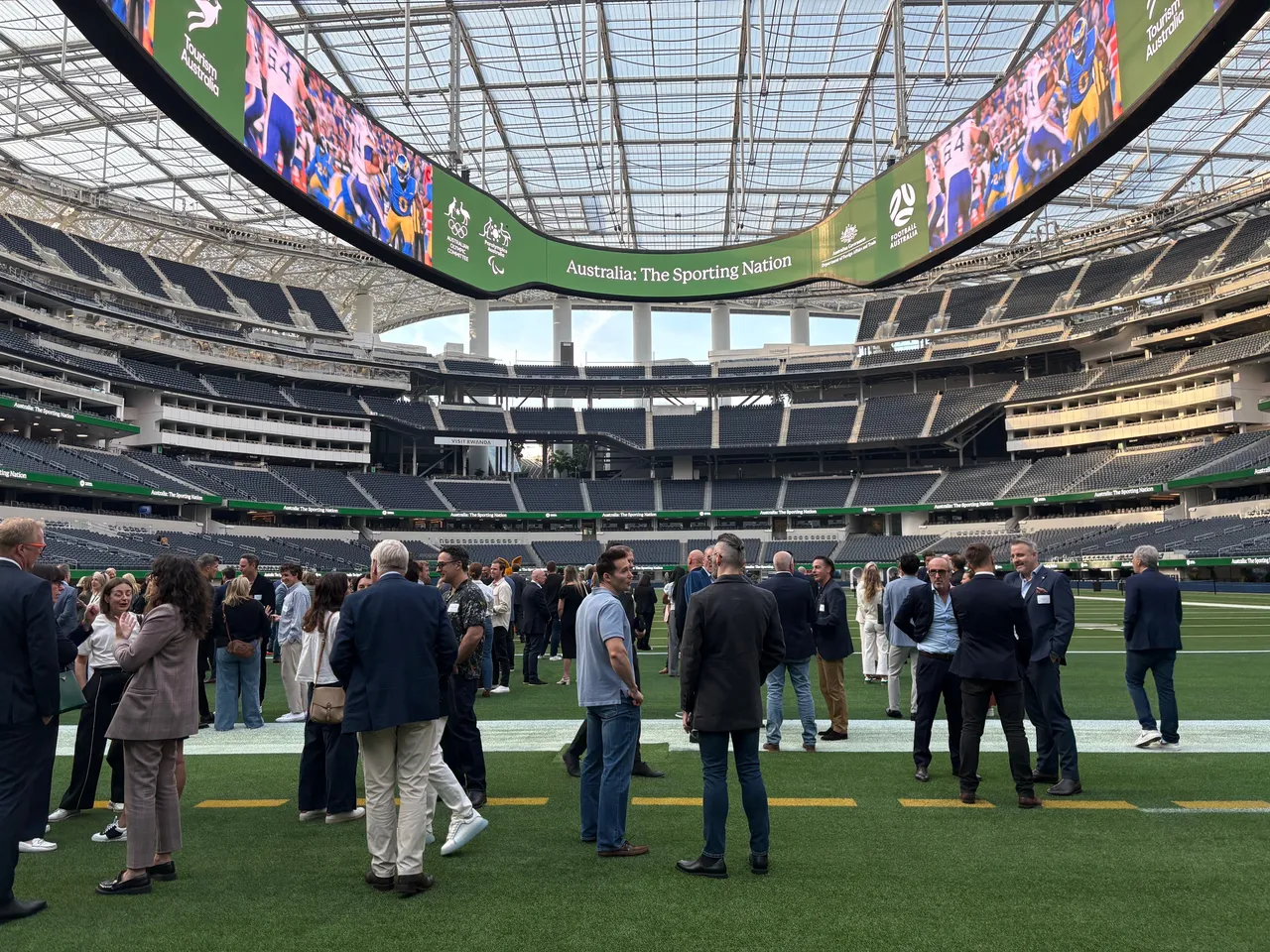
Last Wednesday at SoFi Stadium, the field itself became a diplomatic table. Executives stood along the sideline where championships have been decided. Olympians and Paralympians mingled with ministers, commissioners, tourism leaders, and broadcast executives. The setting was iconic, but the tone was forward-looking. What unfolded was not a celebration of past victories. It was a strategic alignment around what comes next, and how global mega events will shape tourism, trade, inclusion, and international partnerships for the next decade.
Hosted by Tourism Australia in partnership with the Australian Consulate General in Los Angeles, the Australian Olympic Committee, Paralympics Australia, and Football Australia, the afternoon positioned Australia not simply as a future host nation, but as a country actively studying Los Angeles in real time. With the 2026 FIFA World Cup, the LA28 Olympic and Paralympic Games, and the Brisbane 2032 Olympic and Paralympic Games on a shared horizon, speakers emphasized that mega events are no longer isolated spectacles. They are interconnected engines that drive economic growth, cultural exchange, and long term legacy.
“This is not about a single Games,” one executive said as leaders gathered along the field. “It is about building a decade long pipeline where sport, tourism, and trade reinforce each other.”
Master of ceremonies James Bracey framed Australia’s identity as “The Sporting Nation,” pointing to an unprecedented coordination between tourism bodies, sports federations, government officials, and diplomatic offices across the United States. “Australia is not just hosting events,” Bracey said. “We are aligning sport, tourism, and government around a shared global story, and Los Angeles is a critical part of that story.”
That alignment reflects a broader shift. Sport is no longer treated as a silo. It has become a strategic front door to visitation, trade, and international brand positioning. Australia’s Minister for Trade and Tourism, Senator the Hon. Don Farrell, reinforced the point, noting that United States and Australia trade surpassed 133 billion dollars last year. “Sport is culture, and culture is commerce,” Farrell said. “When people travel for sport, they do not just attend a match. They stay, they explore, and they build lasting connections with a place.”
Stadiums such as the Melbourne Cricket Ground and Adelaide Oval were described not simply as venues, but as national assets anchoring tourism and global visibility. The United States, Farrell emphasized, remains a must-win market, particularly for long stay, high value travelers who extend their experience beyond a single event.
Tourism Australia Managing Director Robin Mack outlined what he called a “Decade of Green and Gold,” a coordinated runway of global moments aligned with tourism activation. The flagship campaign, Come and Stay Today, is designed to convert broadcast viewership into visitation, encouraging travelers to experience Australia’s cities, regions, and natural landscapes well beyond match day. “We are focused on long stay, high-value travelers,” Mack said. “The United States is a must win market for us, and sport gives us the most powerful runway to convert global audiences into visitation.”
The event pipeline is deliberate. An NFL in season game at the Melbourne Cricket Ground. The Rugby World Cup in 2027. The Presidents Cup in 2028. All leading toward Brisbane 2032. Each milestone is seen as an opportunity to distribute tourism benefits across states and regions, reinforcing a national brand while sharing economic impact more broadly.
NFL Commissioner Roger Goodell confirmed Australia’s growing importance in the league’s international expansion strategy, citing cultural alignment and strong governmental support. “Australia makes sense for the NFL,” Goodell said. “There is cultural alignment, government support, and a real appetite to grow the game at the community level. If we are welcomed, we intend to build something that lasts.” The announcement of an LA Rams hosted game against the San Francisco 49ers in Australia signals more than a one off matchup. League leaders emphasized sustained investment, including school and community programs aimed at building participation among boys and girls.
Football Australia leaders reflected on the continued momentum following the 2023 Women’s World Cup, positioning the Matildas as both a cultural force and commercial driver. “The Matildas showed the world what women’s football can be,” one executive shared. “Now the work is making sure participation, commercial opportunity, and visibility continue to grow long after the final whistle.” The upcoming Asian Cup, set to begin March 1, 2026, is expected to sell out, reinforcing football’s growth trajectory and its tourism ripple effect.
Inclusion remained central throughout the afternoon. Paralympic gold medalist and board director Jared Cockerell underscored that accessibility must be foundational. “Inclusion cannot be an afterthought,” he said. “From venues to administration to leadership, accessibility has to be built into the system from the start.” Curtis McGrath offered a message that resonated beyond sport. “Have a go,” he told the room. “That mindset, backed by families, schools, and sponsors, is how we unlock potential.” Brisbane 2032 organizers echoed that commitment, stating their intention to deliver the most inclusive and accessible Games in history.
Andrew Liveris, President of the Brisbane 2032 Organising Committee, described the Games’ guiding vision as Believe, Belong, Become. “Brisbane 2032 is about more than a city,” he said. “It is a statewide Games designed to distribute opportunity, inspire future athletes, and leave infrastructure that communities can use for generations.” Unlike traditional centralized host models, Brisbane is pursuing a distributed approach, activating venues across Queensland and leveraging geography to spread tourism and economic benefits beyond a single urban core.
Los Angeles emerged as both host and teacher. From venue scale and transportation logistics to athlete preparation and crowd intensity, Australia is studying LA28 as a living case study. Swimming drew particular attention, with LA28 expected to stage events in a forty-thousand seat stadium. “This will be next-level,” said Gale Hall Jr., a 10-time Olympic medalist.. “A venue of that scale changes everything. The preparation is as much mental as it is physical.” The United States and Australia rivalry in the pool is expected to take center stage once again, adding narrative tension to an already historic stage.
As the event concluded with a charity auction supporting sport related causes, conversations continued across the field. What unfolded at SoFi Stadium was not simply an afternoon of executive networking. It was a coordinated alignment across nations, leagues, athletes, and industries, all preparing for a decade in which sport, tourism, diplomacy, and economic strategy are inseparable.
“The legacy of these events is decided years before opening ceremonies,” one attendee observed as leaders dispersed. “What matters most is who is in the room early, and what decisions they make together.”
For Los Angeles, the groundwork for 2026, LA28, and 2032 is being laid now.
________________________
By Michelle Edgar