

California has once again positioned itself at the forefront of reproductive healthcare innovation, ranking fifth in a new nationwide assessment of where patients can most easily access abortion medication through digital platforms. The report, released by the telehealth provider carafem, evaluates how well each state supports online access to medication abortion—a rapidly expanding sector of healthcare reshaped by shifting laws, rising demand, and evolving technology.
Since the Supreme Court overturned federal abortion protections in 2022, telehealth has stepped into an unprecedented role. By late 2024, one in every four abortions in the United States was provided through telemedicine, according to the Society of Family Planning. Just two years earlier, that number was barely 5%. This dramatic pivot has transformed states such as California into essential access hubs—not only for residents, but for patients nationwide navigating increasingly restrictive laws in their home states.
California’s Position in a Changing Legal Landscape
Carafem’s analysis ranks states based on legal protections, provider capacity, and consumer demand. Maine, Colorado, New York, and Vermont secured the top four spots, with California close behind—reflecting a policy environment that actively supports digital reproductive care.
California is one of only a handful of states that has adopted a comprehensive set of “shield laws” designed to protect both providers and patients involved in abortion care. These measures can prevent out-of-state entities from accessing medical records, prosecuting providers, or pursuing civil penalties for prescribing or mailing abortion medication across state lines. Similar protections exist in Colorado, Maine, Massachusetts, New York, and Vermont, creating a small but influential cluster of states shaping the new digital landscape of abortion access.
The legal protections extend into gray territory as well. Some shield laws explicitly allow clinicians to prescribe and mail abortion medication to patients living in states with bans—an approach that remains legally unsettled and could face future challenges. A recent Texas lawsuit against a New York physician underscores the tension. While the case was dismissed under New York’s protections, experts say conflicts between states are far from resolved.
Telehealth Demand Surges—Even in States With Strict Bans
The study also revealed surprising geographic patterns. Wyoming ranked first for demand, despite political rhetoric around restrictions, with an estimated 95% of abortions provided via medication. Georgia, which enforces a six-week ban, also ranked among the highest-demand states for telehealth care.
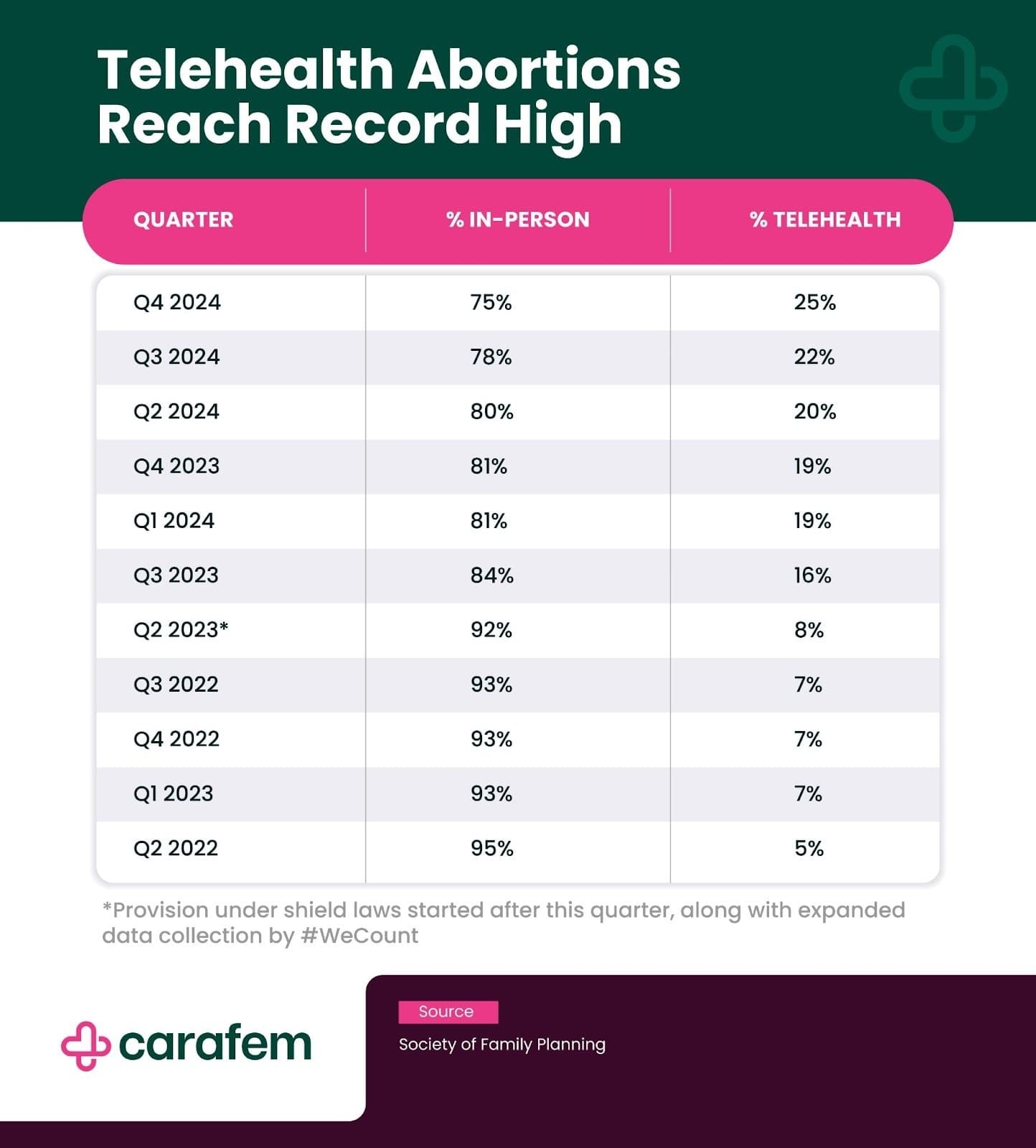
Such numbers point to a broader reality: many patients now rely on online care because in-person services are either legally risky, geographically inaccessible, or overwhelmed by surging demand.
Meanwhile, travel across state lines for abortion care remains significant. According to the Guttmacher Institute, the number of patients who crossed state borders to receive care nearly doubled after the Dobbs decision—from 81,000 in 2020 to 169,000 in 2023. That figure dipped slightly to 155,000 in 2024, due in part to expanding telehealth options that allow patients to remain in their home states while receiving care.
Implications for California’s Healthcare Ecosystem
For California’s medical community and policymakers, the state’s strong ranking is more than symbolic. It reflects California’s growing function as a national access point for digital reproductive care—an evolving market with economic, legal, and healthcare implications.
Telehealth providers operating in California must navigate fluctuating regulatory conditions and substantial uncertainty as interstate legal conflicts grow. At the same time, demand for clinician-supervised, telehealth-based abortion care continues to rise, especially in states where care has become legally precarious. Providers like carafem differentiate themselves with physician oversight, detailed medical support, and ongoing patient communication, setting them apart from unregulated pill distributors that have entered the market.
The study also touches on broader public health concerns. Research from the Gender Equity Policy Institute shows maternal mortality rates are vastly higher in states with abortion bans, underscoring the stakes for preserving access—not just from a rights perspective, but as a matter of healthcare equity.
A New Era of Digital Reproductive Care
The Carafem analysis draws on data from Guttmacher, KFF, UCLA’s Center for Reproductive Health Law and Policy, and Plan C, examining state-by-state variations through October 2025. While state rankings will undoubtedly continue to shift as legislation evolves, one trend is unmistakable: abortion access in the U.S. is increasingly shaped not by geography, but by digital infrastructure, telehealth policy, and state-level willingness to protect providers.
As one of the highest-ranked states in the country, California is helping define what the next generation of reproductive healthcare will look like—one where technology, legal innovation, and patient demand intersect to reshape access for millions.
