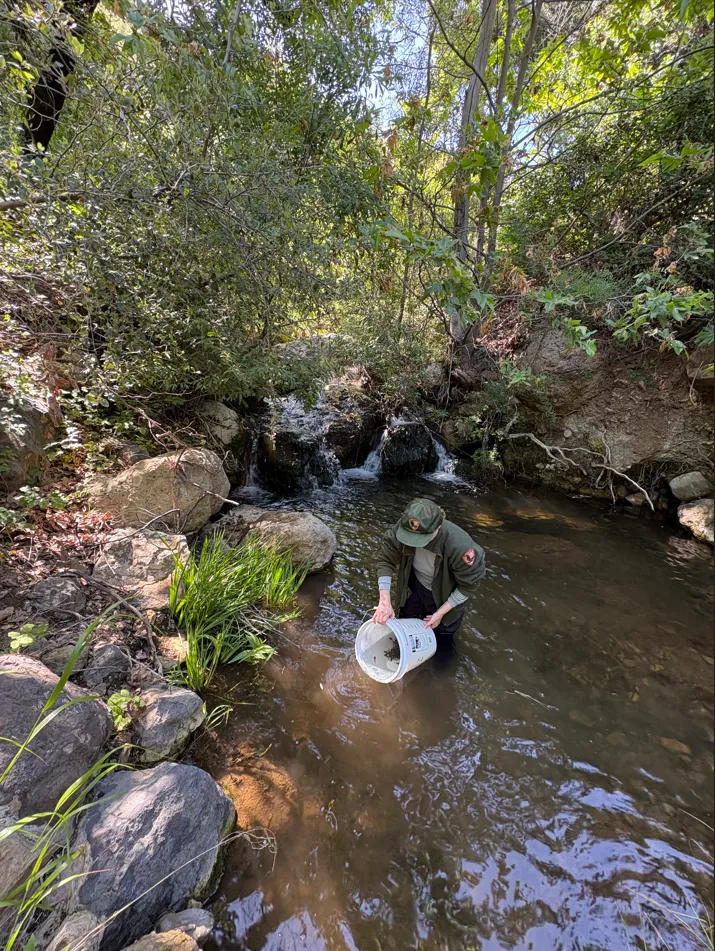
Nearly 600 California red-legged frog tadpoles were released into Santa Monica Mountains streams recently, marking an emergency conservation success for a species that vanished from the area more than 50 years ago.
The tadpoles were rescued as eggs in March after extreme late-winter storms threatened to destroy fragile breeding sites throughout the mountains. National Park Service biologists collected the vulnerable egg masses and transported them to the Aquarium of the Pacific in Long Beach, where staff hatched and nurtured them into healthy tadpoles over the spring.
"We are so proud to be able to support the National Park Service in their work to help local populations of California red-legged frogs," said Erin Lundy, Aquarium of the Pacific manager of conservation initiatives. "Our partners dedicate so much time and expertise to supporting these local species, and it's incredibly meaningful to be able to play a role in the important work that they do."
The emergency intervention represents the latest chapter in a decade-long mission to reestablish the California red-legged frog in its former habitat. The species, listed as federally threatened under the Endangered Species Act, was last documented in the Santa Monica Mountains in the early 1970s.
"No one was formally monitoring California red-legged frogs in the Santa Monica Mountains during their decline here," said Katy Delaney, wildlife ecologist with Santa Monica Mountains National Recreation Area. "By the time people were formally surveying for them in the 1980s they were not found anywhere in the Santa Monica Mountains at all."
Museum specimens from the 1920s show the frogs were once common throughout the mountains and Los Angeles Basin streams. Their disappearance left a critical gap in the ecosystem, as the California red-legged frog is the largest native frog in the western United States and plays a vital role as both predator and prey in stream environments.
The collaboration between the National Park Service and Aquarium of the Pacific emerged from necessity this year. The park service had previously worked with the Santa Barbara Zoo on frog reintroduction efforts, but the zoo was undergoing renovations and couldn't accommodate the egg masses.
"I heard from one of my USGS colleagues that the Aquarium of the Pacific helped them with Mountain yellow-legged frog tadpoles so I got their contact information and the aquarium was super enthusiastic and accommodating," Delaney said.
The aquarium staff set up specialized tanks to hatch the eggs and care for the developing tadpoles over several months. When the tadpoles reached the appropriate size, park service biologists collected them in five-gallon buckets and transported them to reintroduction sites in the mountains.
Reintroduction efforts began in 2014 as part of a broader conservation strategy to restore biodiversity to Santa Monica Mountains streams. The California red-legged frog is the only native amphibian missing from the ecosystem, making its recovery crucial for ecological balance.
"Conservation of native amphibian species helps us to maintain biodiversity and ecosystem balance in our own backyard," Lundy said. "Amphibians like the red-legged frog are a huge component of the food web, playing a role as both predator and prey at different parts of their life cycle."
This summer, park service biologists will monitor the release sites to track the tadpoles' development into froglets. The team will conduct both daytime and nighttime surveys, walking approximately one kilometer through streams and examining banks for young frogs.
"This project has had its share of ups and downs over the years," Delaney said. "But with committed partners like the aquarium, we're writing another hopeful chapter in the comeback story of the California red-legged frog."
The monitoring efforts will continue into fall, when biologists hope to document successful metamorphosis from tadpole to frog. Success would mark a significant milestone in the species' recovery and demonstrate the effectiveness of emergency conservation interventions.
Officials emphasize that public cooperation remains essential for the program's success. Visitors to the Santa Monica Mountains should stay on designated trails and keep pets out of streams, especially during breeding season, to avoid disrupting the fragile recovery process.