
The Santa Monica City Council will meet Tuesday to consider an update to the city's Realignment Plan, reviewing significant public safety gains and voting on a package of new economic development tools, organizational reforms and housing strategies intended to cement those improvements as permanent city standards.
The council adopted the Realignment Plan in October 2025, deploying $60 million in reserves across five strategic priorities aimed at restoring public safety, revitalizing civic spaces and rebuilding organizational capacity. According to the staff report, results since adoption have been significant.
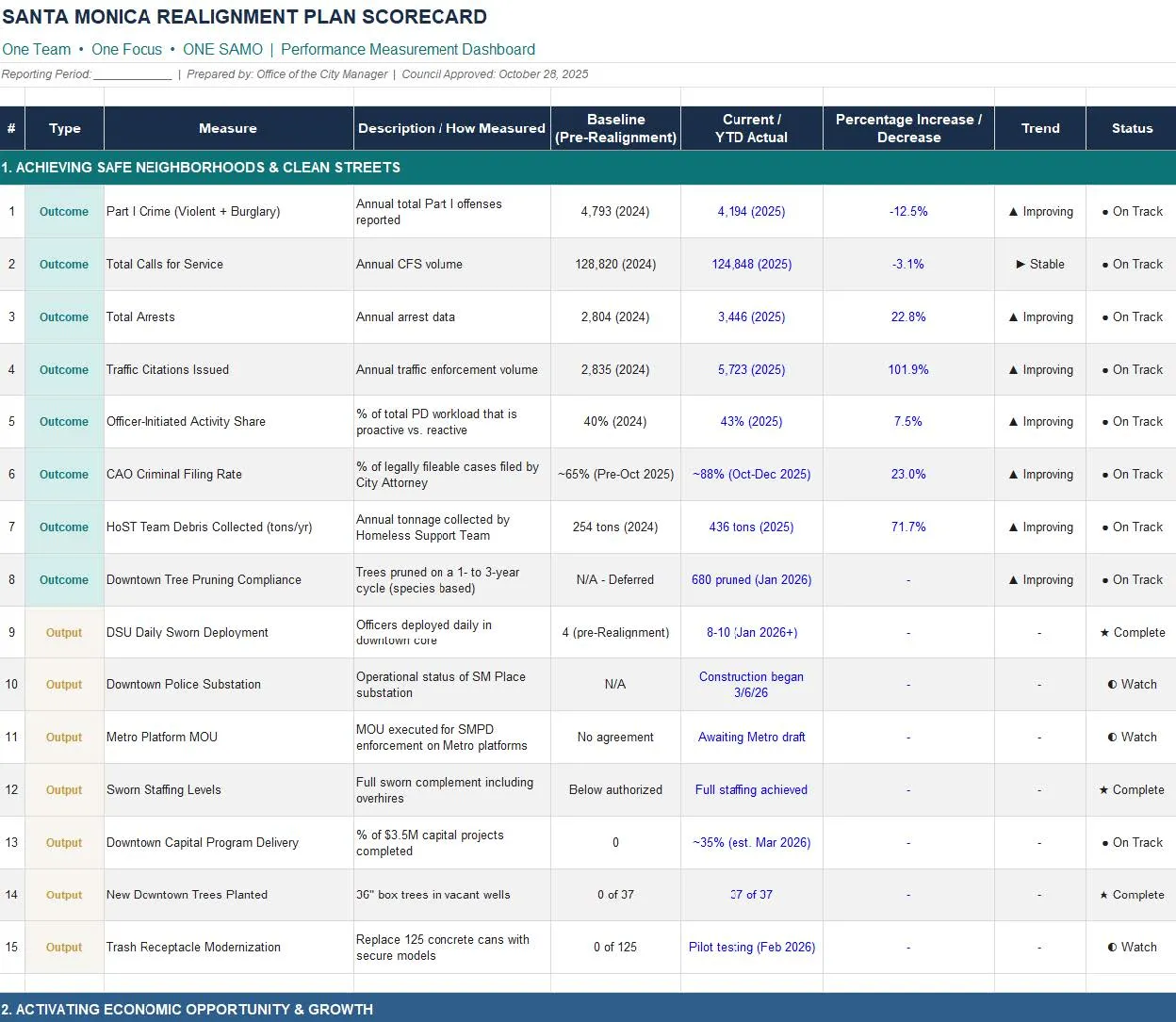
Part I crime — which tracks violent offenses and burglary — declined 12.5%, falling from 4,793 incidents in 2024 to 4,194 in 2025. The Santa Monica Police Department has reached full sworn staffing for the first time in over 20 years. The City Attorney's Criminal Unit is now filing on approximately 88% of all legally fileable cases, up from a previous rate of 65-70%. Building plan check performance improved to 92.5% on-time for first-round reviews, an increase of more than 40 percentage points in four months. All library branches are now open for the first time since 2020.
The post-Realignment policing data is particularly striking. Monthly traffic citations averaged 1,200 during December 2025 through February 2026, compared with 480 per month during 2025. Weekly arrest activity climbed from an average of 81 per week in December to 104 per week in February.
When the Realignment Plan was adopted, the city faced a projected $29.6 million structural General Fund deficit in FY 2026-27. The update presents a materially improved outlook.
New revenue streams secured since October — including an ambulance operator program generating approximately $7 million annually, a parking rate restructuring projected at $8.5 million per year, and a digital signage program expected to yield $4.5 million per year beginning in 2027 — now total roughly $28.8 million in new annual General Fund revenues. Combined with expenditure management, the city now projects a General Fund surplus of approximately $5.4 million in FY 2026-27, a full year ahead of the original plan's timeline.
The city maintains approximately $94 million in unobligated General Fund cash on hand, and staff notes that major event licensing agreements currently under negotiation — including FIFA World Cup activations, a Goldenvoice music festival in September 2026, an ESPN broadcasting partnership and 2028 Olympic hospitality arrangements — could generate additional revenues not reflected in current projections.
Despite the public safety progress, the report acknowledges that private sector reinvestment has not materialized at the scale needed for broader economic recovery. Restaurant and hotel sales declined 4.1% year over year as of the second quarter of 2025, with quick service restaurants down 13.9% and fine dining down 9.1%.
To address that gap, staff is recommending a suite of economic development measures for council action Tuesday.
The council will be asked to establish a $3 million Economic Development Fund from available one-time General Fund reserves, to be used for restaurant attraction incentives, business retention activities, Promenade capital renewal and other economic development efforts.
Staff is also recommending that the council waive the city's portion of the wastewater capacity fee for new restaurants and restaurant expansion projects. The fee currently costs new restaurant operators approximately $1,400 per seat — representing $70,000 in city fees alone for a 50-seat restaurant before the first meal is served. Restaurants would still be required to pay a Los Angeles Hyperion wastewater fee of approximately $400 per seat.
Additionally, the council will consider a no-cost sidewalk dining program that would eliminate permit requirements and fees for outdoor dining setups consisting solely of simple tables and chairs. Staff estimates 19 current operators would see monthly license fees eliminated under the program.
The council will also consider expanding the Entertainment Zone program, which allows alcohol consumption in designated public areas and launched on the Third Street Promenade in June 2025. The proposal would extend the zones to cover the full Downtown core, portions of the Santa Monica Pier, and event-based zones along Main Street and Montana Avenue.
To help fill vacant commercial space, staff is asking the council to endorse a conceptual framework for a Retail to Restaurant Activation Program, which would offer forgivable loans, expedited permitting and case management support for operators converting vacant retail spaces to restaurant uses. Final program design would follow additional outreach to architects, restaurant operators and commercial brokers.
The council will also vote on temporarily waiving city film permit application fees, ranging from $350 to $700, as part of broader efforts to attract production during what the report describes as a challenging period for the California film industry.
Staff is recommending a comprehensive restructuring of the Public Works Department, including the creation of a new Downtown and Beach Maintenance Division and the transfer of the city's 311 customer support operation from the City Manager's Office into Public Works. The reorganization would add 12 positions across the department.
On public safety, staff is seeking council authorization to negotiate a memorandum of understanding with the Los Angeles County Metropolitan Transportation Authority that would allow SMPD officers to conduct enforcement actions on Metro train platforms within the city — a measure staff says is necessary to address the downstream public safety effects of end-of-line Metro rail service.
The council will also receive an update on a proposed vehicle habitation and "vanlording" ordinance. Staff is recommending the council hold off on formally adopting the ordinance until a safe parking site is secured, after a previously identified four-space site near the city's eastern border fell through following intervention by a neighboring jurisdiction.
Staff is recommending the council authorize a community outreach process, running March through May, to gather public input on a proposed transition from the city's current SamoShel shelter model to a housing-first system of care in which the city would control infrastructure at each step of a shelter-to-permanent-housing continuum. A report incorporating community feedback is expected to return to the council in June 2026.
Staff is also asking the council to direct further study of a city-aligned nonprofit housing development entity that could supplement existing affordable housing programs by developing mixed-income housing outside the constraints of the Low-Income Housing Tax Credit program.
The meeting begins at 5:30 p.m. at Santa Monica City Hall, 1685 Main St.