
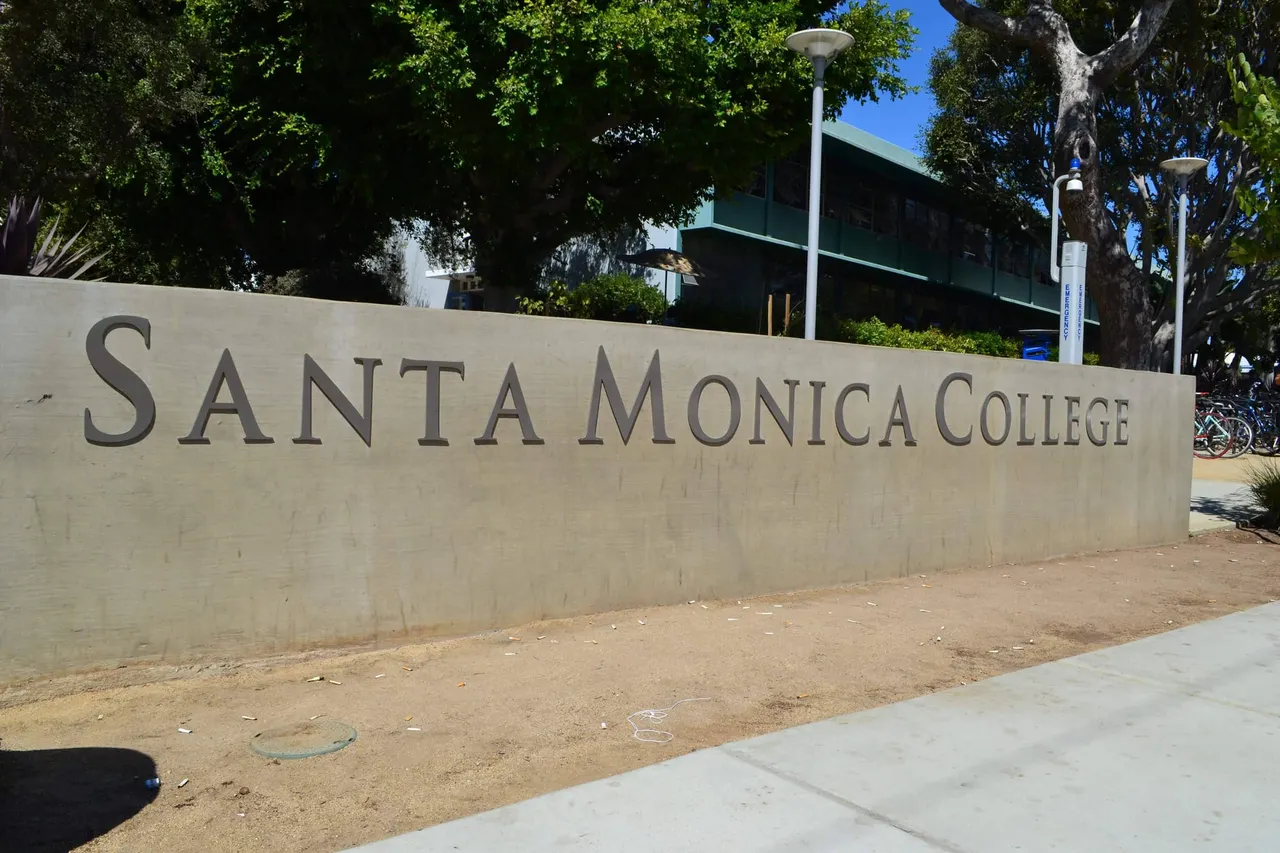
Santa Monica College's Board of Trustees will meet Tuesday night to confront a deepening financial crisis that could result in the elimination of approximately 70 classified staff and management positions as the institution heads for a disastrous fiscal cliff.
The layoffs, announced by Superintendent/President Kathryn E. Jeffery, come as the college faces the prospect of depleting its reserves by 2026-27 despite already implementing $8.6 million in cuts for the 2025-26 academic year. Those earlier measures included a 5% reduction in class schedules and position eliminations through attrition, yet the college still confronts an additional $10.1 million deficit in the current budget.
The financial pressures stem from a combination of declining enrollment and changes to state funding mechanisms that have frozen Santa Monica College's allocations even as expenses continue to rise.
Enrollment at the college has dropped 13% since 2018-19, falling from 19,501 to 17,089 full-time equivalent students. More significantly, changes to California's community college funding formula have placed Santa Monica College among 27 districts in "hold harmless" status. Starting in 2025-26, those colleges no longer receive annual cost-of-living increases, effectively freezing state funding while operational costs escalate.
The college's fund balance has plummeted from $43.9 million in 2021-22 to a projected $13.1 million by year's end, falling well below the recommended 16.67% reserve level. Those reserves will be depleted putting the account into a negative balance by next fiscal year.
The Faculty Association has sharply criticized college leadership for the crisis, with union President Peter Morse placing blame on years of poor decision-making rather than external factors alone.
"I don't believe it had to end up in this place, and I think it's unfair that the responsibility for others actions have fallen on you," Morse said to the staff facing unemployment in a video response to Jeffery's announcement.
Morse noted the potential layoffs continue a pattern of cuts that have already eliminated over 250 part-time faculty positions through reductions to classes, counseling and library hours, even as full-time faculty have resigned or retired without replacement.
"Yes, of course, there have been some external factors that have made balancing the college's budget challenging, but few, if any, were unforeseeable, and certainly none were insurmountable," Morse said. "Local choices, inaction and the inability to see the employees of the college as true partners in crafting solutions led the college here."
The Faculty Association had proposed numerous cost-saving ideas over the years, Morse said, but faced reluctance from administration to discuss creative approaches to increasing revenue or decreasing costs. Only recently has the district shown interest in negotiating with the union.
One recent collaboration allowed full-time faculty to defer their pay for winter assignments, resulting in nearly $500,000 in savings despite an already reduced winter session schedule with slashed classes and minimal counseling hours.
Morse particularly criticized the decision to cut class sections, calling it "terribly wrong" and counterproductive to the college's recovery.
"For years, many of us have tried to raise the alarm about enrollment, advocating for action on revenue-generating and cost-saving ideas, but to no avail," Morse said. "Now everyone can see that cutting class access to classes was terribly wrong. It didn't save us. It didn't help us recover from the trials of COVID. Instead, it led to thousands of students being turned away, hundreds of faculty being laid off, and now could possibly lead to dozens of classified colleagues."
Enrollment has been in freefall at the school since the pandemic. At the college's January board meeting, Vice President Teresita Rodriguez presented troubling enrollment figures that showed the downward trend continuing and worsening.
As of that morning, winter enrollment headcount was down 5.33% from the previous winter, with credit full-time equivalent (FTE) enrollment down 5.93% and non-resident FTE down 14.81%.
Spring semester projections appeared even more dire. Total headcount for spring was down 6.29%, credit FTE down 9.93%, and non-resident enrollment down 6.90%. Rodriguez noted the college was particularly concerned about non-resident numbers, as applications from international students for spring were down approximately 40%.
The enrollment figures represented a stark departure from the college's Strategic Enrollment Management plan projections from several years ago, which had anticipated year-over-year growth of 3% in credit enrollment, 5% in non-credit, and 5% in non-resident enrollment.
By the time of the adopted budget, those projections had been revised to 0% growth in credit enrollment, 2.74% growth in non-credit, and a 7.03% decline in non-resident enrollment. The actual trends were tracking worse than even those reduced expectations.
Dr. Tania Acosta outlined several strategies the college is employing to reverse the enrollment decline.
The college has prioritized its Discover SMC series, which brings high school students to campus to familiarize them with the institution. Nine schools were confirmed for participation, with additional schools still being solicited.
Following a spring focus group with college staff, institutional research personnel and feeder high school counselors, the college identified needs for more intentional outreach to Black and Latinx students and better support for students facing financial concerns. The college responded by creating targeted affinity postings and ensuring open lab hours to assist students with federal financial aid applications and California Dream Act applications.
The college is also participating in five national college fairs and two local fairs, and has developed a two-pronged international recruitment approach focused on strengthening established markets while expanding into emerging markets. Despite ongoing geopolitical challenges, the international team planned outreach trips to Vietnam, Brazil, Turkey, Hong Kong and the United Arab Emirates.
The college initiated a three-call outreach model in January, with student services departments contacting approximately 1,700 identified students. More than 55% have been contacted, with 24% answering phone calls, 20% enrolling, and 191 making progress through the registration process.
Student services departments including the Welcome Center and counseling have extended their hours beyond 4 p.m. to provide more flexible customer service, joining Admissions and Records and financial aid, which already offered year-round extended hours.
When asked how Santa Monica College's enrollment compared to other institutions, staff acknowledged difficulty in making accurate comparisons. While some sister colleges reported enrollment increases of more than 10%, they suggested those numbers might be inflated by institutions not properly clearing rosters or addressing fraudulent enrollment.
Rodriguez noted that while community colleges typically see enrollment increases during economic downturns, current trends don't entirely follow that historical pattern.
"Higher education is in crisis," Rodriguez said, citing published articles and anecdotal reports from students. "A lot of people are questioning the value of education. So there's a whole lot of people who just aren't going anywhere."
International recruitment faces particular challenges due to federal policies. Rodriguez noted that the United States is no longer considered as welcoming to international students, making recruitment difficult regardless of advertising quality.
"We have public leaders on television saying we don't want you here," she said, adding that the college must maintain its international presence to avoid losing additional market share and position itself for when conditions improve.
While the college is facing dire straits, Morse urged faculty to resist rumors, noting that the college is not facing a state takeover, cannot unilaterally decrease faculty wages or remove contractual guarantees, and is not slating academic programs for elimination.
SMC meetings and agendas are available online at https://admin.smc.edu/administration/governance/board-of-trustees/meetings.php.