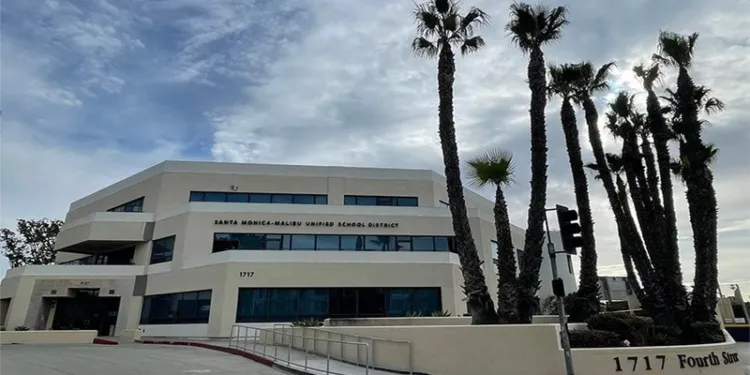
The Santa Monica-Malibu Unified School District could lose between $2 million and $3 million in federal funding if families don't complete free and reduced-price lunch applications by October 2, despite the district's universal meal program that provides free breakfast and lunch to all students.
Superintendent Dr. Antonio Shelton delivered the urgent message to the school board, explaining that the applications are critical for maintaining Title I funding and other federal programs that support the district's most vulnerable students.
"This is about more than just meals," Dr. Shelton told board members. "We want to give the meal, but it's more than just that because specifically we have programming that's attached to the dollars that support our most vulnerable students."
The district currently operates four Title I schools, which receive federal funding based on the number of students from low-income families. Without adequate application submissions, these schools risk losing their Title I status and the associated funding.
Dr. Shelton emphasized that all families must complete the applications regardless of their income level under California's Universal Meals Mandate, which guarantees "every student is eligible to receive one free breakfast and one free lunch each school day."
"We encourage all families to complete the free and reduced meal application by October 2nd 2025 regardless of income," Dr. Shelton said. "It does not matter what your income is — we need you to fill out those forms."
The financial stakes are particularly high given what Dr. Shelton described as federal challenges facing California schools. He warned of "an attack on school education right now specifically in California" from the federal government, with Title I, Title II, Title III, and Title IV funding programs all under scrutiny.
Beyond meal programs, the applications help schools qualify for additional support including after-school financial aid programs, parent engagement workshops, academic interventions, and teacher professional development opportunities.
Gerardo Cruz, the assistant superintendent of business and fiscal services, explained that the wide range of potential funding loss also reflects uncertainty about adult education funding. The district receives funding from three different adult education programs, and it remains unclear which might be affected by federal changes.
"Once we find out which specific portion and block grant of the adult education funding we'll be able to share that with you and put it in your Friday memo and have an exact more approximate number of what's potentially at stake," Cruz told the board.
Board members expressed surprise at learning the full implications of the lunch applications. One member acknowledged feeling "remiss" for not understanding the importance of completing the forms during their own children's school years.
The universal meal program has inadvertently contributed to the problem. Dr. Shelton noted that application rates dropped after the program's implementation because families no longer felt compelled to complete paperwork for meals their children already received for free.
"Prior to this program, people fill out the forms automatically, but when we had the universal meal, people stopped, and it's understandable why they would stop when I don't need to," Dr. Shelton explained.
The superintendent stressed that maintaining Title I status is crucial for continuing programs designed to help students succeed. The four Title I schools depend on this federal funding to provide enhanced educational services and support systems.
"Right now we have four schools — we would like to keep that funding at those four schools and the way we do that is we all fill out the forms to ensure we're at that teetering number," Dr. Shelton said.
The district plans to share application return rates in weekly memos to track progress toward the October deadline. Board members requested copies of the application form to better understand the process and help promote participation among families.
Dr. Shelton assured the community that the universal meal program continues unchanged, and he committed to immediately notifying the board if any changes occur to the program.
The October 2 deadline represents a critical juncture for the district as it works to maintain federal funding streams while navigating an uncertain political landscape for education funding in California.
Application Process and Eligibility
Despite the universal meal program, the district still operates traditional free and reduced-price meal eligibility standards for federal reporting purposes. Students qualify for free meals if their household income falls at or below $20,345 annually for a family of one, scaling up to $70,395 for a family of eight. Reduced-price meals are available for households earning up to $28,953 for one person and $100,178 for eight people.
Families automatically qualify for free meals if any household member receives CalFresh, CalWORKs or Food Distribution Program on Indian Reservations benefits. Foster children, homeless students, migrant workers' children and runaway youth also qualify regardless of household income.
Applications are available online at http://www.myschoolapps.com or can be submitted to the Food & Nutrition Services office at 1717 4th St., Santa Monica. Current eligibility status from the 2024-25 school year will continue for up to 30 school days into the new academic year, but families are encouraged to submit new applications as soon as possible.
For assistance with applications, families can contact Food & Nutrition Services at 310-450-8338, ext. 70228. Parents who disagree with eligibility decisions can request a fair hearing by contacting Richard Marchini, Director of Food and Nutrition Services, at 310-450-8338, ext. 70-342.