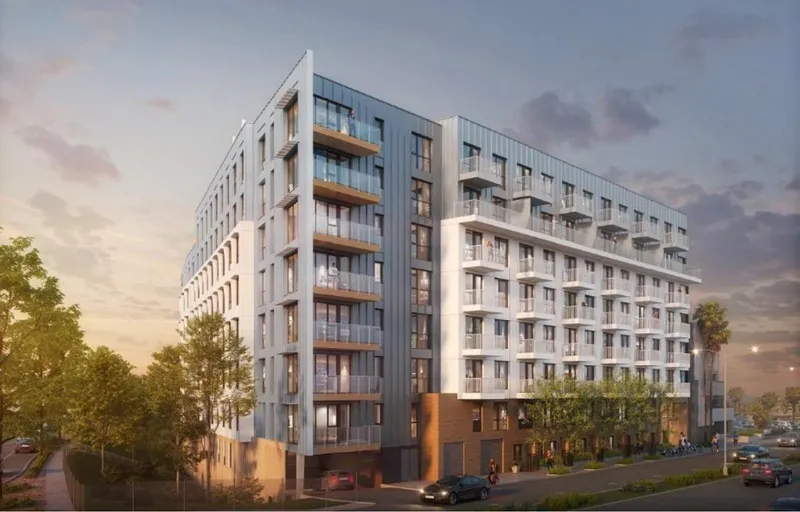
The Santa Monica Architectural Review Board will consider an eight-story residential development Monday that would bring 132 housing units to a highly visible site near the downtown Metro station and Interstate 10 freeway.
The proposed project at 1640 5th Street, the former home of the Santa Monica Daily Press, would rise 87 feet and include 117 market-rate apartments and 15 affordable units above three levels of underground parking. Developer Lincoln Property Company plans to use California's State Density Bonus program to exceed normal height and density limits for the transit-adjacent zone.
The building was formerly known as the Comma Building and housed several businesses until it was shuttered last year. The Daily Press rented office space in the building for more than a decade but has no ownership or investment in the project.
Original plans for the redevelopment included the neighboring building and additional services for the area’s homeless population but after those fell through the new plans for a single lot were developed. The location is across the street from the downtown homeless shelter and has been the location of frequent violent crimes including attempted murders, drug overdoses, multiple stabbings and arson.
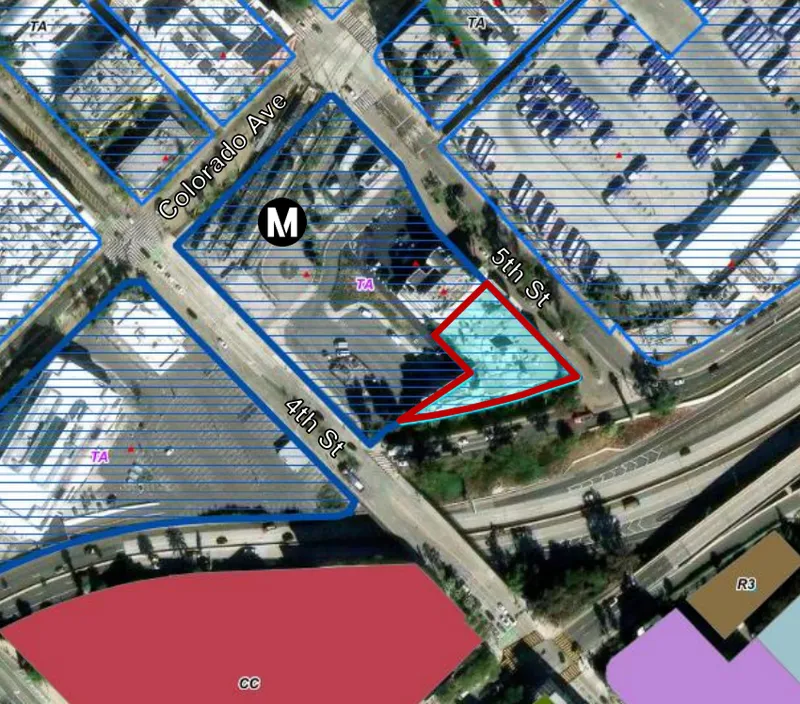
The 112,302-square-foot development would sit on an irregularly shaped, 22,885-square-foot lot that would make it highly visible to motorists entering Santa Monica from the I-10 freeway off-ramp and transit riders using the nearby Downtown Santa Monica Metro station.
"The location of the building along an I-10 off-ramp and near the Metro terminus in Santa Monica will make it a highly visible structure to many as they enter the City," according to the staff report prepared for the board.
City staff is recommending approval of the project, which has undergone significant design changes since the board's initial review in April. Board members had criticized the original design for having "too many different vocabularies" and demanded the developer emphasize corner elements and use more substantial materials.
In response to those concerns, applicant Justin Cua of Lincoln Property Company redesigned the southeast corner, replaced fiber cement board with brick on the lower floors, and wrapped metal siding around the building's protruding wing. The developer also added solar shading on the south-facing windows and changed balcony colors from white to terracotta.
"The project design has been modified to address the Board's comments and the design represents an overall improvement," staff concluded in recommending approval.
The building would feature a contemporary design with white, beige and gray colors intended to evoke Santa Monica's coastal landscape. Amenities would include an eighth-floor roof deck and upper roof deck with a pool, barbecue areas and ocean views.
Due to air quality concerns from the adjacent freeway, the south-facing side would not include balconies or operable windows, limiting design options on that elevation. The project site is located in the city's Air Quality Assessment Zone because of its proximity to I-10.
The project benefits from California's Housing Accountability Act, which restricts cities from denying housing developments that meet objective planning standards. The law has made it difficult for local governments to reject residential projects based on design preferences alone.
"The ARB is prohibited from imposing any design conditions that have the effect of reducing the number of residential units and/or the residential density of this project," the staff report noted.
If approved, the board would impose several conditions, including requirements to further accentuate building corners and ensure smooth stucco finishes. The developer would also need to demonstrate compliance with the city's green building standards for landscaping and irrigation.
The project site currently houses a structure over 40 years old that underwent the required 75-day waiting period for potential historic designation. No applications were filed to preserve the existing building during that period.
The property backs onto the Metro parking lot currently used by Palisades High School students to access their campus and the building has a mural on one side from the prolific local artist Bumblebee. The mural depicts a girl on a surf board and is the “sister” mural to the one at 6th and Wilshire depicting a boy looking through binoculars.
Staff found the project meets all required findings for approval, including that it represents "good taste, good design" and contributes to Santa Monica's image as "a place of beauty, creativity and individuality." The report notes the building's height would be comparable to six-story buildings on neighboring blocks along Colorado Avenue.
The development represents part of Santa Monica's broader effort to add housing near transit hubs as the city grapples with California's housing crisis and state mandates to increase residential density near public transportation. The approval process has been expedited under Senate Bill 330, which streamlines housing approvals. The developer initially submitted a preliminary application in May 2024 and received administrative approval in September 2024.
Any approval by the Architectural Review Board can be appealed to the Planning Commission within 10 days of the decision.
The board will meet at 7 p.m. Monday in the City Hall Council Chambers at 1685 Main Street.