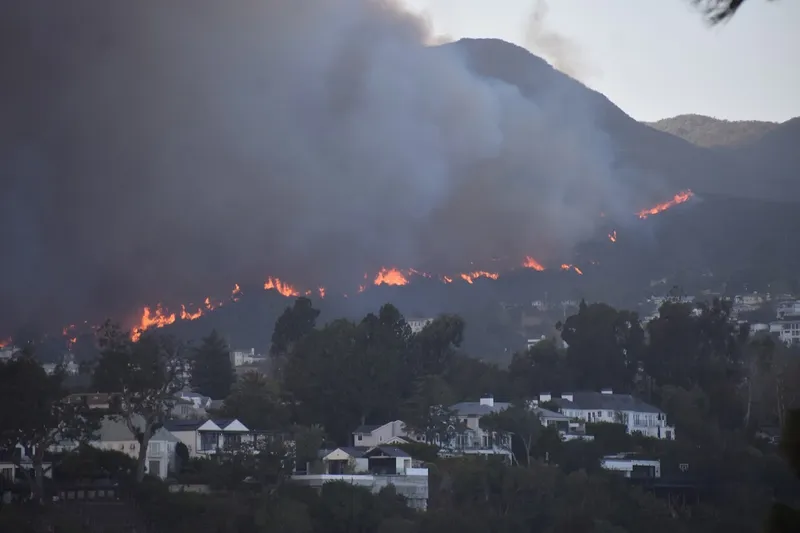
The Los Angeles County Board of Supervisors unanimously approved a motion recently supporting federal legislation that would provide tax credits to homeowners who upgrade their properties to withstand natural disasters, a direct response to devastating January wildfires that destroyed more than 18,000 structures.
The board's backing of the Facilitating Increased Resilience, Environmental Weatherization and Lowered Liability (FIREWALL) Act comes as hundreds of thousands of county residents continue recovering from catastrophic fires that displaced entire communities earlier this year.
"Los Angeles County residents have faced unimaginable losses due to these catastrophic wildfires," said Board Chair Kathryn Barger, who introduced the motion with Supervisor Lindsey P. Horvath. "By supporting the FIREWALL Act, we aim to provide tangible assistance to families striving to rebuild and fortify their homes against future disasters."
The bipartisan federal bill, introduced by U.S. Senators Adam Schiff and Tim Sheehy, would create a tax credit covering 50% of eligible home-hardening expenses, up to $25,000. The credit would be fully refundable, allowing families with little or no tax liability to receive the benefit as a direct payment.
Households earning less than $200,000 annually would qualify for the full credit, with benefits gradually phasing out for those earning up to $300,000. The income thresholds and credit cap would be indexed for inflation beginning in 2026.
Qualifying improvements include fire-resistant building materials, impact-resistant roofing, stormwater barriers, air filtration systems and vegetation removal around properties. Communities that experienced federally declared disasters within the past decade would be eligible for the program.
"Tax credits made possible through the FIREWALL Act will be essential to ensuring home hardening upgrades are feasible for homeowners who have already endured so much," Horvath said. "Federal tax credits have the power to ensure that cost is not the reason our residents are unable to rebuild in a way that protects them from future disasters."
The legislation addresses growing concerns about climate-related disasters nationwide. Studies by the National Institute of Building Sciences show that each dollar spent on disaster mitigation saves approximately six dollars in future disaster costs.
Schiff, who noted that recent California wildfires were "unprecedented in their scope and devastation," made the FIREWALL Act his first Senate bill. The measure aims to encourage proactive home fortification before disasters strike while helping communities rebuild with greater resilience afterward.
The comprehensive list of eligible upgrades covers multiple disaster types. For wildfire protection, homeowners could claim credits for Class A fire-resistant roofing, ignition-resistant exterior walls and decks, and interior or exterior sprinkler systems. Storm-proofing measures include strengthening roof attachments, installing secondary water barriers and adding storm shutters or safe rooms.
Flood mitigation expenses such as elevating homes above flood levels, installing drainage systems and sealing basement walls would also qualify. The bill covers seismic retrofits like foundation anchoring and cripple wall bracing, plus backup systems including standby generators and lightning protection.
Creating defensible space around properties qualifies as well, including removing flammable vegetation and replacing wood fencing with fire-resistant materials near homes.
To prevent duplicate benefits, any portion of projects already covered by government grants would be excluded from the tax credit. The Treasury Department and Federal Emergency Management Agency could approve additional mitigation activities over time.
The credit would apply only to primary residences in disaster-prone areas, specifically locations in states or territories that experienced federally declared disasters, received FEMA hazard mitigation assistance, or were designated as federal community disaster resilience zones within the past 10 years due to wildfires, hurricanes, windstorms or floods.
The targeting mechanism would make the credit available across numerous states that have faced major disasters in recent years, including California, Montana, North Carolina and Florida.
Beyond helping individual families, supporters argue the legislation could improve insurance availability in high-risk areas. If homes are better protected against disasters, insurers may be more willing to provide coverage in vulnerable regions that continue expanding due to climate change.
The Los Angeles County board's unanimous support reinforces the region's commitment to disaster recovery and climate resilience, particularly for vulnerable communities still rebuilding from the January fires that marked one of the most destructive wildfire events in county history.