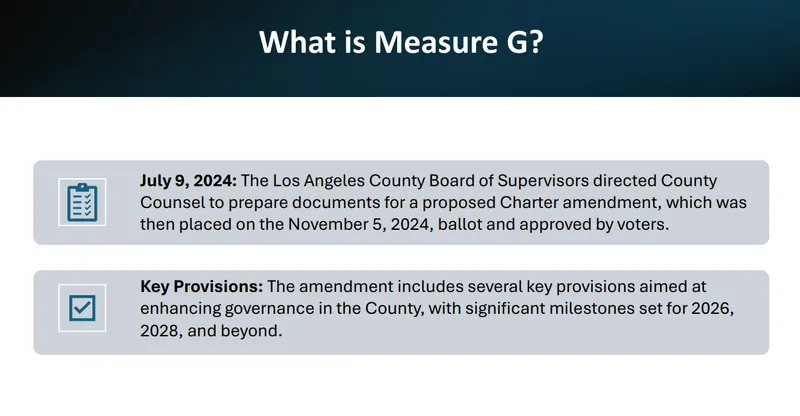
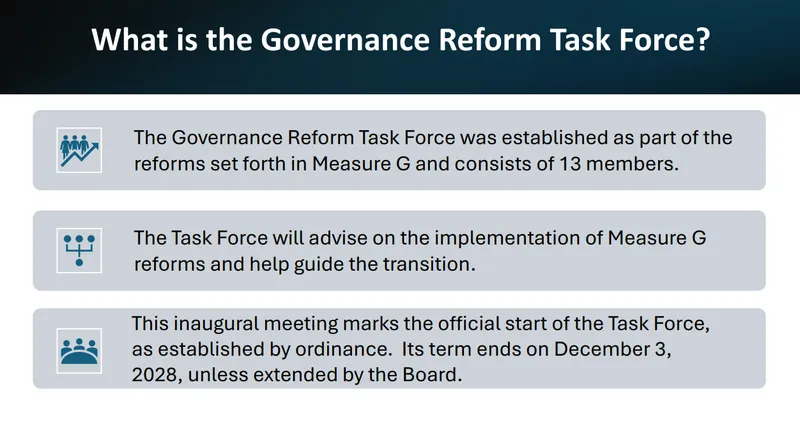
Los Angeles County has established a 13-member Governance Reform Task Force to oversee the implementation of Measure G, a sweeping charter amendment approved by voters in November 2024 that will fundamentally reshape how the nation's most populous county governs its 10 million residents.
The task force, which held its first organizational meeting with interim director Shotti Cardan presiding, faces the monumental responsibility of guiding what officials described as a "truly historic moment" in Los Angeles County's governance structure. The reforms are designed to address a system that officials say no longer reflects today's realities.
Measure G introduces a series of major changes with staggered implementation deadlines extending through 2034. By 2026, all non-urgency county legislation must be publicly posted for at least 120 hours before board action, extending the current 72-hour requirement. The same year will see establishment of an independent ethics commission and office of ethics compliance.
The most significant structural changes come later in the timeline. By 2028, county voters will elect a county executive with executive and administrative powers, fundamentally altering the current board-dominated system. The reforms also call for creation of a county legislative analyst to provide nonpartisan policy support and a director of budget and management.
Perhaps the most dramatic change will occur by 2031, when the Board of Supervisors expands from five to nine members, with staggered elections beginning in 2032. A charter review commission will be established by 2034 to meet every 10 years and recommend further changes.
The task force membership reflects the county's diversity, drawing from varied professional backgrounds including education, nonprofit leadership, political science, military service, local government, business ownership, healthcare and labor advocacy. Members include Ryan Calderon Sabatay, Derek Steel, Sarah Sadwani, Marcel Rardi, John Pana, David Green, Derek Chay, Steve Neil, Gabriella Uronis, Julia Mockeridge, David Phelps, Rosa Sodto and Nancy Yak.
The group includes appointees from individual supervisors and at-large members selected by initial appointees. Representation includes residents from unincorporated areas, leaders of Asian American and Pacific Islander communities, and representatives from labor unions including SEIU 721, CCU and LA FedE.
Executive Officer Edward Yan delivered opening remarks emphasizing the gravity of the work ahead. The task force's official term runs through December 3, 2028, unless extended by the board.
During the meeting, members acknowledged both the significance and challenges of their assignment. Some members revealed they had voted against Measure G, particularly citing concerns about the elected chief executive position and cost neutrality provisions. These members emphasized the need for thorough discussions about the executive's appointing authority and potential impacts on representation in unincorporated areas.
Public participation featured prominently in discussions, with task force members stressing the importance of making the process accessible to diverse communities. Suggestions included holding meetings outside downtown Los Angeles to reach more residents, establishing language interpretation as standard practice rather than by request only, and ensuring voices of historically overlooked communities are heard.
Public commenters raised various concerns and suggestions during the meeting. Issues included calls for continued consumer protection focus, child protection system reforms, addressing problems in unincorporated communities like Florence Firestone and East LA, clarification about the elected executive's term limits, transparency in legislation posting, consideration of ranked choice voting, and the need for independent ethics oversight.
Some expressed disappointment that the task force application process was not conducted publicly, while others called for youth representation in the reform process. Questions were also raised about union involvement and the potential concentration of power in the new nine-member board structure.
The task force now faces the complex work of translating voter-approved reforms into practical implementation. Members plan to establish regular meeting schedules, elect leadership, create bylaws and form specialized committees to tackle specific aspects of the transition.
Officials described the reforms as an opportunity to build a government that is more accountable, transparent, representative and responsive to constituents, particularly those historically excluded from county decision-making processes. The changes represent the most significant restructuring of Los Angeles County government in decades, affecting services and representation for one of the nation's largest local government jurisdictions.