
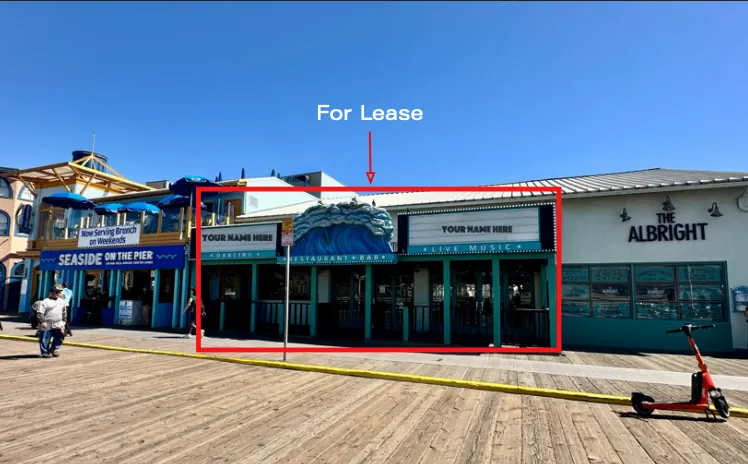
Six months after being selected as the new tenant for a vacant restaurant space on the Santa Monica Pier, California Roadhouse owner Sean Ahaus is still waiting for a draft lease with the latest delay coming after labor union Unite Here Local 11 secured an emergency meeting with senior city staff days before a scheduled City Council vote that prompted officials to pull the item from the March 24 agenda entirely.
The lease was agendized for City Council approval at that meeting, with the city manager’s office recommending the council authorize a five-year agreement with a five-year extension option for the space at 256 Santa Monica Pier, the former home of Rusty’s Surf Ranch, which closed in 2025. Instead, the item was yanked without public explanation after Unite Here met with City Manager Oliver Chi and the city attorney to discuss concerns about the proposed terms.
No detailed explanation of objections or a reason why Unite Here’s feedback warranted pulling the item has been provided.
“There was no official explanation,” Ahaus said. “I asked and was told they were working on it.”
A process that began with a handshake
Ahaus said the path to the current impasse began in the summer of 2025, when the city’s leasing agent marketed the pier space at $6.50 per square foot triple net. He submitted a letter of intent at the asking price, which was accepted by the Santa Monica Pier Corporation Board following a competitive process that drew nine proposals, was narrowed to five, then two finalists.
According to the city’s staff report, California Roadhouse was ultimately selected due to its commitment to reviving live music at the pier and its ability to quickly activate the space after lease execution.
After the Pier Corporation voted unanimously in his favor, Ahaus said staff told him the lease was his.
“She shook my hand and said, ‘You are the new tenant at 256 Santa Monica Pier,’” Ahaus recalled.
That assurance would prove premature.
In November 2025, Ahaus said he was informed that the hospitality union Unite Here Local 11 had challenged the procedural validity of the Pier Corporation’s initial vote, contending the agenda notice was improperly posted. Out of an abundance of caution, the city asked the Pier Corporation to re-notice and re-vote on the matter. At a December 15 meeting, the Pier Corporation again voted unanimously in favor of California Roadhouse.
While Ahaus and city staff thought the process was complete, he was informed within days of the revote that council members had taken an interest in the lease and wanted to take a more active role.
Council pushes labor provisions
According to Ahaus, the council’s primary demand was the inclusion of a labor peace agreement and a right-to-recall provision, requirements he said were communicated to him in December before the City Council had formally enacted the ordinances that would create those obligations.
While the Council delayed the lease to implement the protections, neither was ultimately applicable to the Roadhouse negotiations. The labor peace idea that would have prevented businesses from opposing unionization efforts was dropped due to legal concerns and the right to return, rules that mandate rehiring workers who used to work in the city, do not apply as Ahaus began his lease process prior to their adoption.
The city’s staff report acknowledges that the displaced Rusty’s Surf Ranch workers do not qualify for protections under the right to return ordinance because they lost their jobs before it took effect. California courts have rejected retroactive application of ordinances that impose new liability for pre-enactment conduct, the report notes. Instead, staff and Ahaus negotiated lease provisions that create a parallel framework — requiring structured interviews, mandatory minimum hiring percentages and a 90-day retention guarantee for former Rusty’s employees who are rehired.
Ahaus said he is not opposed to hiring back former Rusty’s workers. His objection is to the bureaucratic apparatus that enforcement of the ordinance would create.
“I’ll likely hire 90 to 100% of the people back. I just don’t know because I haven’t met them, I haven’t interviewed them,” he said. “What if people show up for their interview drunk? Do I still have to hire them back?”
He said he ultimately agreed in concept to a provision requiring him to hire back 80 to 90% of former workers, subject to objective performance standards. The draft lease reflected that framework.
Proposed lease terms
The staff report submitted to council for the March meeting detailed the proposed terms: a five-year initial lease with a five-year extension option at $26,728 monthly beginning six months after commencement, based on $6.25 per square foot for interior and patio space, subject to annual Consumer Price Index adjustments and a 3% annual base rent increase.
The city proposed a one-time capital contribution of up to $500,000 — structured in three disbursement stages — to fund eligible improvements including kitchen systems, HVAC and electrical upgrades, stage and sound infrastructure, and bar improvements. All city-funded improvements would become city property at the end of the lease. The financial contribution is projected to generate $325,000 in annual rent revenue to the Pier Fund, according to the staff report.
Ahaus said the $500,000 also incorporates compensation for disruption during the upcoming Pier Bridge construction project, which he said would significantly impact foot traffic and business operations.
However, none of those terms are included in the April agenda and instead the item is written as a negotiation over terms, a step backward from the March agenda that asked for approval of terms.
Union’s role disputed
While the union has no legal standing in the lease negotiations, several city officials referenced the past unionization efforts at Rusty’s as justification for the union involvement.
After the draft lease was published, the union contacted local officials and were given a meeting before the scheduled vote.
In a statement, the union’s community director, Pastor Bridie Roberts, said the workers who staffed the prior restaurant “have been speaking out for months to ensure that they are able to return to work when it reopens.” Roberts added that because the restaurant sits on publicly owned land, workers and the public have a right to weigh in on how it is used.
Chi, in a written statement, said the city did not consult with the union on lease terms but did listen to its feedback and the lease approval was pulled from the March agenda after that meeting.
“As you may recall, Unite Here had previously organized the workforce that worked at the prior Rusty’s Surf Ranch restaurant on the Pier, which is the same property that the City is considering leasing to the California Roadhouse,” said Chi. “Further, Unite Here was one of the advocates for the new Worker Retention / Recall regulations that were recently adopted by the City as being applicable to businesses located on the Pier.”
Councilmember Dan Hall said in a statement that he spoke briefly with Ahaus and characterized the union’s engagement as a natural outgrowth of its prior relationship with Rusty’s workers.
“As you know, workers under the previous proprietor attempted to organize this location before that business ended their lease,” he said. “Seems to be an understandable reason for the workers and their union to weigh in on what they saw in the staff report, just like dozens of other stakeholders did, some of whom, like Mr. Ahaus, also spoke with senior staff.”
Mayor Caroline Torosis said in a statement that city staff regularly engage with stakeholders on agenda items of community interest and that the final lease terms reflect closed-session guidance from the full council.
“Unite Here worked with the workers at Rusty’s Surf Ranch, the prior restaurant at this location on the Pier,” she said. “Those workers lost their jobs when that establishment closed. Given that history, hearing their perspective was a natural part of the process.”
Both Unite Here and City Hall refused to provide details on the union’s specific concerns or any potential legal threats. The City has also delayed production of documents discussing the Union’s objections.
Mounting costs
The prolonged process has come at a price. Ahaus said the delay has burned through much of his financing, forced him to decline other business opportunities and led to the departure of his key staff.
“It is hurting us tremendously,” he said.
He said it’s also taking a toll on the City as about 150 people could have been back at work months ago and the City is in desperate need of business revitalization.
Ahaus said he had submitted a revised response to the city’s latest draft lease and is awaiting a reply. The April 14 council meeting agenda lists the item as a closed-session real estate negotiation over price and terms — a step back from where things stood three weeks ago, when a signed lease seemed within reach.
“I could sit down with the council and we could have this deal hammered out in 30 minutes,” Ahaus said. “This doesn’t need to be a six-month process.”
editor@smdp.com