When Mayor Lana Negrete shared with the City Council that she had breast cancer in February 2024, she didn’t expect to share the disease itself. But almost a year to the day later, former council member Christine Parra was also diagnosed with breast cancer.
“We’re breasties,” said Negrete, describing her relationship with Parra with affection and humor belying the life-threatening experience they now have in common.
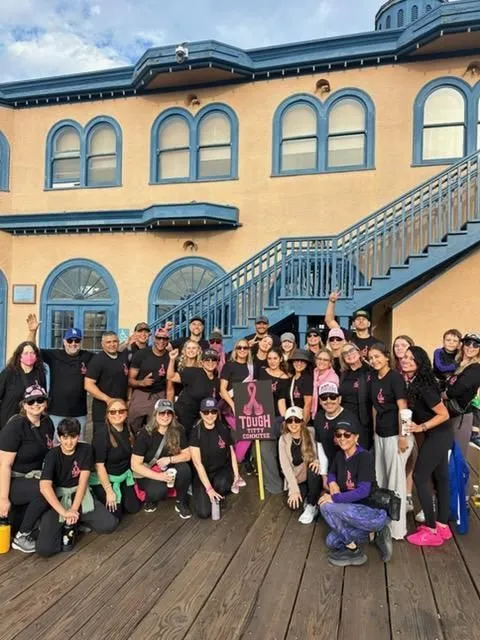
It might seem unlikely for breast cancer to have struck both of them, but the sobering statistic is that one in eight women will get diagnosed in their lifetime, which is a primary reason Negrete and Parra are joining together this Saturday, October 25th, for the American Cancer Society’s Making Strides Against Breast Cancer walk at the Santa Monica Pier.
Negrete received her stage-two diagnosis only shortly after her father, local jazz musician Paul “Chico” Fernandez, suffered an incapacitating stroke. “He went from being my business partner and best friend to being paralyzed,” said Negrete, who had to balance the physical and emotional burdens of caring for a debilitated parent, running the family business (the Santa Monica Music Center), and fulfilling her responsibilities as a mother, wife and council member—all while undergoing an extensive treatment regimen.
“I went through three surgeries, five months of chemo, and 20 rounds of radiation, and never missed a council meeting,” Negrete proudly stated last week as part of a short speech for Breast Cancer Awareness Month.
But she doesn’t claim it was easy. She was often nauseous at those meetings and exhausted. Her penultimate chemo infusion leaked, damaging her veins. Then in short order she lost her father and she got COVID. Yet she said the hardest part was what came after: living with cancer.
In addition to ever-present neuropathic pain, she has to take estrogen inhibitors every day for five years, resulting in medically-induced menopause with the hot flashes, night sweats, bone loss and fatigue of a much older woman.
“There’s a mourning for your old body and self,” said Negrete, who also wrestles with fear about her future as she continues to get tested regularly. “It’s the anxiety every cancer patient has.”
The number of those patients keeps growing. In the 20 months since Negrete was diagnosed with breast cancer, 22 women she knows have been diagnosed, 16 of them under 35, and one of the 22 was Parra.
When Parra’s mammogram came back abnormal, Negrete was one of the first people she told. “She cried with me,” Parra said, but there was also something more unexpected. Parra recalled Negrete telling her: “Chris, it’s going to be hard for you to hear this now, but you’re going to get to a point where you’re going to be able to say thank you to cancer.”
It was a novel concept for Parra, who was already confronting the disease on multiple fronts. Her mother was undergoing treatment for stage-four lung cancer, and her sister had also been diagnosed with breast cancer, which had prompted both sisters to test for any genetic predisposition. The tests came back negative, but Parra was diagnosed with a different type of breast cancer than her sister only three months later.
At first, Parra, a self-described “fighter,” was defiant. “I’m a first responder,” said Parra, who works as the emergency preparedness manager for the Culver City fire department. “I’ve got this.”
But the more she read about negative outcomes for her particular subtype, the more it unnerved her. “I had to stop looking at Google and just pray,” she said.
She felt she couldn’t discuss her fears with her sister, because her sister was in the midst of her own cancer battle. So she reached out more to Negrete, who showed up at Parra’s home after her surgery and lay on her bed with her, holding her hand.
Negrete wasn’t the only one who showed up. A multitude of friends and family jumped in to help, as had also happened for Negrete. “There wasn’t a day I came home when there wasn’t a flower, a card, or a meal,” Parra said, still overwhelmed by the outpouring of affection and support, and, like Negrete, she discovered the life-affirming gratitude that can come from something as unwanted as cancer.
For both women, participating in Making Strides, which raises awareness for breast cancer in addition to money for research, is a way of giving back and a way of reminding people to get tested. “Not only annual mammograms but monthly self checks,” Parra said, emphasizing “regardless of your age.”
“My friend’s daughter who is 26 just got diagnosed,” said Negrete, who had been tested every six months because of her dense breast tissue. “Go get checked.”
They both heaped praise on the Margie Petersen Breast Center at Providence St. John’s, a Making Strides partner, where they were fortunate to have a team of medical professionals collaborating with each other in one location. Parra still goes weekly for physical therapy to break up scar tissue from her surgery.
Of course, not all scars heal, and one doesn’t come through cancer unchanged. Both women described becoming stronger and more focused on their physical and spiritual well being. “I don’t have a promise of tomorrow,” said Parra, who struggles with symptoms similar to Negrete’s. “I want to find joy every day.”
As for Negrete, she said, “I don’t think there’s anything that scares me anymore.” She named her team for Saturday’s event the Tough Titty Committee. “When I was diagnosed, I called my right breast my shitty titty,” she explained, “and now it’s my tough titty.”
Anyone interested in participating in the Making Strides of Santa Monica event can sign up or donate money at www.makingstrideswalk.org/santamonica, or you can show support at the Pier on Saturday morning.