The city of Malibu is asking residents to weigh in on a proposed speed camera program that would install up to five automated enforcement cameras along Pacific Coast Highway, with public comments being accepted through July 18.
The Speed Safety Program represents the city's latest effort to address what officials call a public safety crisis on the scenic but dangerous 21-mile stretch of highway that runs through the coastal community.
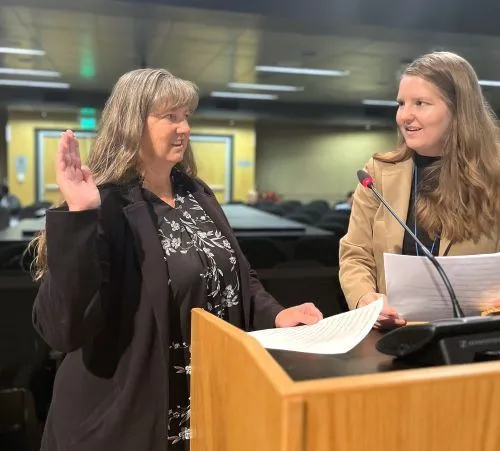
"The success of the Speed Safety Program depends on our community's support," said Mayor Pro Tem Marianne Riggins. "This is about creating a culture of safety on PCH that protects pedestrians, cyclists and motorists. We're sending a strong signal that speeding and reckless driving will not be tolerated in Malibu."
The city has released draft policy documents and an impact report for public review, with questions and comments to be submitted to publicsafety@malibucity.org. Once adopted by the City Council, the city can proceed with purchasing and installing the camera system along with speed feedback signs.
The program was made possible by legislation authored by state Sen. Ben Allen, signed into law in September 2024 — just one year after four Pepperdine University students were killed by a speeding motorist while standing along PCH in October 2023.
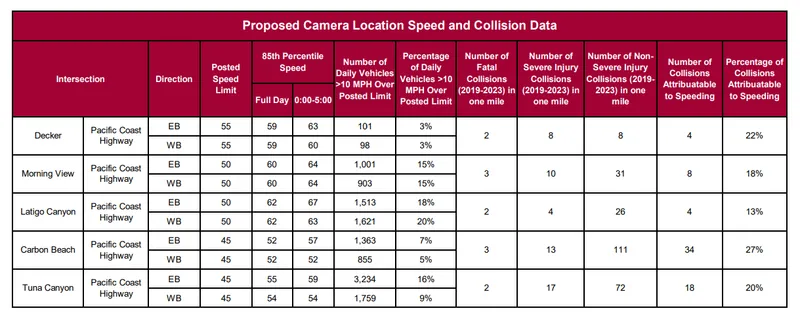
Under the proposed system, cameras would be installed near the intersections of Decker Road, Morning View Drive, Latigo Canyon Road, Carbon Beach Terrace and Tuna Canyon Road, spaced roughly 4-5 miles apart to cover the length of the city's PCH corridor.
The cameras would use radar or laser technology to measure vehicle speeds and photograph the rear license plates of speeding vehicles. Drivers would not be photographed, and facial recognition technology is explicitly prohibited under the policy.
For the first 60 days after the system becomes operational, all violations of 11 mph or more over the speed limit would result only in warning notices with no fines. Even after that period, a driver's first offense in the lowest speeding bracket would be a warning rather than a citation.
Once the warning phase ends, civil citations would be issued on a sliding scale: $50 for driving 11-15 mph over the limit, $100 for 16-25 mph over, $200 for 26 mph or more over, and $500 for extreme speeds of 100 mph or higher.
The program includes provisions for low-income drivers, with state law allowing fine reductions of 80% for those below the poverty line and 50% for those with modest incomes. Payment plans and community service options would also be available for those demonstrating financial hardship.
Traffic safety data underscores the need for intervention on PCH. Between 2019 and 2023, over 80% of all traffic collisions in Malibu occurred on the highway — 546 out of 672 total crashes citywide. Within one mile of the five proposed camera sites, there were 64 fatal or severe-injury collisions during that period, with more than 20% involving speeding as a primary factor.
The community response has been largely supportive, shaped by grief over past tragedies and a collective desire for safer roads. During public meetings following the 2023 incident, residents called for speed cameras and better enforcement. One speaker, describing the dangers, said reckless drivers had turned "Pacific Coast Highway" into "Pacific Coast Hellway."
Local advocacy groups have endorsed the program. Damian Kevitt, director of the traffic safety nonprofit Streets Are For Everyone, called the camera system a "lifesaving" solution rather than a revenue scheme.
"Using technology, there's not an officer involved... You're essentially supercharging the system [of traffic enforcement]. The fines are more equitable... It's not a speed trap. It's saving lives," Kevitt said.
The program is designed with strict privacy protections. Data from non-speeding vehicles would not be retained, and violation images would be deleted within 60 days after cases are resolved. Revenue from fines must first cover system costs, with any excess funds directed toward traffic safety improvements on PCH or forwarded to the state's Active Transportation Program.
If approved, the cameras could be operational by fall 2025, with about 40,000 vehicles traveling PCH daily through Malibu. The five-year pilot program is estimated to cost approximately $2.1 million to install and operate.
Similar automated speed enforcement programs in other U.S. cities have shown reductions in speeding, traffic collisions and traffic injuries and fatalities, according to city officials.