
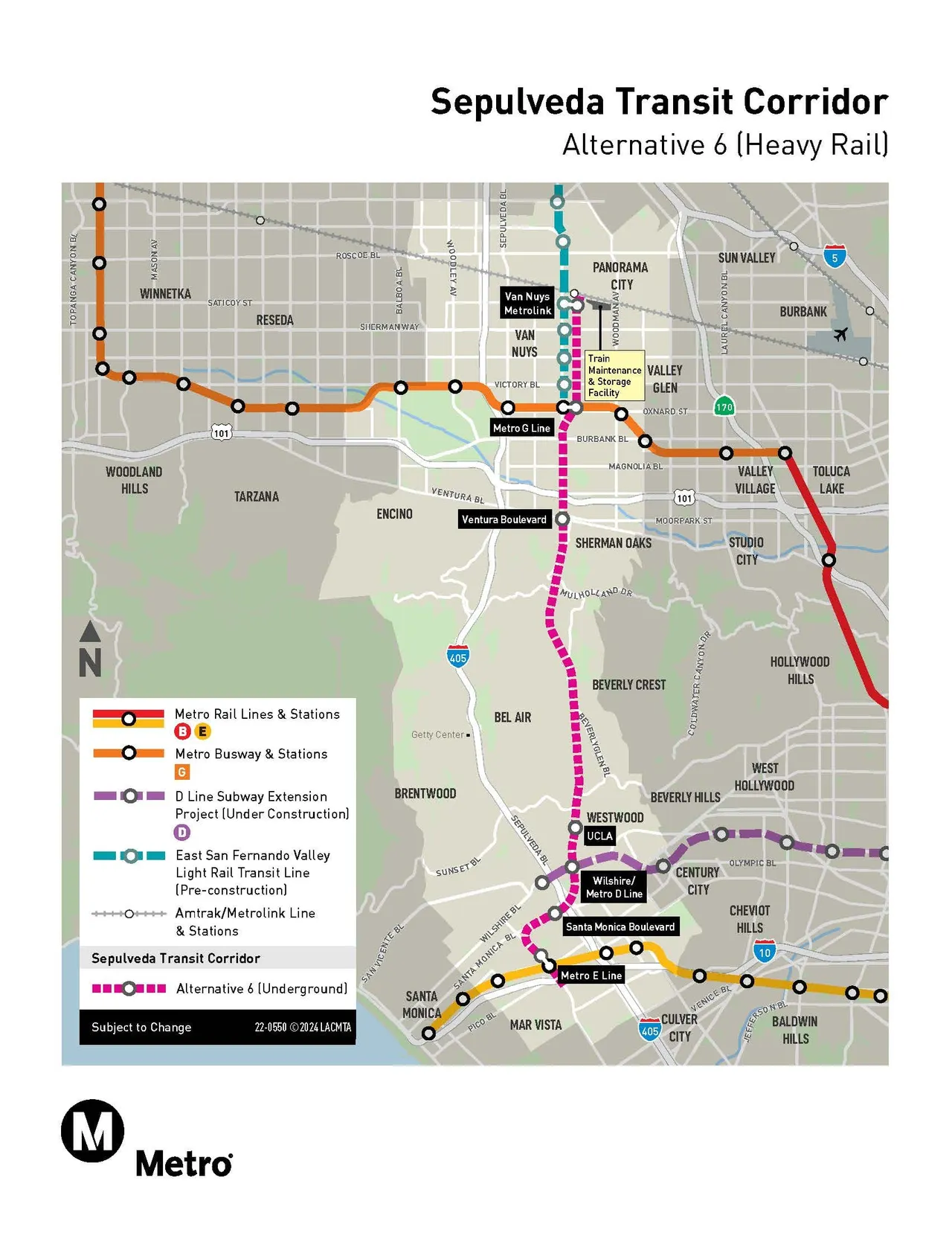
The Los Angeles County Metropolitan Transportation Authority Board of Directors has unanimously approved an all-underground heavy rail subway as the preferred route for the Sepulveda Transit Corridor, selecting a nearly 13-mile alignment designed to connect the San Fernando Valley with the Westside in under 20 minutes.
The board chose Modified Alternative 5, a refined version of one of five alternatives studied during the environmental review process. The selected route will run from the Van Nuys area to the Metro E Line's Sepulveda station, with seven planned stops including Van Nuys, Sherman Oaks and UCLA's campus in Westwood.
The heavy rail line will be entirely underground, burrowing as deep as 500 feet beneath the Santa Monica Mountains and neighborhoods like Bel-Air and Beverly Crest. The deep-tunnel design avoids surface disruption, eliminating the need for elevated tracks or stations in the pass and minimizing property demolition, noise and vibration impacts at ground level.
Metro officials hope the project will provide a fast transit alternative to the notoriously congested Interstate 405 freeway, which carries roughly 400,000 daily car trips over the Santa Monica Mountains. By offering high-frequency service with trains running every 2.5 minutes during peak travel times, officials anticipate the line could remove about a quarter of I-405 freeway drivers from their cars and significantly improve regional mobility.
The selected alignment addresses key concerns raised during the public comment period on the Draft Environmental Impact Report, which drew more than 8,000 submissions. Metro adjusted the tunnel path to avoid a high-pressure Los Angeles water pipeline under Sepulveda Boulevard after residents and engineers raised safety concerns. The refined route follows Van Nuys Boulevard and other corridors, reducing the project's overall length and anticipated costs compared to the original Alternative 5.
Planned stations include Van Nuys Metrolink Station, Metro G Line at Van Nuys Boulevard, Ventura Boulevard, UCLA Gateway Plaza, Wilshire Boulevard connecting to Metro D Line, Santa Monica Boulevard and Metro E Line at Expo/Sepulveda. The alignment provides direct connections to Metrolink and multiple Metro rail lines, enhancing the time competitiveness of transit.
The board rejected monorail alternatives, which carried lower upfront costs but would have offered lower capacity, slower travel times and less ridership potential. Some monorail options did not include an on-campus UCLA station, a major drawback for Westside connectivity. The board also opted against including a Getty Center station, as serving the museum would have required an indirect route, increasing project costs and travel times while reducing forecasted ridership.
The project carries an estimated price tag between $20 billion and $25 billion, a dramatic increase from the $6 billion to $13 billion anticipated when voters approved Measure M funding in 2016. In 2015, the Measure M Expenditure Plan identified $5.7B for the project of which $2.54B is Measure M funding. Metro officials acknowledged additional funding will be needed from state and federal sources and are exploring public-private partnership models to finance and deliver the line.
Los Angeles City Councilmember Katy Yaroslavsky, who represents part of the affected area and serves on the Metro board, called the moment "important and exciting" and likened the corridor's potential impact to the transformation brought by the L.A. Aqueduct. She noted Los Angeles had "tried widening freeways…and spent billions" on the 405 with little effect, making this rail project a fundamentally new strategy.
Public reaction at the board meeting was overwhelmingly positive, with comments drawing cheers when the subway plan was approved. Transit advocacy groups, UCLA and labor unions supported the project, anticipating improved regional connectivity and the creation of thousands of jobs. However, some homeowners in upscale canyon communities like Bel-Air remain opposed to tunneling beneath their properties, voicing concerns about unknown impacts. Metro pledged extensive outreach to address residents' questions as engineering progresses.
The timeline for opening remains uncertain. Initial plans aimed for completion by 2033, later pushed to 2035 and 2038, but Metro has not set a firm date for the newly adopted route. With existing local funds, the agency can continue final design and environmental clearance, but major construction will require securing new revenue streams or grants.