
On the morning of January 7, the American Legion hall in Pacific Palisades filled slowly and deliberately not with spectacle, but with people who had learned over the past year how to sit with grief together.
Neighbors embraced quietly. Families who had lost loved ones held roses. Veterans stood beneath flags that, for twelve months, had come to represent something deeper than patriotism - they marked safety, steadiness, and the first sign of order in the days after everything burned.
One year after the Palisades Fire, the community gathered not only to remember what was lost, but to bear witness to what carried them through — and to what still must be rebuilt.
In the earliest days after the fire, when streets were still closed and ash coated everything familiar, the American Legion became the first and only place to open its doors. What had been a neighborhood post transformed overnight into a lifeline.
Jim Craig remembers walking up to the building uncertain of what remained, and being struck by what was still standing.
“The flag was still there,” he said. “That’s when we knew what this building needed to become.”
Over the next year, the Legion became the bedrock of the Palisades, a place where people sat for hours with friends and strangers alike, crying together. It became a space for resources, information, paperwork, meals and just as critically, for hugs, tears, and human connection.
One moment defined that transformation. Early on, while Craig and others were planning next steps, a woman walked in off the street with her children. She asked to see the wall of past commanders, searching for a photograph from the 1950s. When she found it, she told her children it was the only remaining record of their grandfather’s existence.
“The tears that came from that,” Craig said, pausing, “that’s when we understood what this place had become.”
There are more than 10,460 families connected to the Palisades. Every one of them carries a different version of trauma. The mission that emerged inside the Legion was simple but immense: help each family find a path from loss to triumph.
Around them stood the quiet infrastructure of recovery — engineers, National Guard units, LAPD officers, donors, public officials — what Craig described as “millions of dollars of love,” coordinated without hierarchy, each group functioning in its own lane.
Councilwoman Traci Park spoke to the American Legion’s role not as a temporary shelter, but as a civic anchor when residents needed one most. “In the days after the fire, this became more than a building,” Park said. “It became a home base — a place where people could walk in without an appointment, without a form, without knowing what came next, and simply be met with help.”
Park emphasized that recovery in the Palisades has never been about a single agency or leader, but about showing up consistently over time.“What I’ve witnessed here is a community that refused to wait for permission to take care of one another,” she said. “Neighbors organized. Veterans opened their doors. Volunteers filled the gaps when systems were overwhelmed. That kind of response doesn’t happen everywhere, and it deserves to be honored.”
She noted that while visible progress is underway, the responsibility of leadership does not end with anniversaries. “One year later, the work isn’t finished,” Park said. “Families are still navigating insurance, rebuilding, displacement, and grief. Our obligation mine included is to stay present, to listen, and to make sure recovery happens with transparency, care, and urgency.”
For Cindy Kirven, a Palisades resident since 1982, that sense of humanity mattered as much as any formal assistance. She recalled the moment she first realized the scale of her loss — not through flames, but through absence.
“You don’t think of yourself as a disaster victim,” she said. “But suddenly you don’t have a broom, a hammer, extension cords — things you don’t think about until they’re gone.”
Inside the Legion, she encountered something unexpected. Relief organizations lined the hall. Volunteers sat face-to-face with survivors. Someone reached across the table, took her hand, said a prayer, and handed her a gift card.
“It wasn’t transactional,” Kirven said. “It was human.”
As insurance disputes mounted and mortgage processes grew adversarial, the Legion remained a place of trust. Survivors met with SBA representatives at desks instead of call centers. They cried openly. They were helped without being reduced to claims numbers.
Inside the hall that morning, the names of 12 people who lost their lives in the fire were read aloud. Eight families were present. Roses were placed in the front row — one for each life lost.
Children were spoken of those who lost not only homes, but schools and childhoods. Seniors were acknowledged residents who arrived decades ago when the Palisades was still forming, who paid $30,000 for lots in the 1950s and 1960s and now face rebuilding without access to loans. Many of them, Craig noted, carried the beauty of the Palisades for generations.
What emerged was not a story of one leader, but of many - Team Palisades, recovery coalitions, social groups, neighbors holding hands, offering psychological support, helping each other navigate both grief and logistics. Already, more than 30 homes are under construction.
The flag, Craig said, became a central symbol. As a veteran, he described returning from missions and seeing the flag at the gate - the sign that you are home, that you are safe. When flags were placed at entry points to the Palisades, residents saw the red, white, and blue before they saw smoke and ash.
Messages poured in, pleading that the flags remain.
“They helped people keep their tears away,” Craig said.
Faith leaders spoke of what was lost beyond structures — the routines, support systems, and sense of belonging that anchor daily life.
Rabbi Zushe Cunin described how the Chabad Jewish Community Center temporarily relocated to Santa Monica’s Franklin campus and Broadway, alongside the Persian synagogue, while its Palisades home is restored.
“Our roots here were never broken,” he said. “Our people were displaced.”
Students with special needs were among those most deeply affected, losing access to public school resource rooms and community networks. Until families can return, Cunin said, the commitment is to support them wherever they are — with compassion and understanding for trauma that lingers long after flames are extinguished.
Father Liam Kidney of Corpus Christi Parish echoed that message — that rebuilding is about restoring presence, not just places.
State Senator Ben Allen, now running for California Insurance Commissioner, called the American Legion a model of community-centered recovery.
“Community spaces like this are more than buildings,” Allen said. “They’re where neighbors gather, share strength, and rebuild not just homes, but hope.”
Assemblymember Jacqui Irwin reflected on the dual weight of the anniversary — grief and progress intertwined.
“If you drive through the Palisades and see how many homes are being rebuilt, it’s heartwarming,” she said. “But today also reminds us what a terrible tragedy this was — and why we can’t stop showing up a year, two years, or three years from now.”
Her office has assisted hundreds of residents navigating insurance disputes, permitting delays, and recovery roadblocks, securing $4 million in state funding to help accelerate permitting. Insurance reform — particularly around the FAIR Plan and smoke damage — remains the most frequent concern residents raise.
Later in the day, the focus moved outdoors. Flags that had flown throughout the year were formally retired and rededicated. A color guard led a procession accompanied by bagpipes — the sound carrying through streets now marked by rebuilding.
The procession concluded at Palisades Village Green, a gathering place built and sustained through the care and commitment of the Palisades Lions Club. For decades, the Green has been where the Palisades comes together, and on this day it once again served its purpose: a place to remember, to heal, and to recommit.
“This past year tested us beyond measure,” speakers reflected. Yet where systems fell short, compassion stepped forward.
Community leaders including Jessica Rogersand Sharon Kilbride were recognized for holding space when it mattered most — restoring trust, guiding neighbors through uncertainty, and helping the community find its footing during its most difficult season.
Kilbride’s presence carried the weight of continuity. Her family roots stretch back more than 200 years in Pacific Palisades and Malibu, making her a sixth-generation member of the historic Marquez family. In her work supporting vulnerable populations and serving as a liaison, her leadership has been defined by stewardship — quiet, persistent service grounded in care for place and people.
As part of the ceremony, a healing dance was offered in partnership with Global Empowerment Mission. Through movement and song, the performance honored grief held in the body and affirmed resilience — a reminder that healing is both collective and deeply personal.
The ceremony concluded with the ringing of the bells.
They sounded three times — once in remembrance of each life lost, once in honor of families forever changed, and once as a call to duty.
Wreaths were presented. A moment of silence followed.
Through the Abramson Foundation, twelve native trees — live oaks and sycamores — have now been planted in Temescal Canyon, creating a living memorial. The foundation also supports **TreePeople’s partnership with Los Angeles Unified School District, extending restoration into school communities impacted by the fire.
“We’ve seen the impossible made real,” Rogers said. “And learned what impossible truly means.”
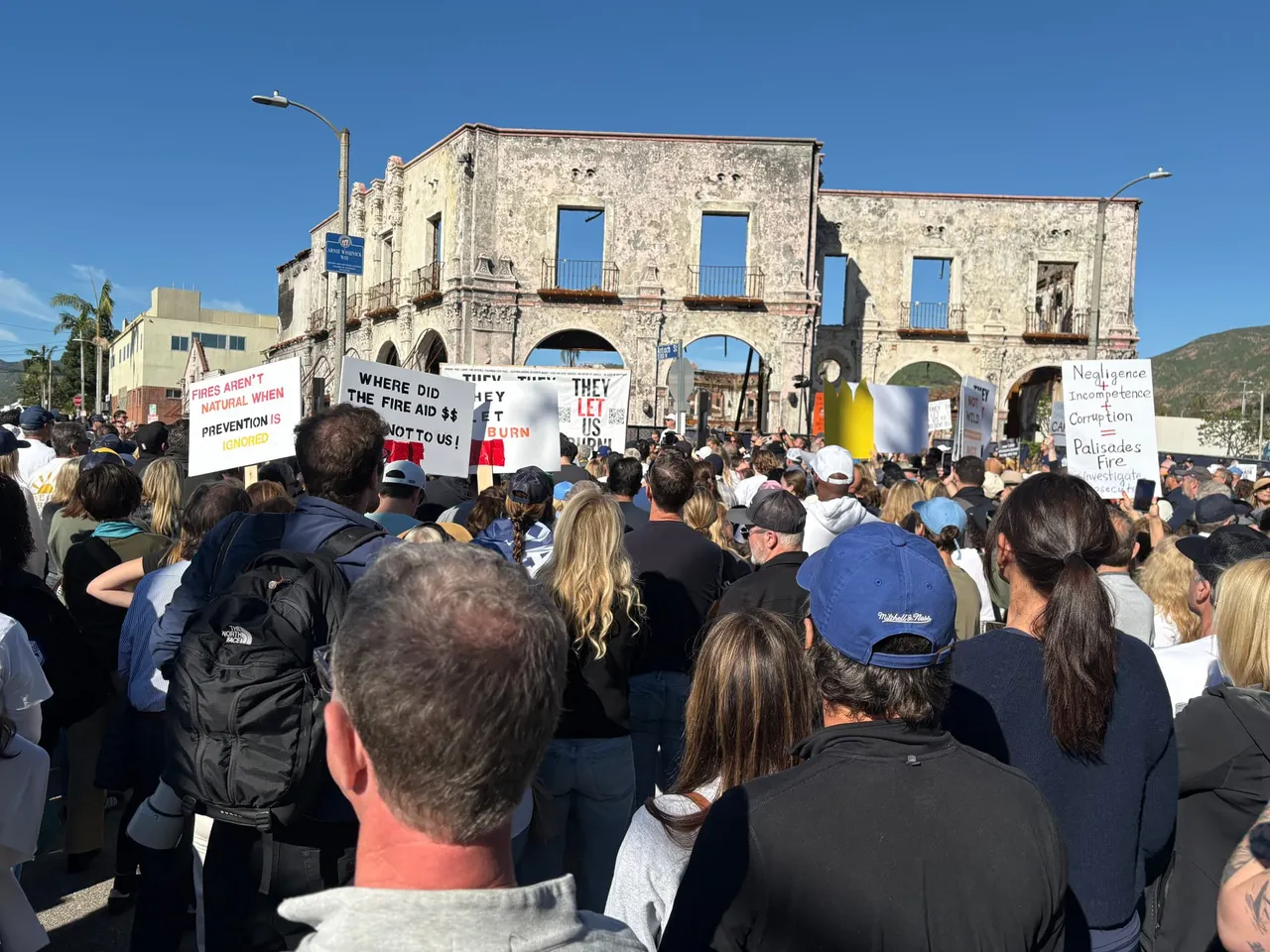
Just blocks away, a protest unfolded, where 12 speakers voiced continued frustration with insurance, rebuilding timelines, and accountability. Among them was Spencer Pratt, who announced running for mayor — underscoring how deeply the fire has reshaped civic engagement and political discourse.
Grammy- and Emmy-winning songwriter Jimmy Dunne said what surprised him most was not sorrow — but belief.
“People came expecting sadness,” Dunne said. “But instead, we looked around and realized the promise is right in front of us. The people of this town are what’s bringing it back.”
He pointed to public-private partnerships, including the work of Steadfast LA, as the engine of real progress.
“It won’t be the same,” Dunne said. “It will be better.”
As the sun set on a day of remembrance, protest, prayer, music, and resolve, one truth became unmistakable.
What the fire took was immense — homes, history, and lives. What it did not take was the will of a community determined to rebuild — together.
Under a newly raised flag, the Palisades stood united.
Together, it will heal, rebuild and become one of the greatest disaster recovery stories ever told - through belief in what’s possible.
By Michelle Edgar, Special to the Daily Press