
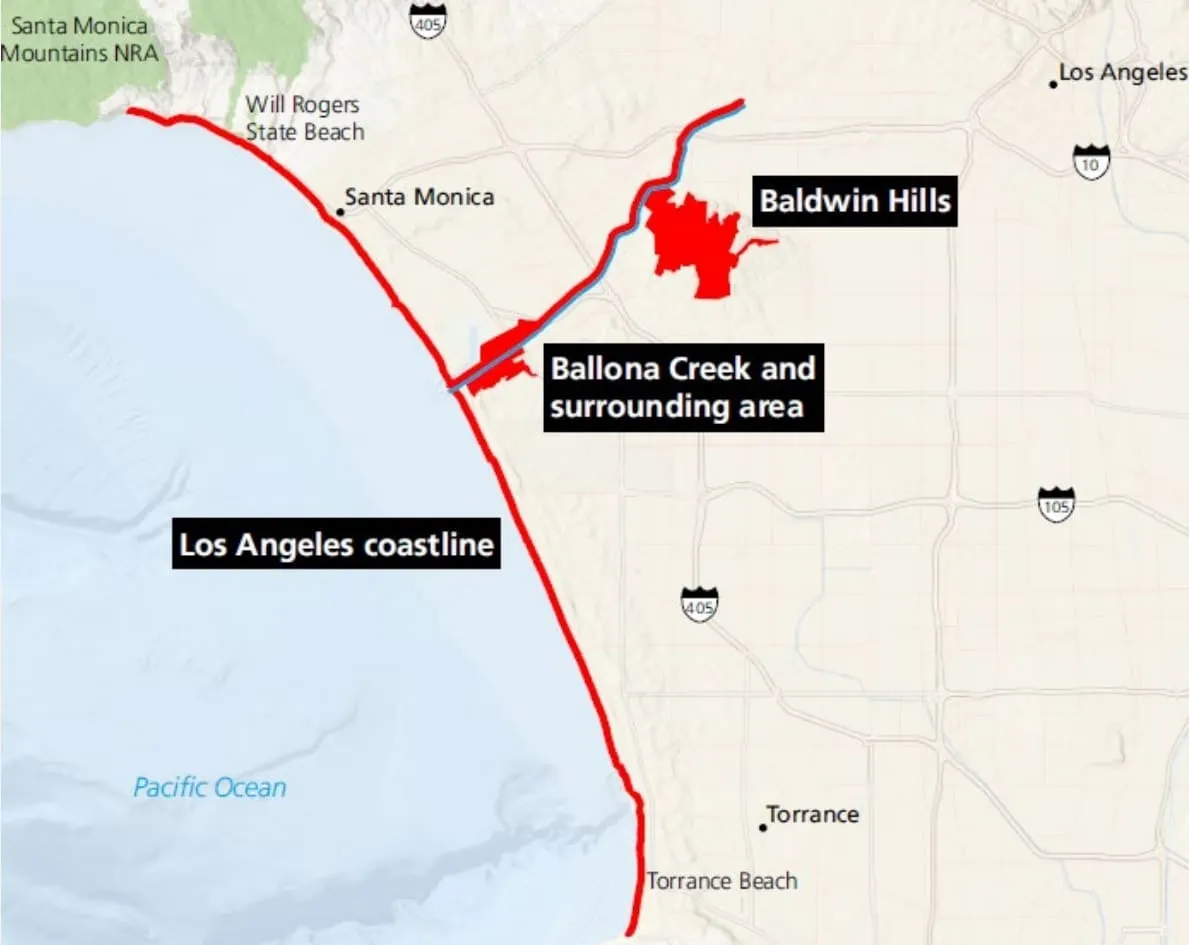
The Federal Government is considering a new national park covering a wide swath of the Los Angeles coastline and residents had many questions about the sweeping proposal at a community meeting this week.
The National Park Service is asking the public to weigh in on a congressionally mandated study evaluating whether select sites along the Los Angeles coast should become part of the national park system.
The study, required by Public Law 117-328, examines coastline from Will Rogers State Beach to Torrance Beach, including areas around Ballona Creek, the Baldwin Hills and the San Pedro section of Los Angeles. The public comment period runs through April 6, 2026.
"We invite you to participate in this process," said Sarah Bodo, project manager for the National Park Service's Denver Service Center, during a virtual public meeting Feb. 11. "Your thoughts and ideas are important to us."
Congress directed the Secretary of the Interior to conduct the special resource study to determine whether the area contains nationally significant resources suitable for National Park Service management. The study must be completed within three years of receiving funding, which came in 2025.
However, completion of the study does not establish a new park unit. Only Congress through legislation or the president through the Antiquities Act has authority to designate new units of the national park system. About one of four studies result in an actual park.
The preliminary study area spans from Will Rogers State Beach south to Torrance Beach along the Santa Monica Bay coastline, extending approximately 200 yards inland from the mean high tide line. It also includes the Ballona Creek bike path, the Ballona Wetlands Ecological Reserve, Baldwin Hills, and San Pedro coastline from Royal Palms Beach Park to where Crescent Avenue intersects the coast. The Port of Los Angeles north of Crescent Avenue is excluded.
Private residences and other private properties are not included in the study boundary, though Bodo said property owners may request their land be excluded or suggest public lands for inclusion.
To qualify for national park designation, the study area must meet all four congressionally mandated criteria: contain nationally significant natural or cultural resources; be suitable and not already adequately represented in the park system; be feasible to manage efficiently at reasonable cost; and require direct National Park Service management clearly superior to other approaches.
For cultural resources, National Historic Landmark criteria are applied to determine national significance. Natural resources must be outstanding examples that possess exceptional value, offer superlative opportunities for public enjoyment or scientific study, and retain high integrity as relatively unspoiled examples.
The feasibility analysis considers factors including landownership, acquisition costs, life cycle maintenance costs, public access, threats to resources, and staffing requirements.
If Congress or the president were to designate a national park unit, management could take several forms, from full National Park Service ownership to jointly managed partnership parks to NPS management without ownership, according to Carrie Miller, an NPS official who provided examples during the meeting.
Under a partnership park model, the National Park Service would only directly own and manage a small portion of the land within the authorized boundary, deferring to existing local, state and regional agencies to continue their responsibilities for land use regulations, Miller said. That would mean California’s Coastal Commission, State government and local municipalities could all retain some element of control over the territory depending on the final agreements.
In some cases, Congress grants individual park units special reviewing authority over projects on lands outside of their direct management, but that authority is not guaranteed for every park and would require specific congressional action, Carrie said.
Bodo said a potential designation could bring several benefits to the area. The National Park Service is required under its mission to conserve the scenery, natural and historic objects and wildlife of parks and to provide for public enjoyment, she said. National parks can also generate economic activity in nearby communities.
Federal ownership of land requires compliance with federal laws and National Park System policy, which can differ from local and state laws. However, in cases where existing property ownership is maintained under a partnership model, operational management by counties, cities and state governments would not necessarily change, Bodo said.
"If a national park is designated, the Park Service would seek to work collaboratively with local communities and existing agencies on common goals for resource protection and recreational opportunities," Bodo said.
Miller added that a designation could unlock additional funding. Congress could authorize the National Park Service to expend appropriated funds to assist other agencies and organizations in resource protection or recreational opportunities — funding not currently available outside the national park system's existing external technical assistance programs.
Regarding long-term protections, Miller said lands directly owned and managed by the National Park Service are protected in perpetuity under the agency's Organic Act and subsequent laws. However, for areas within a park boundary not under direct NPS ownership, protections depend on the terms of any conservation easements in place and the specific authority granted in the park's enabling legislation.
The study team is time-bound to complete its work within the congressional mandate, Miller said, acknowledging that analyzing every resource within the study boundary is "a tall order." If the team identifies potential for additional research beyond the study's scope, that opportunity will be noted in the findings.
"What we are mainly driven by is knowing enough to at least make a recommendation and findings based on the criteria that we're required to answer," she said, adding that any fundamental change to the study's original directive, such as a boundary change or extended timeline, would require additional congressional legislation.
The study team is gathering data through spring 2026, followed by analysis through fall and finalization of findings in early 2027. The Secretary of the Interior will then transmit the study to Congress, though there is no timeline for congressional action.
The study team is consulting with the Tongva tribe and has reached out to all property owners within the study area. Information about the study has been shared with the offices of U.S. Representatives Ted Lieu and Nanette Diaz Barragan, as well as Senators Alex Padilla and Adam Schiff.
Public comments raised concerns about the Ballona Wetlands Ecological Reserve, with some participants urging National Park Service takeover to prevent what they described as destructive plans by the fossil fuel industry and California Department of Fish and Wildlife.
Other questions addressed potential impacts on fishing and hunting regulations, lifeguard services, and whether areas like the Venice Canals, lighthouses at Point Fermin and Point Vicente, and federal lands such as LAX airport dunes could be included.
The National Park Service is seeking feedback on five questions: what nationally significant cultural and natural resources should be protected, what role NPS should serve, what concerns exist, and general comments.
Comments can be submitted online at parkplanning.nps.gov/LosAngelesCoastal or mailed to National Park Service, Denver Service Center, Attn: Los Angeles Coastal SRS, One Denver Federal Center, Building 50, Denver, CO 80225.
A second virtual public meeting is scheduled for March 11 at 6 p.m. Pacific time.