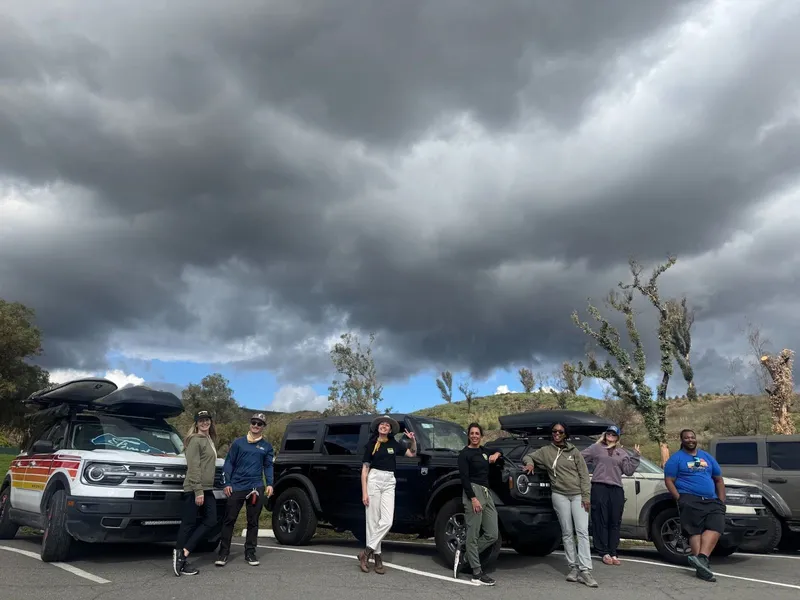
Will Rogers State Historic Park, nearly wiped out when the Pacific Palisades fire scorched 99.5% of the park, is officially on the path to renewal. The fire reduced the canyon landscape to ash and transformed the park into an emergency operations hub. According to Richard Fink II, District Superintendent for California State Parks’ Los Angeles District, the site became a debris processing center for more than 4,400 residential lots, enabling the fastest and largest wildfire debris removal operation in U.S. history.
The park reopened yesterday with something it had not seen since the fire to restore the land with the support of Ford’s Bronco Wild Fund bringing together over 50 community volunteers, environmental partners for what California State Parks officials described as the first public wildfire resiliency and replanting project since the disaster – marking a symbolic and turning point for one of Los Angeles County’s most beloved historic landmark and outdoor spaces. Volunteers helped remove invasive plants and planting natives including artemsia California and two different types of native sages along with Elymus condensatus replanting the two hillsides facing the public area,
The fire had reduced the surrounding canyons to ash and transformed the park into an emergency operations hub. “This landscape was ground zero,” said Richard Fink II, District Superintendent for California State Parks’ Angeles District. “Will Rogers became a debris processing site for over 4,400 residential lots, enabling the fastest and largest wildfire debris removal operation in U.S. history. To see people back here planting trees — it’s powerful. It marks the beginning of real recovery.”
Marking its fifth anniversary, Ford’s Bronco Wild Fund announced two new commitments totaling $200,000 to support ongoing wildfire recovery across Los Angeles County: $100,000 to the National Forest Foundation for reforestation and habitat work, and $100,000 to California State Parks to assist parks hit hardest by the Palisades fire, including Will Rogers. These investments reflect the fund’s core pillars of access, preservation, and stewardship. Over the past five years, the Bronco Wild Fund has contributed more than $9.8 million to environmental and outdoor-access programs, funding that has been leveraged by partners to plant more than two million trees and restore hundreds of miles of trails nationwide and expand programs that introduce new communities to the outdoors. The Fund supports six national partner organizations: the National Forest Foundation, America’s State Parks, Outward Bound USA, Sons of Smokey, Tread Lightly and American Trails - each bringing specialized expertise in restoration, access, education, and stewardship.
Bronco Wild Fund leaders emphasized a shared commitment to expanding both environmental restoration and equitable access. Bronco Wild Fund representative Kathleen Denton shared that the devastation of the Palisades fire reinforced why their work matters. “This land is a national treasure,” she said. “Helping it come back to life is part of our responsibility. We believe in preserving wild places and ensuring everyone, especially young people, has the opportunity to experience them.”
Natalie Simon, Bronco Enthusiast Manager, spoke about the personal nature of the restoration. With team members connected to the Palisades community, the fire’s impact was felt deeply within the organization. “Healthy outdoor spaces are essential treasures,” she said. “Seeing volunteers back out here planting trees shows the strength of this community and our collective commitment to rebuilding.”
The event drew national representation as well. Scott Strong, Deputy Director, Business Management at Utah Division of Parks and Recreation, described how Bronco Wild Fund support has transformed countless outdoor experiences in Utah through trail rebuilding, facility upgrades, and accessibility initiatives. He recalled families using mobility track chairs funded by the program, allowing individuals with disabilities to explore trails once entirely inaccessible. “Moments like that remind us why this work matters,” Strachan said. “It’s not just conservation - it’s restoring access, dignity, and joy.”
National Forest Foundation Chief Advancement Officer Kyle Funakosh shared a parallel story from the Klamath National Forest, where a catastrophic wildfire burned 145,000 acres. With Bronco Wild Fund support, the NFF planted 85,000 new trees across 360 acres. “A burned landscape can feel like an ending,” he said. “But when replanting begins, hope becomes visible again. That’s what today represents at Will Rogers. What’s happening here in the Palisades echoes what we see nationwide,” he said. “A burned forest can feel like the end. But the act of planting - tree by tree - is an act of hope.”
The Bronco Wild Fund emphasized its commitment to expanding community engagement throughout Los Angeles County and is planning a major Earth Month initiative next year designed to mobilize Ford dealerships, local nonprofits, and neighborhood partners in hands-on restoration projects. A key focus will be involving students—from elementary schools to high schools—to help cultivate a culture of stewardship and environmental responsibility. The team shared that future programs will intentionally bring young people into the restoration process, positioning Will Rogers as both a recovery site and a living outdoor classroom.
As volunteers stepped back to admire newly planted saplings, Superintendent Fink reflected on what the day represented. The Palisades fire devastated the land, he said, but the community’s response shows a different kind of strength. Every tree planted is a testament to the region’s resilience and a promise of what the park will become again. With strong partnerships, ongoing investment, and a renewed emphasis on youth engagement and community restoration, Will Rogers State Historic Park is beginning its comeback - rooted in hope, collaboration, and the shared belief that this historic landscape will thrive once more.
By Michelle Edgar, Special to the Daily Press