

While homelessness decreased throughout Los Angeles County last year, the City of Santa Monica failed to keep up with the regional trend, instead reporting an increase in homeless individuals found within city limits.
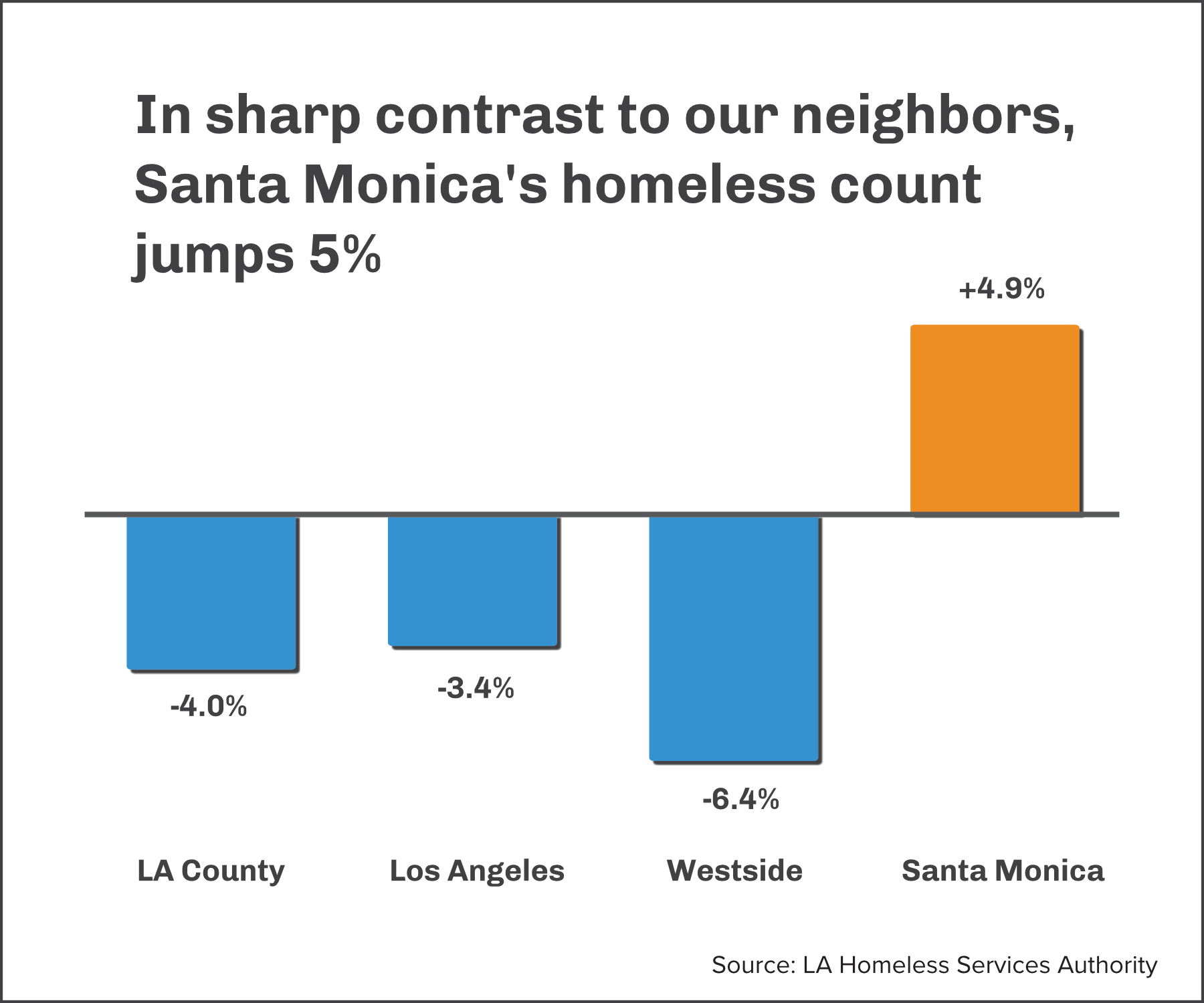
The local count showed homelessness increased by 5% in 2024 rising from 774 to 812. The population growth was driven in large part by car campers with an increase of 21 people living in vehicles (to a total of 84 last year). The City also saw the number of people living in local shelters increase by 29 to a total of 202. Four fewer people were found living outside dropping that total to 475 and there were 10 fewer tents/camps throughout the city.
The City of Santa Monica framed the results as good news saying the results showed progress towards moving people off the streets.
“Seeing an increase of unhoused individuals moving indoors reflects the progress of our efforts,” Director of Housing and Human Services Heather Averick said. “With our new Homelessness Strategic Plan as a guide, and continued local and regional investments and collaboration, we will remain nimble and flexible, using data to make shifts in programming as needed. We remain optimistic that we will continue to see more unhoused Santa Monicans transition from the streets indoors to stable housing.”
Santa Monica’s increasing homeless population is in stark contrast to the county, regional and other local results.
The Los Angeles Homeless Services Authority (LAHSA) released the results of the overall 2025 Greater Los Angeles Homeless Count earlier this month. For the second straight year, homelessness is down across Los Angeles County, falling 4% to 72,308. Homelessness also declined in the City of Los Angeles, falling by 3.4% to 43,699. Another key metric, unsheltered homelessness, decreased countywide by 9.5% and within the City of Los Angeles by 7.9%. Over the last two years, unsheltered homelessness has dropped in the County and City of Los Angeles by 14% and 17.5%, respectively.
County data is also broken down into eight “Service Planning Areas” (SPA) that group individuals by regional geography. Santa Monica is in SPA 5 which includes Bel Air, Beverly Hills, Beverly Crest, Beverly Glen, Brentwood, Century City, Culver City, Holmby Hills, Laurel Canyon, Malibu, Mar Vista, Marina Del Rey, Manchester, Pacific Palisades, Palms, Rancho Park, Santa Monica, South Robertson, Venice, Westchester and Westwood.
In SPA 5 homelessness declined by 6.4%, a decline of 343 people.
In some of those specific communities, homelessness also declined. Culver City identified 105 unsheltered persons experiencing homelessness down nearly 9% from its count of 115 persons in 2024. A RAND report released this year reported a 22% decline in homelessness in Venice. Malibu reported a record low of 33 homeless people.
“In Santa Monica, coordination with the city and county of Los Angeles and other regional partners has led to positive results,” said the city in its press release. “The city, in line with the recently adopted Homelessness Strategic Plan, will continue to implement strategies to address the housing and homelessness crises.”
The city cited its partnership with the County’s Pathway Home program as an example of success with an additional 25 transitional shelter beds in Santa Monica.
Car camping has been a growing source of complaints for residents within the city who have said people have been allowed to live in vehicles for extended periods despite the City’s prohibitions on living in cars.
In a recent incident, a camper near Douglas park spent more than six months living on the adjacent residential streets before eventually leaving.
At the time, the Santa Monica Police Department said it had issued multiple parking citations and conducted repeated outreach through the Homeless Liaison Program and contracted service providers. The occupants refused repeated offers of relocation assistance or safe parking alternatives and officials said they were helpless to address the problem.
SMPD said enforcement actions are guided by the Fourth Amendment and the California Vehicle Code. Towing an inhabited vehicle from a public street requires specific legal thresholds, such as an immediate hazard to public safety, obstruction of traffic, or an environmental threat. Unpaid citations or general concerns alone do not meet this standard.
The City acknowledged the increase in car camping.
“Outreach teams in Santa Monica continue to connect individuals to safe parking programs in Culver City and the greater Los Angeles area,” said the City’s announcement. “Moving forward, the city will further assess policy and program shifts to ensure this population of individuals receives the necessary support and resources.”
The Santa Monica count is administered by the Los Angeles Homeless Services Authority. The City used to manage its own count but handed organization over to the county agency two years ago.
LAHSA has become a controversial agency in recent years with multiple accusations and reports that its methodology undercount homelessness. At the same time, the agency’s financial management practices have been questioned and its contracts with both the County and City of Los Angeles have been terminated.