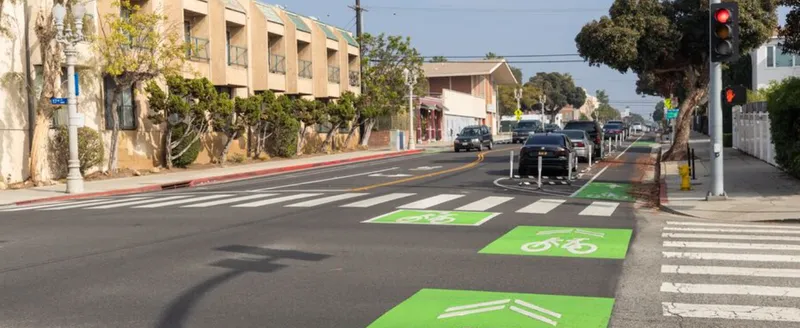
Changes are coming to Santa Monica Boulevard to address safety but what and when are still up for debate.
Santa Monica City Council members received a comprehensive safety study last week revealing 435 injury crashes over the past decade on Santa Monica Boulevard, while debating whether proposed improvements go far enough to address the city's Vision Zero goals.
The study, funded by a $522,327 Caltrans grant, analyzed the 2.4-mile corridor from Ocean Avenue to Centinela Avenue and found that right-of-way violations were the primary cause of crashes. One fatality occurred during the 10-year period at 18th Street, with pedestrians overrepresented in serious injury crashes despite accounting for only 11% of all incidents.
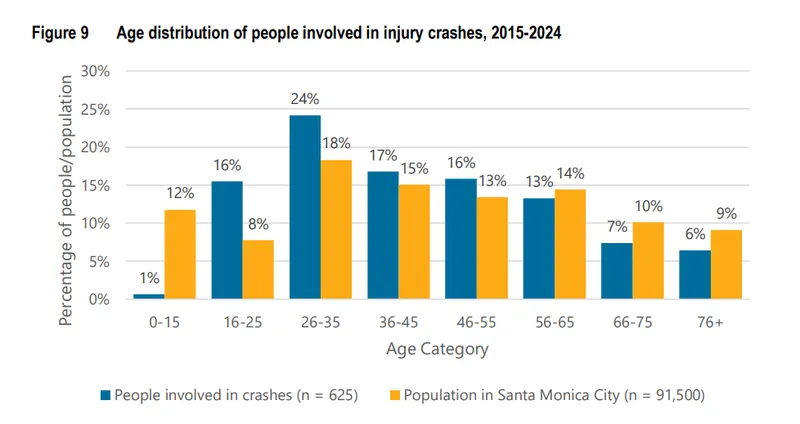
"Young people are overrepresented in crashes, while older adults constitute a large percentage of pedestrian-related crashes," said Carlos Hernandez, a transportation planner with the city's Department of Transportation, presenting the findings to council.
The analysis revealed that 83% of crashes occurred at intersections, with injury severity highest at unsignalized intersections where side streets have two-way stops. Speed data showed drivers regularly exceed limits, particularly on the eastern end where 85th percentile speeds reach 35-49 mph in a 30 mph zone.
City staff proposed three categories of improvements: systematic changes like consistent pavement markings and right-turn-only restrictions from side streets at 13 unsignalized intersections; concept-level plans for 15 focus intersections; and transit improvements including relocated bus stops and potential bus-only lanes.
Key intersection improvements would include pedestrian scrambles at 6th, 5th and 7th streets, new crosswalks with flashing beacons at locations like 10th Street, and pedestrian refuge islands on the wider eastern segment. Staff noted that left turns and through movements from side streets represent only 1-2% of vehicle movements but account for 80% of injury crashes at unsignalized intersections.
However, several council members and public commenters argued the proposals don't adequately address fundamental safety issues.
"Speed is the problem here," said public commenter Eli Gil, contrasting Santa Monica's $120 million police budget with "few million" for mobility improvements. He cited Hoboken, New Jersey, which has had no traffic deaths in seven years, challenging the council to show "political will" and "do something big" rather than just "talk a good game."
Council Member Jesse Zwick questioned why the study didn't consider reducing travel lanes, noting that wide multi-lane streets like Santa Monica Boulevard are "treated like highways" by drivers. He pressed staff on engineering solutions to reduce speeds, particularly on the eastern portion where current speeds are "alarming."
"When I look at streets like Wilshire, Lincoln, San Vicente, Santa Monica Boulevard... they're all really wide. They have multiple lanes of traffic moving in the same direction, and they're all basically treated like highways as a result," Zwick said.
Council Member Dan Hall advocated for transforming the eastern section into "a boulevard with a great streetscape like we have on Broadway or San Vicente with a median" to reduce lanes and slow traffic while creating a clearer entrance into Santa Monica.
Mayor Pro Tem Caroline Torosis pressed for consideration of "significant tradeoffs" like reducing travel lanes or parking to create a "truly multimodal space."
Public commenter Connor Webb criticized the proposals as a "copy-paste" from Wilshire Boulevard improvements, which he described as still "hostile and dangerous" for pedestrians. He urged the council to direct staff to include "raised intersections and raised crossings" and noted that wide lane widths of 13-20 feet "begs for drivers to speed."
The study's transit analysis found that bus-only lanes could be implemented on the eastern segment from 26th Street to Centinela Avenue, extending planned Los Angeles County peak-hour bus lanes. However, implementing bus lanes further west would require removing travel lanes due to the narrower street profile.
Staff emphasized that the proposed improvements are designed not to preclude future bus-only lanes and that systematic intersection changes would address the specific crash patterns identified in the data analysis.
The project will continue with community engagement through a summer open house before returning to council for final adoption in February 2026. Implementation would require additional grant funding and follow a phased approach similar to the Wilshire Boulevard safety improvements.
Council unanimously approved receiving the study and providing direction to staff for further refinement of the recommendations.