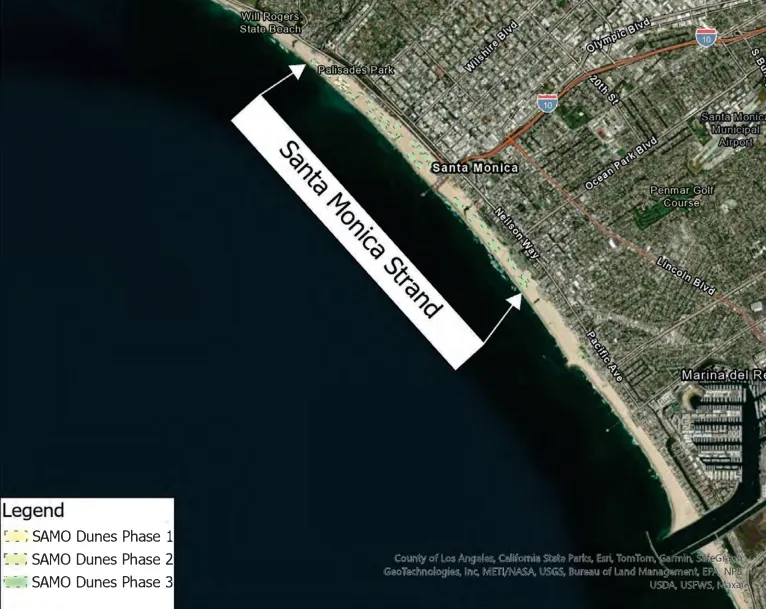
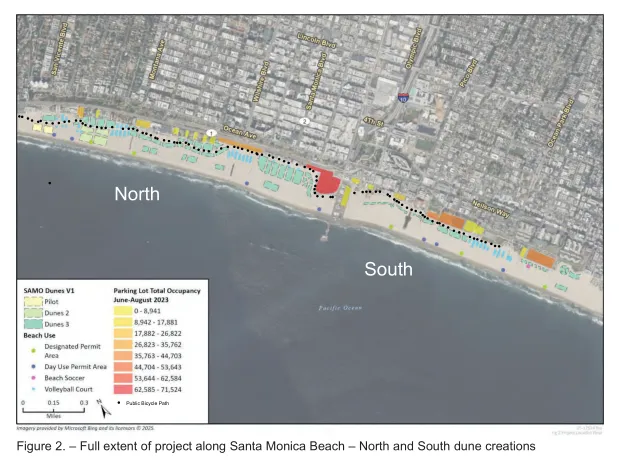
The California Coastal Commission postponed a vote on a controversial dune restoration project that would transform nearly 40 acres of Santa Monica's beach, following fierce opposition from residents who warn the plan poses fire risks in the wake of the devastating Palisades Fire.
The commission delayed consideration of the Santa Monica State Beach Dune project's Phase 3, despite staff recommendations to move forward with the multimillion-dollar initiative that would convert about 19% of the city's beach into native dune habitat.
The postponement came after more than 20 residents submitted opposition letters raising concerns about fire hazards, homeless encampments, maintenance costs and reduced beach access. The proposed phase would cover 38.5 acres — triple the size of the first two phases combined.
"The planned vegetation, directly next to our homes, is a direct fire threat, amplified by existing encampments," wrote Paul Schneider, a longtime Santa Monica resident and homeowner along Palisades Beach Road. "Santa Monica's painful history with fires, including the Palisades Fire, makes this risk inexcusable."
The Palisades Fire, which destroyed thousands of homes in January, has heightened concerns about placing dry vegetation near residential areas. Multiple residents cited the disaster as evidence that the dune project could create dangerous conditions.
"We've already seen what can happen in the Palisades, and yet we're inviting the exact same conditions right back into one of the most vulnerable areas," Schneider wrote in his public comment.
Despite the opposition, commission staff recommended approval with conditions, arguing the project would enhance coastal resilience and create habitat for sensitive species like the western snowy plover. The staff report addressed resident concerns but maintained the project's benefits outweighed the risks.
The project would install foredune and back dune habitat along 3 miles of coastline, using 3-foot-high fencing and native vegetation. Areas would be seeded with plants including beach evening primrose, red sand verbena and beach bursage.
Residents also complained they received no direct notification about the project, despite it being located within hundreds of feet of their homes.
"We never received any direct notice of this project that will be within a few hundred feet of our residence, thus we feel we have had no chance to respond and comment on this project when it was being developed," wrote David Newberg, a resident at 1415 Palisades Beach Road.
The opposition letters raised additional concerns about maintenance costs, arguing the city lacks resources to properly clean and monitor the dune areas. Several residents warned the fenced areas could become havens for homeless encampments and trash accumulation.
"Dune structures will trap debris and become long-term garbage zones, especially given that the city already struggles to maintain basic public spaces," wrote resident Jonathan Spica.
Public comments during the commission's July meeting in Pismo Beach revealed the depth of community division. Opponents described the dunes as a "huge disruption to the vision" and worried about reduced beach access for community activities like frisbee leagues and fitness classes.
Environmental advocates supported the project as a nature-based solution to climate change. Hila Bay, an environmental nonprofit, called dune restoration crucial for protecting beaches from "increased wave action and storm surge" and providing "important habitat for sandy beach organisms."
The project is a collaboration between the City of Santa Monica and The Bay Foundation, building on earlier phases that restored about 8.25 acres of beach. Previous phases have demonstrated success, with the federally threatened western snowy plover nesting at the site for the first time in the Los Angeles region in nearly 70 years.
Staff proposed a five-year authorization period and required the applicants to assume risks from coastal hazards including flooding and erosion. The project would maintain 25-foot-wide public access corridors and a shore-side buffer for beach access.
The commission has not announced when the item will be rescheduled for consideration.