
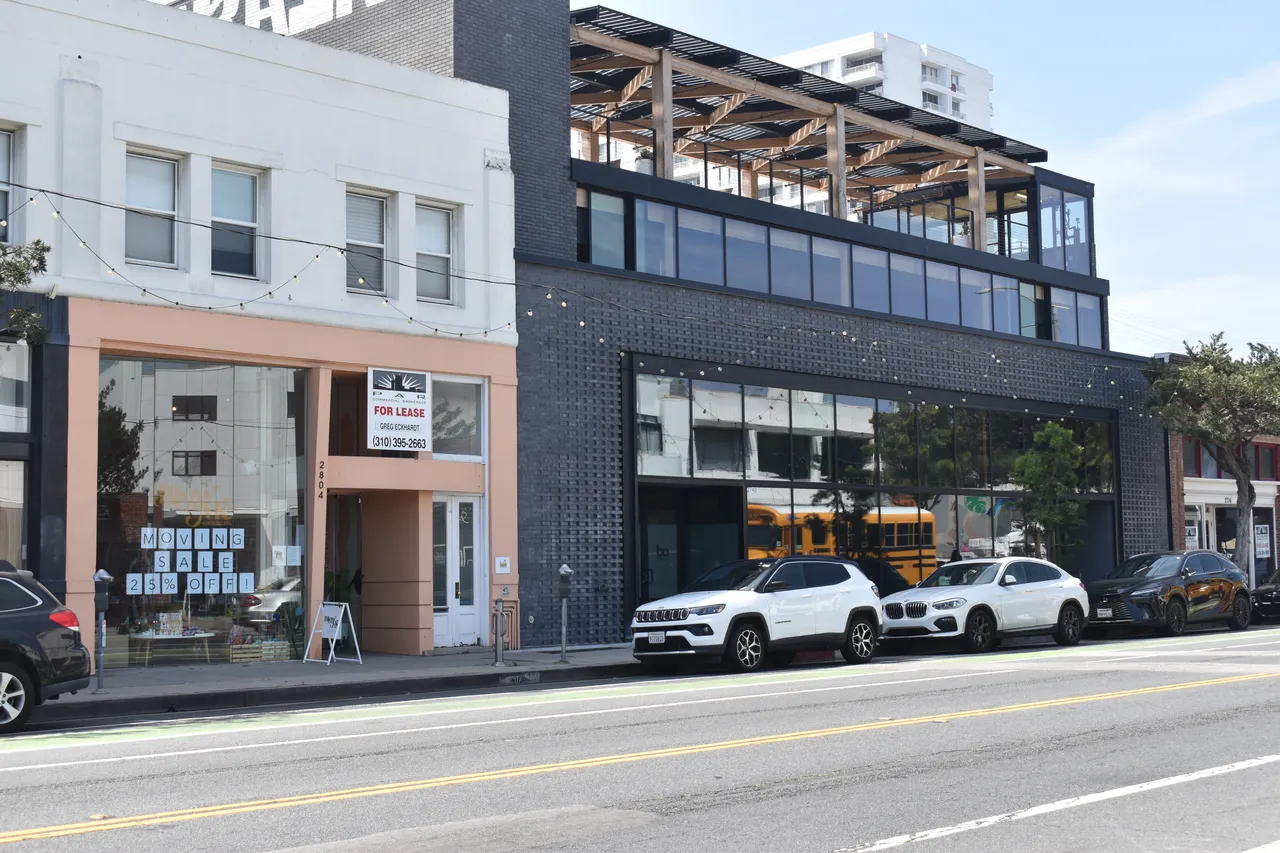
Facing declining restaurant sales, stubbornly high retail vacancies, and the lingering economic shadow of the 2025 Palisades Fire, the Santa Monica City Council on Tuesday unanimously approved an eight-point economic development toolkit designed to lower barriers for businesses, attract new investment, and position the city to capitalize on a wave of major global events arriving in the next two years.
The package, adopted as part of a broader update to the city's Realignment Plan, includes a $3 million economic development fund, elimination of key restaurant fees, an expanded entertainment zone, discounted downtown parking, and a temporary waiver of film permit fees — measures city officials said reflect both the urgency of the city's economic challenges and a newfound confidence in its financial footing.
"Without foundational safety-related considerations addressed, the recovery of our city will really be challenged," City Manager Oliver Chi told the council before the vote. "We have to invest in public safety to make sure that we have terrific spaces that people feel comfortable in."
The toolkit comes against a backdrop of steep economic decline in the city's hospitality and retail sectors. Data from the city's sales tax provider, HdL, showed that restaurant and hotel sales fell 4.1% year-over-year through mid-2025. Quick-service restaurants fared even worse, posting a 13.9% decline, while fine dining dropped 9.1% and fast-casual fell 8.2%.
Chi acknowledged that improvements in public safety and infrastructure alone have done enough.
"Creating favorable conditions has not yet been sufficient to catalyze the level of private investment the city needs to achieve a revitalization of the local economy," he said.
Among the most significant measures approved Tuesday was the elimination of the city's $1,000-per-seat portion of the wastewater capacity fee for new restaurants and restaurant expansions. Under the prior structure, a new 50-seat restaurant would have paid $70,000 in city fees before serving a single meal.
Restaurants will still be required to pay a $400-per-seat Hyperion wastewater fee to the City of Los Angeles, though council members directed staff to study whether to subsidize that cost as well.
Councilmember Lana Negrete, who said she had pushed for a similar measure years earlier and been turned away, welcomed the reversal.
"I was told, unequivocally, that it was illegal to waive fees," Negrete said. "I'm really excited about that."
Councilmember Natalya Zernitskaya asked staff to confirm the city could revisit the $400 Hyperion fee in the future if Tuesday's actions proved insufficient to stimulate restaurant activity. Staff confirmed the council retains that authority.
The council also approved the expansion of the city's entertainment zone program, which allows open-container alcohol consumption during designated events. The original zone, covering the Third Street Promenade, launched in June 2025 as the first of its kind in Southern California under California Senate Bill 969.
Tuesday's action extends that framework to the entire downtown core, the Santa Monica Pier, Main Street, and Montana Avenue — though the new zones will operate only in conjunction with specific events and managed under plans developed by local business improvement districts.
Downtown Santa Monica Inc., the nonprofit that manages the Promenade, submitted a letter supporting the expansion but insisted that operational decisions remain at its discretion. The group noted it spent more than $200,000 in the current fiscal year to staff, equip, and promote the pilot program and said any further expansion would need to occur "incrementally" and only "when appropriate operational safeguards and funding mechanisms are in place."
Early data from the pilot showed promise: Oktoberfest events doubled foot traffic compared to prior years, and Dodgers World Series watch parties tripled attendance on event nights.
Not everyone was enthusiastic. The North of Montana Association urged the council to establish a buffer zone around Roosevelt Elementary School before activating the Montana Avenue zone, noting that the proposed ordinance would permit open containers as early as 8 a.m., seven days a week. Resident Alan Mont wrote separately that expanding a program less than a year old carried unnecessary risk. "It would take only one serious incident to undermine public confidence," he wrote.
The council also approved modifications to downtown parking rates, extending the initial discounted period to 90 minutes at $1 — up from a 30-minute free window — while creating two pilot validation programs for fitness businesses and schools operating near the parking structures.
Sidewalk dining fees for simple tables-and-chairs setups will be eliminated entirely, a change staff said would benefit up to 59 restaurants currently in the city's outdoor dining program and streamline the approval process.
A temporary waiver of city film permit application fees — which range from $350 to $700 — was also approved. Film Santa Monica CEO Misti Kerns and COO Evan Edwards submitted a letter calling the measure "a meaningful and strategic step" toward strengthening Santa Monica's competitiveness as a filming destination, noting that comparable jurisdictions across California are adopting similar incentives.
Underlying the entire toolkit is Santa Monica's positioning for two transformative events: the FIFA World Cup in summer 2026 and the 2028 Olympic Games. The council authorized acceptance of two Metro grants — $250,000 for a World Cup open streets activation and $500,000 for an Olympic Games event — and approved an expanded contract with event production partner Revel Republic to produce a five-week World Cup activation in the downtown core running June 11 through July 19, 2026.
A large-scale music festival partnership with Goldenvoice is also advancing, with a licensing agreement expected before the council in April for a September 2026 event. Staff said negotiations are also ongoing for an ESPN broadcasting partnership in 2027 and multiple Olympic hospitality agreements.
Chi framed the economic tools not as a short-term fix but as a foundation for long-term recovery, noting that the city's general fund is now projected to run surpluses through fiscal year 2030 — a turnaround from the $29.6 million structural deficit it faced when the Realignment Plan was first adopted in October 2025.
"The financial strength is what is enabling the recommendations we're making tonight," Chi said. "It's giving staff confidence to make these recommendations, knowing that we're in a much more solid financial footing than we were a year ago."