
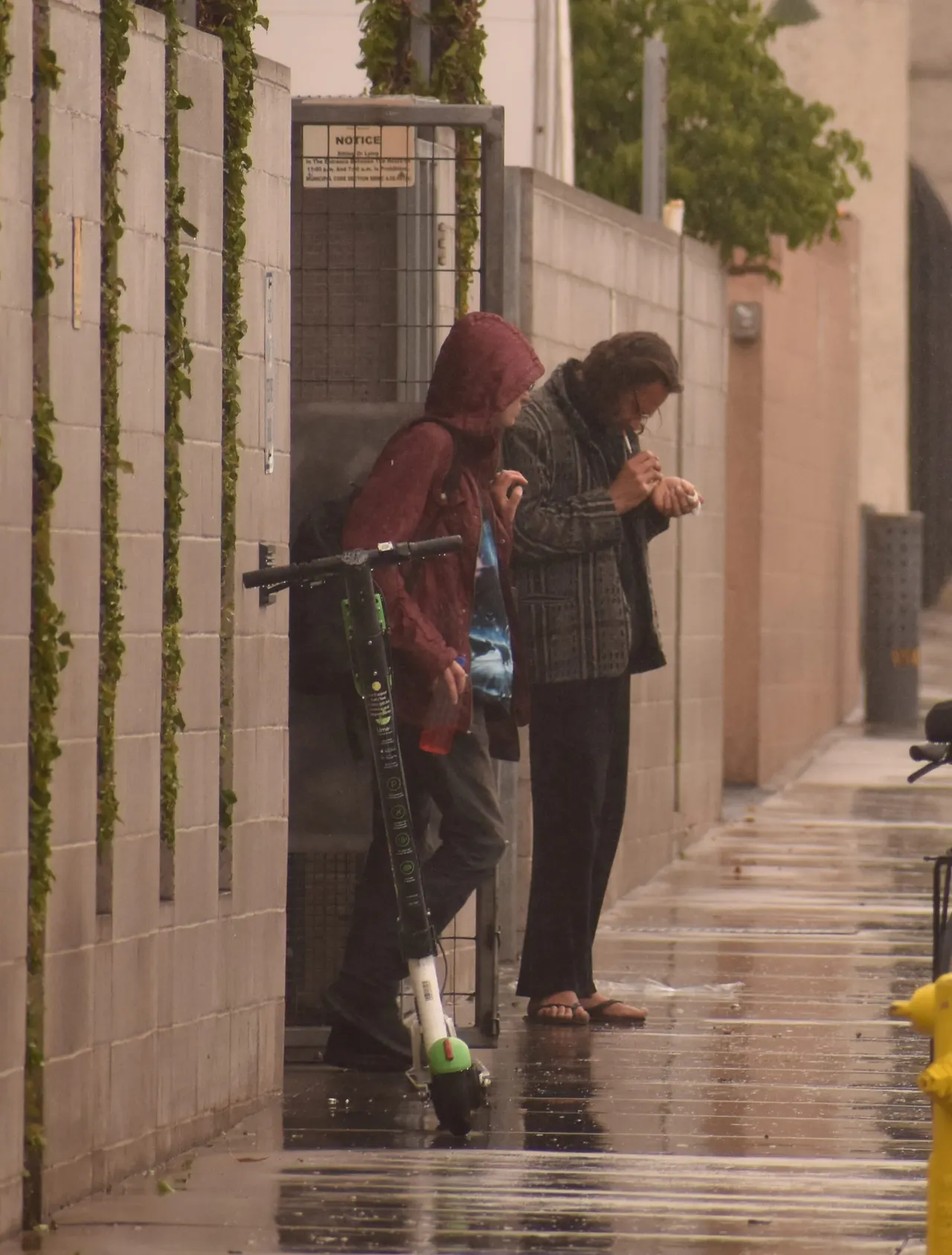
The Santa Monica City Council has authorized a sweeping reassessment of how the city addresses homelessness and affordable housing, directing staff to begin community outreach on a potential shift to a "housing first" system of care while also studying the creation of a city-aligned nonprofit housing development entity modeled on approaches used in Montgomery County, Md., and Atlanta.
The two votes, taken separately at the end of last Tuesday’s meeting due to recusal requirements, represent the most ambitious rethinking of the city's homelessness and housing strategies in years — and acknowledge, in the words of city staff, that the current system "funds the impacts of homelessness without controlling the outcomes."
For years, Santa Monica's primary homelessness response infrastructure has centered on SamoShel, a shelter and access center located in the downtown core. City Manager Oliver Chi told the council that conditions have shifted significantly since that model was established, pointing to the proximity of Metro's end-of-line Expo station, a more acute behavioral health population, and an increasing concentration of calls for service in the city's commercial center.
"The current model provides the city with access to shelter capacity only, without city-controlled interim housing or permanent housing pathways," Chi said, describing a proposed transition to a continuum of shelter, interim housing, and permanent housing in which the city would control placements at every stage.
The new system would prioritize the "Santa Monica priority population" — defined as individuals who have lost permanent housing or full-time employment in the city, who have frequent contact with city emergency services, or who have experienced homelessness in Santa Monica for more than three years.
Staff proposed conducting community outreach from March through May, with a report back to the council in June that would include refined proposals for formal consideration.
Councilmember Ellis Raskin voted in support of the outreach process but noted reservations about the direction. "I have some hesitation about moving away from an Access Center style model," he said, adding that he hoped any transition would complement rather than displace existing services.
Councilmember Dan Hall recused himself from the vote, citing his residence's proximity to the SamoShel site within 1,000 feet and a formal determination by the Fair Political Practices Commission that his participation was prohibited.
In a separate action, the council directed staff to study the creation of a city-aligned nonprofit housing development entity capable of building mixed-income housing at a pace and scale that the Low-Income Housing Tax Credit program alone cannot achieve.
Chi described the proposed entity as a vehicle that could secure land, access tax-exempt financing, and develop housing across a range of income levels — without the competitive delays and rigid income-targeting requirements of the federal tax credit system.
"Rather than being limited to income bands prescribed by federal programs, the entity could develop mixed-income housing serving a range of needs — from very low income through moderate and workforce levels," Chi said, with higher rents from market-rate and workforce units subsidizing deeply affordable units within the same building.
The model, sometimes described as social housing, has gained traction internationally and in a handful of U.S. jurisdictions. Chi cited the Housing Opportunities Commission of Montgomery County and the Atlanta Urban Development Corporation as instructive examples.
Council member Hall asked Chi to explain the concept in plain terms. "So you'd have tiers of incomes where higher rents subsidize the lower rents," Hall said, summarizing the model. "And that's essentially like the private market developing the affordable housing." Chi confirmed that was essentially correct.
Santa Monicans for Renters' Rights submitted written comments expressing broad support for exploring the social housing model but urged caution, calling on the council to ensure that any concrete proposal be made available for public review at least two weeks before a vote. The group also questioned why a new entity would be needed rather than working through the Community Corporation of Santa Monica, a nonprofit that has long partnered with the city on affordable housing.
Council member Raskin echoed those concerns, asking that staff clarify income targeting and engage existing community partners before bringing a formal proposal back to the dais.
Council member Jesse Zwick, who recused himself from this item due to his employment's relation to housing production, did not participate in the vote.
According to figures presented to the council, approximately 72% of all individuals arrested in Santa Monica are experiencing homelessness — a figure that reflects where the demands on city services are concentrated rather than a characterization of the homeless population as inherently criminal. Jacob told the council that the department has maintained for decades that homelessness is not a crime.
According to the 2025 Los Angeles Homeless Services Authority count, Santa Monica's homeless population stands at approximately 812 individuals, with roughly 10% — about 84 people — living in vehicles, a 38% increase from the prior year.
The city had drafted ordinances to address vehicle habitation and the practice of renting recreational vehicles as unlicensed housing on public streets, known as "vanlording," but staff said those measures will not be brought forward until a safe parking site is secured. An initial site had been identified just outside the city's eastern boundary, but a neighboring jurisdiction — identified by Hall as Los Angeles City Council District 11 — intervened to block Santa Monica's use of the location.
The council also received updates on several programs aimed at keeping housed residents stable and connecting unhoused individuals with services. The SamoBridge program — operated with Exodus and funded by a three-year grant — has been operational for nearly a year, providing officers with an immediate referral option for individuals in crisis. Staff said they are exploring funding extensions as the grant's first-year mark approaches in May.
On the tenant side, the city is hiring three new analysts to launch data collection for its newly adopted rent registry, which will track conditions across approximately 15,000 non-rent-controlled housing units. Chi also acknowledged that the city's internal response to tenant habitability complaints is currently fragmented across multiple departments with no coordinated process, describing it as a situation where "every single issue is sort of a uniquely artisanal response." The executive team is developing a framework to streamline that process.