

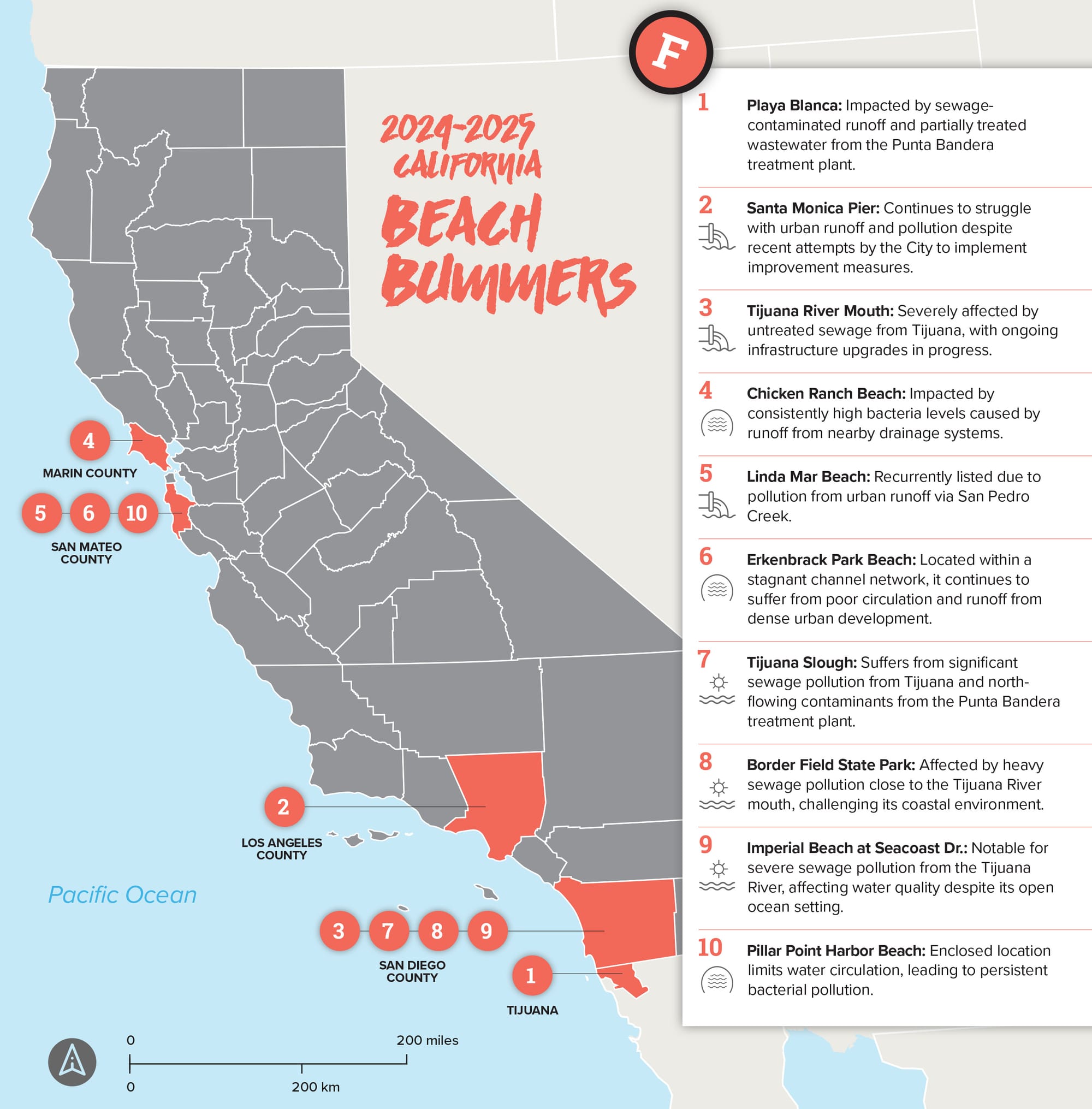
The beach adjacent to the Santa Monica Pier has again been named one of California’s most polluted, landing in second place on Heal the Bay’s annual “Beach Bummer” list, part of the environmental nonprofit’s 35th Beach Report Card released on Thursday.
The report, which assigns weekly water quality grades to more than 700 beaches along the Pacific Coast, found that the pier continues to suffer from persistently high levels of fecal-indicator bacteria, particularly during the dry summer season. The report is based on 2024 data and shows the pier receiving a failing grade, despite years of remediation efforts.
“Every day, families who visit Santa Monica for a day of fun in the sun may be unknowingly risking illness by splashing in polluted waters,” said Tracy Quinn, CEO of Heal the Bay. “It’s time for the City of Santa Monica to prioritize efforts to identify and reduce bacteria levels at the Santa Monica Pier.”
Naomi Maurice, a water quality data analyst at Heal the Bay, said the pollution under the pier remains a chronic concern. “We’re seeing high levels of bacteria at this beach almost daily,” she said. “Millions of people visit the pier each year and plenty of them are getting in the water, especially during the warmer season. We want to make sure that this area is safe for swimming, but unfortunately that’s just not what the data is showing.”
Santa Monica city officials responded Thursday by noting that the report’s failing grade applies only to the ocean water within 100 yards north and south of the pier. “Santa Monica’s beaches are wide and expansive,” a spokesperson from City Hall said. “The majority of our three miles of coastline is highly rated by Heal the Bay.”
Nearby beaches at Pico and Wilshire boulevards received B and A+ grades, respectively, according to Heal the Bay, underscoring the localized nature of the pier’s contamination. And officials also pointed to stormwater diversion systems and bird-deterrent netting as evidence of ongoing efforts to address the problem.
But Maurice suggested that past mitigation efforts have not gone far enough. “Despite all of these actions, the water quality continues to persist as being poor,” she said. “What we’d really like to see is a source identification project to determine where exactly this bacteria is coming from.”
Maurice said modern technology can be used to trace the origin of fecal contamination, whether it stems from birds, urban runoff or other sources. “That would be really helpful,” she said. “If we did a source identification study and it showed that 95 percent of the bacteria is coming from birds, then we know we need to focus on bird netting. But if only 5 percent is coming from birds, then we should not be putting all our energy into that. It would help make smarter, data-backed choices.”
She said the organization lacks the necessary materials and funding to undertake such a study on its own. “We’re happy to work in collaboration with other groups,” she added, “and we’re hoping the City of Santa Monica is willing to invest in that.”
The City has said it is working with researchers to map surface and underwater currents around the pier and has partnered with Heal the Bay on educational initiatives and community cleanups. City Hall stated that piers pose unique challenges due to limited ocean water circulation and the presence of large bird populations, which can contribute to bacteria levels.
Still, Heal the Bay’s report makes clear that the pier’s persistent contamination stands out. The rest of Santa Monica’s coastline, including more open stretches of beach, generally performs well. The discrepancy underscores the highly localized nature of ocean pollution and the limitations of one-size-fits-all mitigation strategies.
Maurice also addressed the potential role of recent wildfires in water quality concerns. While the report focuses solely on bacterial contamination, she said wildfires can lead to increased sediment and nutrient runoff that may worsen pollution in coastal waters.
“It’s definitely possible that wildfire runoff affected water quality,” she said. “Some research shows that fires can increase the amount of sediment that flows into waterways, and that sediment can lead to higher bacteria levels. But all available beach report card data since the fires shows grades have remained pretty consistent with historical trends. So we’re not seeing any major spikes in bacteria right now.”
She noted that harmful algal blooms, which thrive on nutrient-rich runoff, had already begun forming in Southern California prior to the January wildfires. “We saw the first bloom of the season in December,” Maurice said. “That was before the fires started, so we can’t directly link them. But nutrients from wildfire runoff, especially when rain follows a burn, can act like fertilizer in the ocean and contribute to those blooms.”
In addition to wildfire runoff, Maurice pointed to ongoing discharges from local wastewater treatment plants as a more consistent contributor to excess nutrients in the water.
The Santa Monica Pier’s second-place finish on the “Beach Bummer” list placed it just behind Playa Blanca in Baja California, which suffers from sewage-contaminated runoff related to failing infrastructure near the Tijuana River. Four beaches in San Diego County made the bottom 10, and three beaches in San Mateo County also appeared on the list.
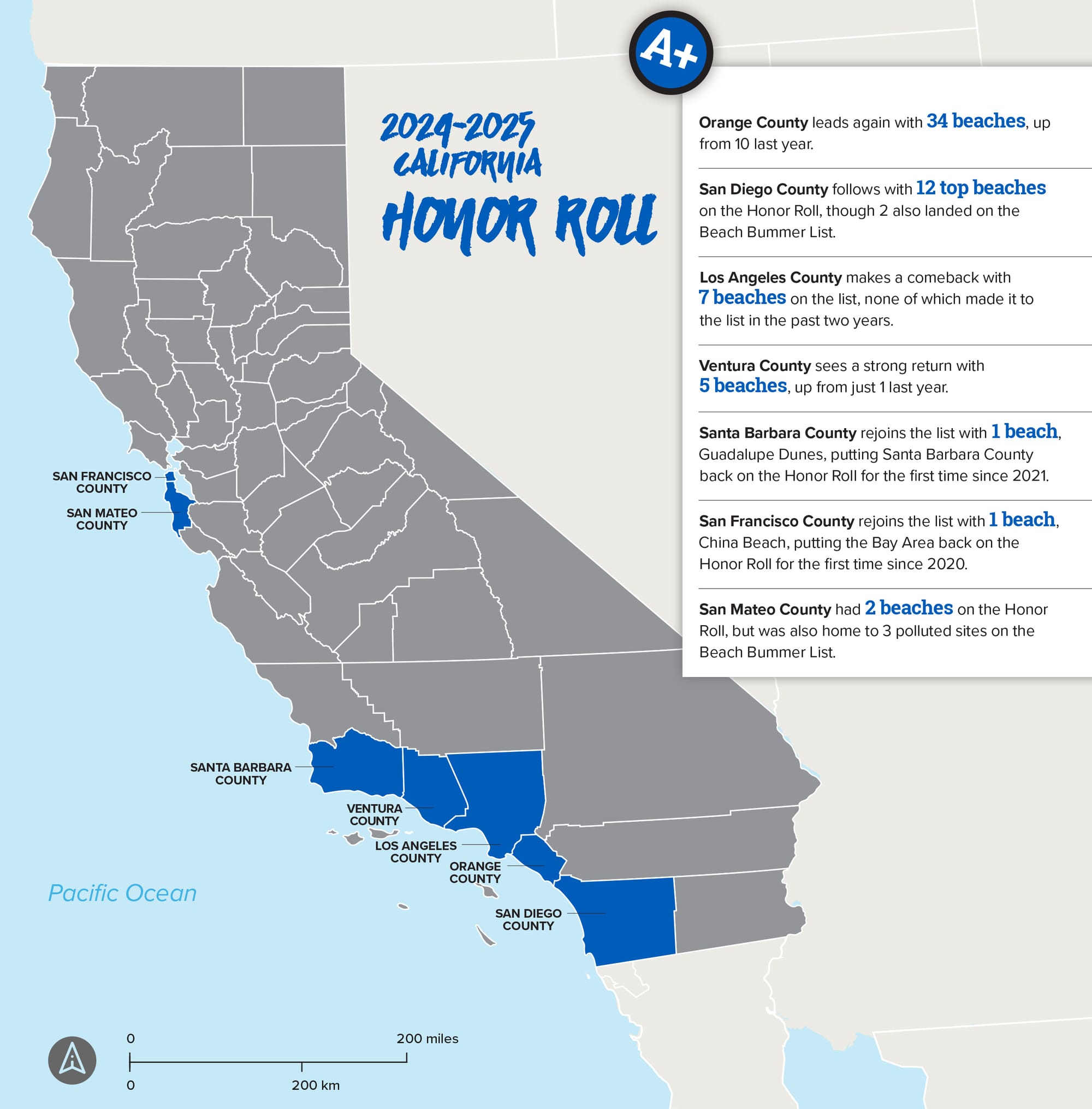
At the other end of the spectrum, 62 beaches across the state earned perfect water quality grades in 2024, a sharp increase from only 12 the year before. Orange County led the state with 34 beaches on the Honor Roll, followed by San Diego County with 12 and Los Angeles County with seven.
Heal the Bay attributed the overall improvement in part to lower rainfall totals, which reduced the volume of polluted runoff entering the ocean. Still, the Santa Monica Pier has remained stubbornly resistant to improvement, with little year-over-year progress.
Maurice said Heal the Bay has been in conversations with the city about forming a new task force to review past efforts and analyze available data, but those plans have yet to materialize. “We’re hoping that they take the lead on that and really make sure it gets done,” she said. “We’re all working toward the same goal. We all want people to be safe when they’re entering the water.”
But with major events like the 2026 FIFA World Cup and 2028 Summer Olympics set to bring global attention to the region, she said Santa Monica could be doing more.
“This should be a priority,” Maurice said. “I know the city has done some good work, but clearly what’s been done so far isn’t working. We need to invest in understanding the problem so we can fix it. Otherwise we’ll be back here next year saying the same thing.”
Beachgoers are encouraged to visit beachreportcard.org to check current water quality grades and avoid swimming within 100 yards of piers or storm drains. Officials also advise staying out of the water for at least 72 hours after rainfall.
scott.snowden@smdp.com