
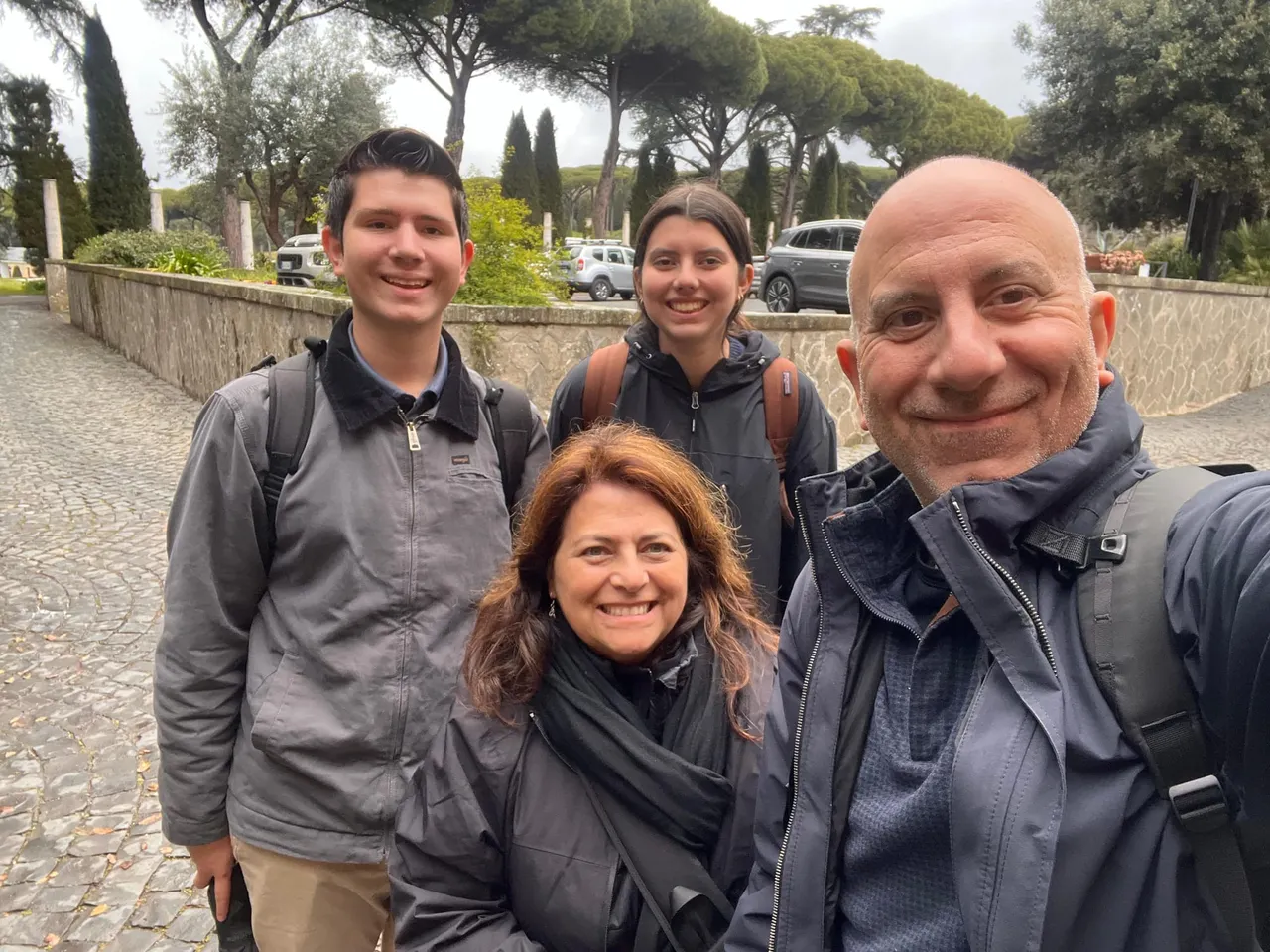
Two high school students from Santa Monica are trading their California classroom for the Pope's summer residence this week, putting their artificial intelligence skills to work on a real-world technology project at one of the Catholic Church's most historic sites.
Felix Figueroa, a senior, and Olivia Rogers, a junior at Saint Monica Preparatory, traveled to Castel Gandolfo, Italy, to help design and test a location-based tour app and improved ticketing system for Borgo Laudato Si', the Vatican's living laboratory for integral ecology housed on the roughly 135-acre papal estate about 20 miles southeast of Rome. They were accompanied by engineering teacher and STEM Academy Dean Roland Labana and Dean of Spirituality and Faith Formation Suzette Sornborger.
The timing carries its own symbolism. The trip coincides with Holy Week, and with Pope Leo XIV's customary Tuesday visits to the grounds.
For Rogers, the experience delivered something no classroom project could fully replicate.
"One of my goals was to get insight into what onsite testing is like in a professional software development setting," she said. "I definitely achieved this goal through our many iterations of testing, reviewing, and making improvements to the app."
The tour app, designed with offline functionality in mind, uses location-based triggers to deliver information, images, audio, and an AI-powered chat feature as visitors walk through the estate's gardens, buildings, and grounds. Offline capability was a non-negotiable design requirement, Labana said, because internet connectivity across the historic property is inconsistent.
"We designed the app to deliver the exact same high-quality experience whether visitors are connected or completely offline," Labana said. "No one should miss out on this special tour just because of connectivity issues."
The project traces back to an October 2025 pilgrimage to Rome with a delegation from the Archdiocese of Los Angeles. During the trip, Labana struck up a conversation with Father Manuel Dorantes — known as Father Manny — the administrative and management director of the Laudato Si' Center for Higher Education and the general manager of Borgo Laudato Si'. The two men discovered a shared connection: both had attended the Kellogg Graduate School of Management at Northwestern University. From that conversation, a professional collaboration was born.
Borgo Laudato Si' itself is a Vatican initiative inspired by Pope Francis's 2015 encyclical Laudato Si', which called for care of the environment and human dignity. The site, officially inaugurated by Pope Leo XIV on Sept. 5, 2025, features productive farmland, orchards, and vineyards, producing olive oil, honey, and dairy, while offering hands-on activities in organic gardening and demonstrating zero-waste and ecological sustainability practices. It is designed as an inclusive space welcoming visitors, students, and marginalized communities including migrants and refugees.
For Sornborger, accompanying the students deepened the meaning of both the place and the project.
"This journey was never merely a trip," she said. "It was, in the truest sense, belief expressed with the body, spirit, and the mind — the integration of an app to help engage people to see God's beauty."
The students' selection for the trip was based on their performance in SMPREP's AI and Machine Learning course, where they had already built projects including a prayer app shared with the Archdiocese of Los Angeles, a facial recognition attendance system, and autonomous model vehicles. Labana said both students distinguished themselves not just through technical ability, but through initiative.
"They don't just complete assignments — they go further, ask thoughtful questions, and show real passion for applying technology to meaningful problems," he said.
For Figueroa, the project reframed how he thinks about a future in tech.
"In the world today, technology can be used for anything," he said. "No matter what we do, our ideals can be integrated."
Rogers echoed that message, offering it as encouragement to younger students.
"If you want to have a professional career in technology, but you still want to be able to service others in a faithful manner, it's all possible," she said. "This project should not only inform students about the capabilities in combination with all three of these fields, but also encourage them to try new things, even if they are young."
The team's goals for the week included presenting prototypes to Borgo leadership, conducting on-site testing with staff and visitors, and securing approval for a broader rollout of the finished app. Labana said a successful outcome would mean leaving Italy with usable data, clear next steps — and two students with a clearer sense of where their futures might lead.