
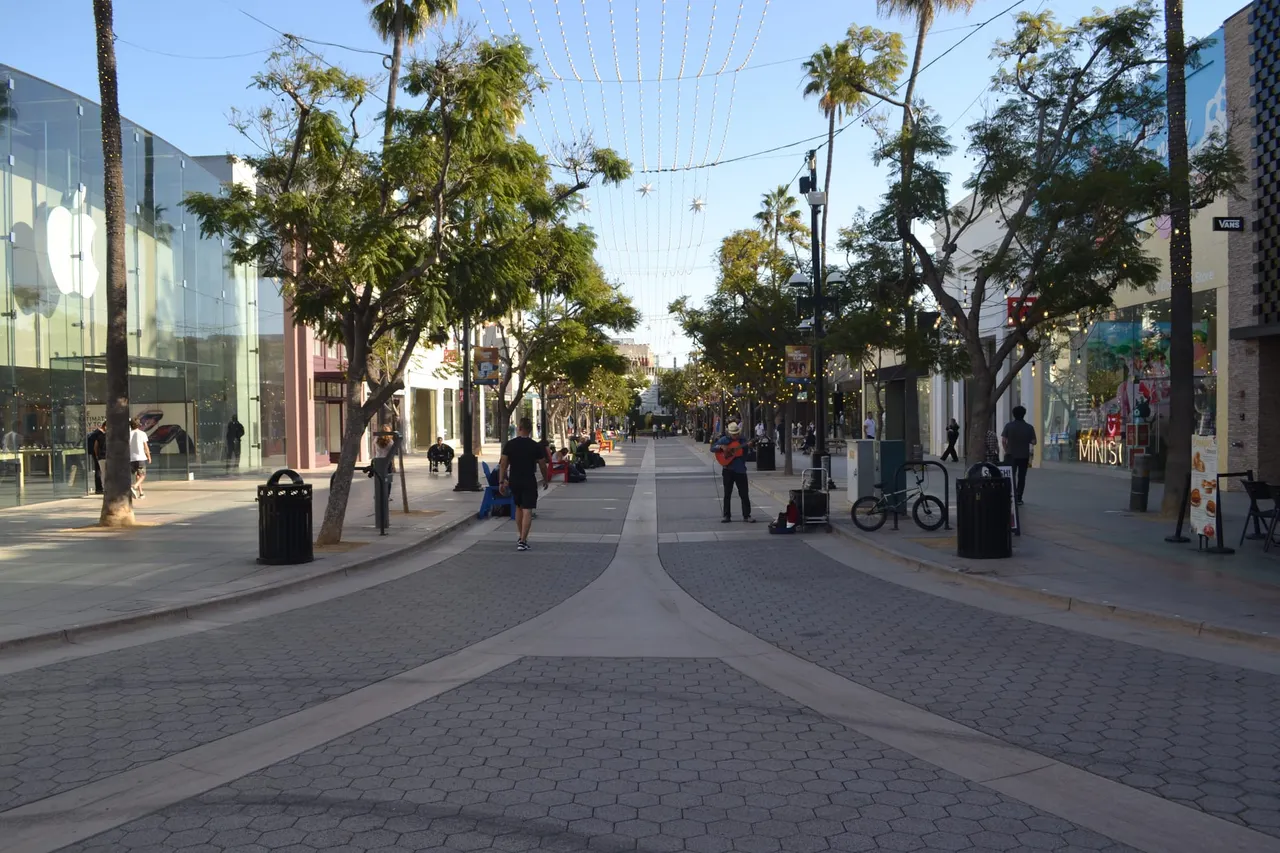
Santa Monica officials are considering an expansion of the downtown Entertainment Zone but by how much and to what effect are still very much up for debate.
The Entertainment Zone (EZ) debuted last year allowing patrons to carry alcoholic drinks purchased from approved restaurants while walking the three-block stretch between Wilshire Boulevard and Broadway. The pilot version runs Fridays through Sundays from 11 a.m. to 10 p.m. Per state law, drinks must be consumed in plastic or paper containers and patrons must be 21 or older, wearing wristbands issued by the restaurants. Beverages cannot be taken into other businesses or beyond the designated zone.
It’s been six months since the launch and so far it hasn’t led to drunken debauchery but nor has it triggered an economic renaissance.
According to the Santa Monica Police Department, there was no increase in downtown crime attributed to the EZ. They said that during the six month period, the department did not increase staffing but it did put greater emphasis on the area. The end result was an increase in officer initiated calls but a decrease in citizen initiated calls.
On the business front, the City has no data regarding sales increases. Officials said they have anecdotal evidence that sales increased at the seven participating businesses but that didn’t translate into a meaningful increase for the larger area with foot traffic actually declining year over year and an uptick in vacancy during the six months.
However, city officials said the EZ succeeded in doubling the number of visitors for Oktoberfest and tripling the number for the World Series watch party, though the Dodgers likely deserve some of the credit.
Last Thursday, the city’s economic development team shared a half-year report card with the board of Downtown Santa Monica, Inc. (DTSM) and proposed expanding the EZ a half block east and west along the avenues, in order to incorporate nearby properties that are eager to participate, especially the Westside Comedy Theater.
The EZ is authorized by an ordinance so any changes would have to be implemented via the City Council. While the possibility of event-based entertainment zones in other parts of the city were discussed, the deliberations at the DTSM meeting were centered on the downtown use of the zone.
Unsurprisingly, one of the strongest supporters for expanding was board member and former Mayor Gleam Davis, who had championed creating an EZ while on Council. “If you said, let's do it throughout all of downtown, I'd be hell, yeah,” she said.
Board member Albin Gielicz said that many neighbors and constituents had expressed enthusiasm for the EZ. “They wonder why it's not more days a week and why it's only the Promenade,” he said.
It seemed that he’d been talking to different constituents than board member Stanley Iezman, who was skeptical about the impact of alcohol on retail stores and dismayed that the city didn’t provide any sales data. “People do not come to Santa Monica to buy a beer,” he said. “They come to shop.”
The accuracy of that statement formed the crux of a much larger debate that’s been taking place on the board and within city management.
“What is the future of the Promenade?” asked Bruce Fairty, DTSM vice chair. “Is it a place to buy things or is it a place to do experiential things?” Answering his own question, he said “the days when visitors and Angelenos are going to come to buy things isn’t in the cards. People go to Century City mall these days to buy things.”
Agreeing to disagree, the board primarily deliberated security needs. DTSM staff said intervention by private security is what had prevented incidents from requiring police attention and that an expansion would need more security officers. Staff said the suggested EZ size would require six officers per activation day at an added cost of $1,600/day. For event-level staffing they recommended an additional eight officers to maintain two officers per block at $3,200/day.
Davis mocked the focus on security.
“Nobody comes to downtown Santa Monica because we're going to have a police substation,” she said. “They come because there's something fun to do, and while they’re here we want them to feel safe. But safety alone isn't going to do it.”
Many board members remained reluctant about expediting an expansion, until they were given another option: they were told they could request an ordinance expanding the EZ now and decide later if they want to implement it. They would have the option, not the obligation to extend the zone.
That appealed to the majority of them, leading them to vote for a far larger territory than initially contemplated—including everything from Fourth Street to Ocean Avenue and from Wilshire Boulevard to Colorado Avenue.
This was done on the assumption that DTSM will retain full control over the selection of the borders and operation times of the actual EZ, but that assumption may not be accurate as a revised ordinance could include requirements of the Council's choosing.
When City manager Oliver Chi was contacted for this article, he confirmed that DTSM will have “full authority to activate when/where they want” within a Council approved zone. However, if the Council desires something greater than what DTSM chooses, the Council could contract with another organization to fulfill their goals.
Seven of the 12 board members present at the meeting voted in favor of the expanded EZ. Five of the seven were appointed to DTSM last summer when the Council purged six previous directors without cause.