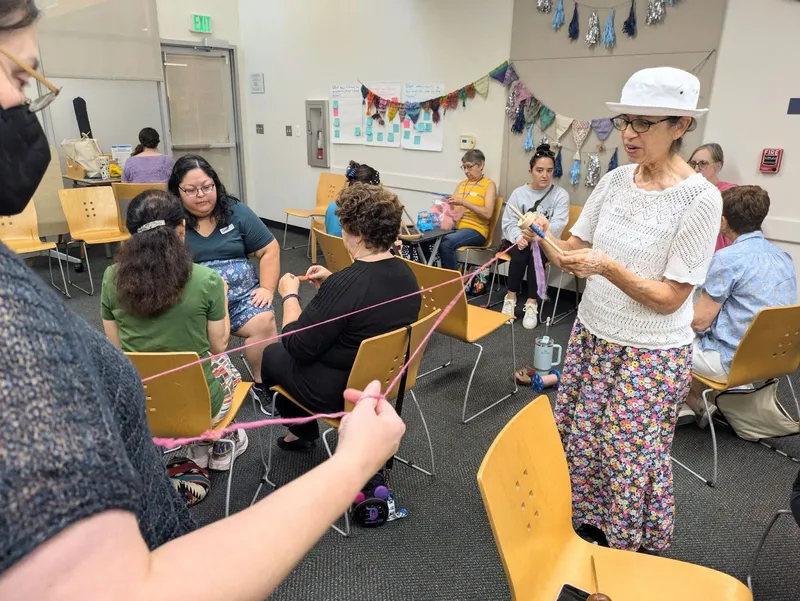
If you hear someone talking about “spinning,” they’re most likely referring to aerobic exertion on a stationary bicycle. But Sleeping Beauty wasn’t looking to improve her target heart rate when she pricked her finger on a spinning wheel. Last Saturday, the Montana Branch of the Santa Monica Public Library offered an opportunity to learn about an ancient craft when they hosted a yarn-spinning workshop, sponsored by the Greater Los Angeles Spinning Guild.
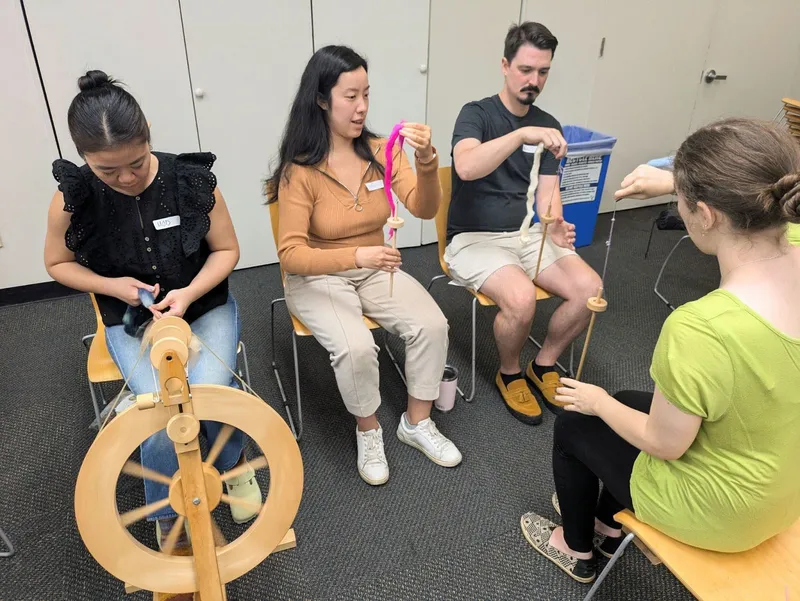
Participants at the workshop were each instructed to pick out a ball of fluffy colored wool they found appealing. They were then shown how to pull the wool through a hook at the end of a handheld wooden spindle that looked something like an elongated spinning top.
Next, they spun the spindle rapidly and repeatedly, which twisted the wool like a drawstring caught in a dryer door, if you’ve ever had the misfortune to experience that. The difference is that a drawstring needs to be untwisted to return to functionality, but the twisting of the wool is what turns the strands of fiber into yarn, quite literally “spinning” it into existence.
What seemed somewhat magical to this reporter has been a fundamental human activity for millennia. “If you were out in the field looking at your crops, women would have a spindle with them,” said Drew Hirschinger, a volunteer with the guild. “Whatever few minutes they could spare, they would spin some yarn.”
After food and shelter, clothing might be the most vital necessity for humans, and before the time of fast fashion and online shopping, every garment was created by hand with thread or yarn that was hand spun.
Shagane Basegian, who attended the workshop, said she was motivated to learn her ancestors’ traditions. “We used to know how to do these things,” she said, “because our ancestors and grandmothers would pass them on to us, but today there's knowledge attrition.”
Ms. Basegian described herself as descending from agrarian Russians and Armenians. “They were much more connected to the land,” she said. “That goes into a bigger social issue that we don't have land, and we can't grow vegetables or materials to make things with, and we have to pay for everything.”
That disconnect is part of the ethos of the spinning guild. “A lot of people don't think about how their garments are made or what goes into manufacturing their clothing,” said Stacy Renfroe, the guild’s Secretary. But she also said there was a shift taking place, with an exponential increase in the Guild’s membership since COVID.
Members “run the gamut of skills” according to Ms. Renfroe, from people brand new to spinning to those who grow their own cotton, with goals ranging from making their own clothes to a form of meditation. ”When you're sitting there, you don't have to think about the heaviness of the world,” Ms. Renfroe said. “You can distract yourself and calm yourself.”
Tasha Lam, another attendee, concurred after her first experience spinning. “I find it very therapeutic,” she said. “It's a good way for me to get off my phone and just do something present and tactile.”
The therapeutic benefit was a primary reason the library scheduled the workshop. “The guild members were interested in doing something in areas affected by the wildfires, because it's a very relaxing sort of meditative process,” said Barbara Fleeman, an adult services librarian, who said the guild had offered a similar program at the Altadena library.
Ms. Fleeman added that another benefit of the workshop was that it gave people in the community an opportunity to meet and interact with one another. If Santa Monica residents want to see more of this kind of programming, or have any other requests, Ms. Fleeman encouraged them to participate in the library’s Community Mapping Initiative survey.