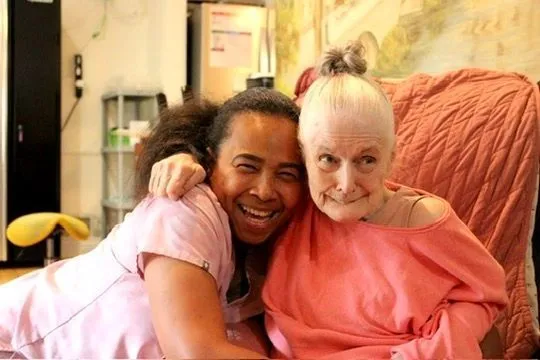
In 2025, during volunteer work at Santa Monica Home & Care, two residents with dementia and a longtime caregiver were interviewed to understand how memory loss affects daily life. Through these conversations, the goal was to learn how people can better support, respect, and humanize those whose memories are fading.
The experiences shared at Santa Monica Home & Care continually raised one central question: what does it actually feel like to live with dementia, and how should others respond when someone no longer remembers where they are, who they’re with, or even their own name? To find answers, residents experiencing dementia and those caring for them were interviewed. Their stories revealed not only the complexity of memory loss but also the moments of clarity, fear, frustration, and resilience that define their everyday lives.
The first interview was with Doris Cosman, born in 1938 in Newark, New Jersey, who has lived with dementia for several years. Doris demonstrated that dementia does not look the same in everyone; on some days she is completely lucid, while on others she struggles to recall basic details. When asked how people treat her, she said that the vast majority respond with patience and kindness, even when she has to ask the same questions repeatedly. Doris emphasized acceptance, patience, and being treated like a normal person. She explained that some days are harder than others, especially when she becomes overwhelmed and asks repeatedly for her deceased mother, but she believes that approaching dementia with understanding instead of irritation makes the experience far less isolating.
The second resident interviewed was a client who has chosen to remain anonymous. They recently moved into the facility and have lived with Alzheimer’s for several years. Before their diagnosis, they noticed early signs such as slower thinking, repeated mistakes at work, and difficulty organizing tasks—changes that ultimately led them to seek medical evaluation.
Throughout the conversation, the resident emphasized how important it is for people with dementia to be treated with basic respect, the same way anyone else would want to be treated. They also shared how meaningful simple, joyful interactions—like laughter and casual conversation—can be in helping them feel included. Their perspective echoed Doris’s: people living with dementia want dignity and genuine human connection, not pity or condescension.
According to the Alzheimer’s Association, dementia is not a single disease but a general term used to describe a decline in memory, language, and problem-solving abilities severe enough to interfere with daily life. Alzheimer’s disease is the most common cause, accounting for 60–80% of dementia cases. The National Institute on Aging notes that dementia progresses differently depending on the person, but nearly all individuals benefit from consistent routines, calm environments, and caregivers who understand how memory loss affects behavior and emotional regulation. This research supports what both Doris and the anonymous client described: dementia is both medical and deeply human, requiring compassion as much as clinical knowledge.
The final interview was with Shelly Ann Chuck, a private caregiver who has worked in gerontology for more than twenty years. Shelly challenges common assumptions about dementia, especially the widely used term “Sundowning Syndrome.” She shared that many behaviors labeled as “sundowning” are actually expressions of frustration or unmet needs, not symptoms that require medication. By observing one of her long-term clients closely, she realized that patience, attention to body language, and emotional understanding were enough to calm her without medication. Shelly believes that labeling patients as “aggressive” or “combative” often reflects a lack of understanding rather than the patient’s actual intent. Her approach aligns with guidance from the National Library of Medicine, which emphasizes that behavioral symptoms are often expressions of fear, confusion, or unmet needs—not true aggression. Shelly’s emphasis on respect over pity adds an essential dimension: caregivers must recognize that patients live in a different cognitive reality and meet them with patience rather than correction.
The interviews revealed that while dementia alters memory, it does not erase someone’s humanity. Every interaction—with a resident asking the same question five times, with someone fearing they’ve forgotten a loved one, or with a caregiver choosing patience over frustration—is an opportunity to offer dignity. Understanding dementia isn’t just important for caregivers or medical professionals; it matters for everyone. As the population ages, more people will face memory loss themselves or care for someone who does. The way society responds will define whether those living with dementia experience fear and isolation—or connection, respect, and compassion.
By Athens Teitelbaum, Crossroads High School