

House finally has a home
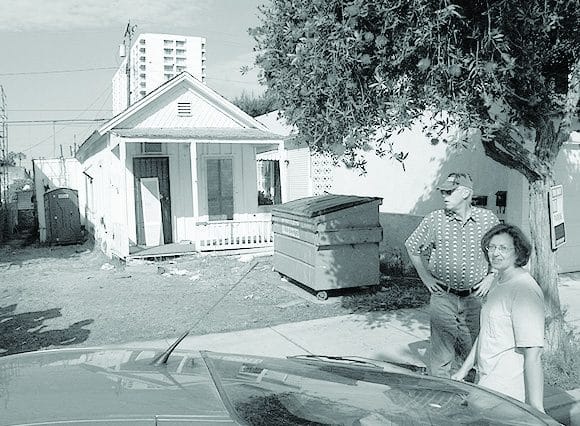
CITY HALL The last remaining intact “shotgun house” in Santa Monica was provided a caretaker Tuesday night when the City Council granted a 20-year-lease to the Santa Monica Conservancy to run a preservation resource center from the tiny and aging facility.
The non-profit is the same organization that created an offshoot committee that dedicated itself to preserving and finding a new home for the 109-year-old, white and slightly dilapidated house that sparked preservation efforts among residents in 1998, when the previous owner filed a demolition permit application. The roughly 396 square-foot shotgun house — so-called because the rooms align back-to-back so that a bullet would travel freely from the front door out the back — has been stored at various Santa Monica locales since the now-defunct Ocean Park Community Organization purchased it earlier this decade — from its original location at 2712 Second St. to the Santa Monica Airport to the former Fisher Lumberyard site, where it remains today.
The shotgun house, roughly the size of a studio apartment, will be relocated to a city-owned parking lot at the corner of Norman Place and Second Street, adjacent to the Ocean Park branch public library and two blocks from its original location. The house will face east, the same as its original orientation, and will take up about one parking spot.
Preservationists on Tuesday celebrated the near-conclusion of an eight-year-long battle to save the building.
“I sort of feel like the dog in that old Coppertone ad hanging on to that baby’s diaper,” said Sherrill Kushner, the chair of the conservancy’s Shotgun House Committee. “Yeah, I’m not letting go.”
After the City Council approved the Ocean Park lot as the permanent location in June, a request for proposals was sent to 76 non-profit organizations that receive city funding to see if any had interest in operating out of the shotgun house and taking on the responsibility of rehabilitation and maintenance. The Santa Monica Conservancy was the only one that submitted a proposal.
The conservancy is proposing to operate a preservation resource center that would teach owners of historic homes how to rehabilitate their properties, running workshops and keeping a database of specialized suppliers, architects and engineers. The conservancy would also hold some of its board meetings at the shotgun house. Tours will also be conducted from the resource center, including for the Third Street Historic District, which is located just one block away.
The cost of relocation and rehabilitation — estimated at more than $260,000 — will fall on the conservancy, which will gear for a 30-month-long fundraising campaign. City government will assume the cost for the $84,000 for site improvements. Though the resource center will be run by volunteers, Kushner estimates it will cost about the $10,000 a year to keep operations going, which the conservancy already raises through its various programs and fundraisers. The conservancy will pay an annual rent of $1.
Mario Fando Bonardi, a Santa Monica architect who serves on the Shotgun House Committee, said planting the house on Norman Place and Second Street is like adding the missing piece to the historic buildings puzzle in Ocean Park, with several city landmarks located in the vicinity, including the Ocean Park Library and the California Heritage Museum.
The shotgun house is a symbol of Ocean Park’s history, the neighborhood once cluttered with shotgun houses which have been compared to the mobile homes of today. The houses are still commonly seen in New Orleans.
CONFLICT OF INTEREST? While the conservancy was selected by a unanimous vote, the decision didn’t come easily, as several City Councilmembers debated whether there is a potential for conflict-of-interest in the conservancy’s role in advocacy.
City Councilmember Pam O’Connor said she hoped if a resident came in to the resource center with a rehabilitation proposal that the conservancy opposed, that client would still be treated fairly.
“Preservation in this town is starting to become a neighbor against neighbor (situation) and it has become very adversarial, and I would hope the Santa Monica Conservancy would take the high ground if they’re going to be operating in the next level of maturity as an organization and not take advantage of the position they’d be in,” she said.
The conservancy’s relationship as a city tenant would not enhance their status during Landmarks Commission or City Council public hearings, said City Attorney Marsha Moutrie, who added that any comments conservancy members offer would hold the same weight as the rest of the public’s.
Councilmember Ken Genser questioned why O’Connor would see it as an issue, adding that city-owned properties are leased to non-profits that take part in advocacy, including Heal the Bay, which operates the Santa Monica Pier Aquarium.
Kushner assured on Wednesday that there would be no conflict-of-interest.
“There are other non profit organizations that are similarly situated and don’t have any kind of restrictions concerning advocacy,” Kushner said. “I don’t see it as a problem.”
Originally published in the Santa Monica Daily Press print edition on December 13, 2007. Read the original PDF.