

Man wearing pig mask in fear of imprisonment HOMELESS AND ANIMAL-RIGHTS
DOWNTOWN LA — Attorneys are joining the fray over a Venice Boardwalk ordinance some contend is disturbing the free speech zone.
Attorneys associated with the American Civil Liberties Union filed a complaint on Friday in the U.S. District Court against the city of Los Angeles, alleging an updated Venice Boardwalk ordinance — in effect since March — violates the First and 14th Amendments of the U.S. Constitution, because it is too broad and subjective to enforce.
The complaint contends that Venice founder Abbot Kinney aimed to create a cultural and artistic renaissance by instilling a tradition of free speech in the community he began. This “unique history of celebrating the freedom of speech” has come into question by the enforcement of the new law and “threatens to change the character of Venice Beach forever,” the complaint claims.
For decades, the Venice Boardwalk has been a free-for-all for those who regularly use it to express themselves. But as the area has transformed into more of a flea market setting, Los Angeles City Hall clamped down on people who use the boardwalk as their storefronts. The city attorney’s office wrote an updated ordinance in October at the request of some residents and merchants.
The updated ordinance aimed to regulate the time, manner and place in which “peddling, hawking and vending” can occur on the Boardwalk. Presently, vendors and artists who sell their wares are subject to routine patrols, checking to make sure they have a permit and are not using illegal structures like canopies or tents. Expressionists also are subject to a weekly lottery, restricting when they may or may not occupy a predetermined space on the boardwalk.
Carol A. Sobel, attorney representing the plaintiffs, said the complaint filed by her office is a step to help protect the unique community of Venice. The complaint asks the city of Los Angeles to throw out the new law, a circumstance which, if successful, would affect other Boardwalk expressionists.
“The city proclaims the Boardwalk as a free-speech center, and if that’s the case, it needs to make sure it doesn’t violate its own proclamations,” Sobel said. “For years, the Boardwalk has been fine without the ordinance. Things work well without regulations and police deciding what’s art, or what’s religious.”
The complaint alleges rules of the per-mitting program are subjective and made on an individual basis by city employees. It also suggests the 154 lottery spaces available on the Boardwalk, often empty, are being bought up by nearby business owners to reduce their competition, which might unfairly take advantage of the ordinance.
Frank Mateljan, a spokesperson with the Los Angeles City Attorney’s Office, said the new law was intended to maximize the liberties of all Boardwalk groups.
“It sets up a scheme in which the various interests are balanced out and allows as much free speech as possible, while recognizing the rights of neighbors and businesses,” Mateljan said. “Our office is certainly willing to work with the Los Angeles Department of Rec. and Parks, as well as all interested parties, to address whatever problems may arise in the implementation of the plan.”
ADVOCATES SUE LOS ANGELES Plaintiffs represented in the case include a homeless advocacy group called “Food Not Bombs” and two individual permit holders, Woody Mulligan and Robert “Jingles” Newman.
FNB is an all-volunteer organization devoted to drawing attention to the lack of food for the poor in connection with U.S. war-preparation activities, as defined in the complaint. The group has provided information to passersby about the plight of homeless people, as well as providing meals and clothing to those in need on the Boardwalk for the last three years.
According to the complaint, FNB was denied a permit to be on the Boardwalk on March 11 because only individuals, and not organizations, may be granted permits under the program. The complaint said that requirement is neither “practical nor possible” since no one volunteer is in charge of FNB’s Boardwalk activities and that the particular permit holder can’t always be on hand to represent the organization whenever the permit is to be in use.
Sobel also is representing FNB in a Santa Monica case challenging a law that requires the group to obtain a permit to provide food to homeless individuals in public areas, such as parks. Sobel said she made her arguments for that case in February and is waiting for a decision from the Ninth Circuit Court of Appeals.
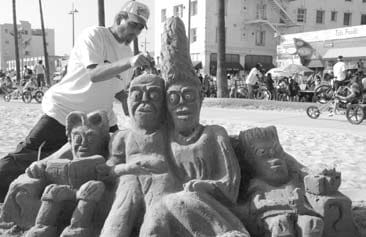
Mulligan is an artist who makes sculptures out of wood, beads, plastics, photographs and paintings, and whose pieces often replicate the shape of miniature “altars” to religious, mythological and cultural figures, the complaint said. Mulligan allegedly has been warned to stop selling some of his work because it has been deemed “offensive” and “commercial.” Mulligan was allegedly told to display his altars with religious figures, but not those depicting pop-culture icons.
The complaint said Mulligan was told his work is not art, but if he painted a Latin cross on his work, it would “make his (work) compliant.” Mulligan wants to “engage in expressive activity that is in compliant with the regulations,” but he does not understand how Los Angeles City Hall has defined the terms “art” or “commercial,” the complaint said.
Newman is a political activist who has been protesting the mistreatment of animals and police brutality on the Boardwalk since 1974, oftentimes wearing a pig mask to “take on the character of the animals on whose behalf he advocates,” the complaint said.
Newman was prosecuted for soliciting donations on the Boardwalk after a young girl gave him a few dollars for some flyers he had given her earlier in the day, the complaint said. When he returned to the Boardwalk a few weeks later, Newman changed the manner of his protest. He wears his pig mask and costume, and pulls a small cart with his flyers mounted on it. He wears a sign on his back that says “donations greatly appreciated.”
The misdemeanor was reduced to an infraction and subsequently dropped, but Newman “fears engaging in free speech activities” after receiving the violation and “being threatened with imprisonment and a large fine,” the complaint said.
Originally published in the Santa Monica Daily Press print edition on July 12, 2005. Read the original PDF.