

Non-profit organization to show rare, unusual films and turns.
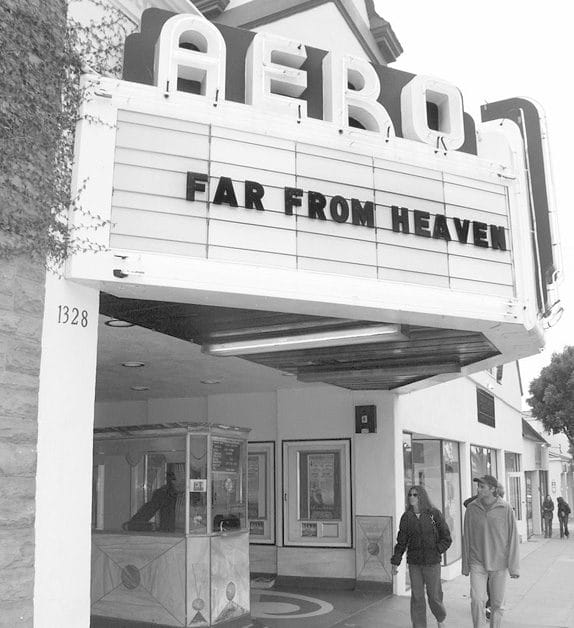
After years of searching, landlord James Rosenfeld has found a film operator that he hopes will keep the Aero Theatre’s 65-year-old tradition alive.
Rosenfeld recently secured a 10-year lease earlier this month with American Cinematheque, a non-profit organization that plans to hold its first screening at the end of the summer. American Cinematheque will take over the Aero on April 14 and spend a few months renovating the Montana Avenue theater.
“I’ve been working for as long as I’ve owned the building to secure a tenant that could renovate the theater and operate it,” Rosenfeld said. “It was obvious that they have a great amount of experience.”
The American Cinematheque recently restored the historic 1922 Egyptian Theatre in Hollywood and many of the films shown there will make it to Santa Monica.
“We have a different concept... it’s about attracting an audience who want to see things that are different and are rare,” said Barbara Smith, American Cinematheque director. “There will be something different every night.”
Cinematheque presents a diverse, year-round film series at the Egyptian Theatre featuring rare, unusual films and videos from around the world, Smith said.
By expanding its operation in Santa Monica, American Cinematheque hopes to broaden its audience by offering one-of-a-kind films.
“People on the westside don’t necessarily get to Hollywood with all the traffic,” Smith said. “Now we can show them films that you’ll never see again in your lifetime.”
The theater’s old seats will be replaced with larger, more luxurious seats and the interior of the theater will be renovated. The symbolic marquee on the street, located at Euclid and Montana avenues, will remain intact, as will the theater’s art deco interior.
Like any well-plotted drama, the recent history of the Aero is filled with twists and turns.
In May 2000, a representative of Robert Redford announced to the Santa Monica City Council that the actor/director had plans to buy the theater and restore it as part of a planned chain of independent movie houses. Redford frequented the cinema when he was a young boy.
Theater fans were relieved the Aero, located on a street that is fast becoming the Rodeo Drive of Santa Monica, had been saved from conversion to a clothing store. But Redford’s plan later unraveled because of financial problems.
Rosenfeld then began his search once again to find the right operator for his theater. He approached American Cinematheque in 1998 after visiting the Egyptian. But it wasn’t until the end of 2001 that discussions between the two parties became serious.
“We weren’t looking for another theater,” Smith said. “But it seemed like it fit with us. It’s a wonderful theater and seems to have enormous support in the community.”
Last year Allen ran into financial problems and fell behind on the $10,000-a-month rent. The community rallied behind the Aero at several fundraisers that Allen held to keep the theater going.
The Aero currently shows second-run blockbusters fans might have missed at big-name multiplexes, or independent films. But with only five or six people arriving for most showings, the theater’s future was constantly at risk.
Single-screen movie houses have become a dying breed over the years. It’s gotten increasingly difficult to find an operator that has access to and can afford films that aren’t mainstream, Rosenfeld said.
“In the world of exhibitors, I didn’t have my pick,” he said, adding that even Steven Spielberg was interested in taking over the Aero but the financial realities were even too risky for him. “It’s fine to be interested in saving the Aero but no one wants to lose money.”
Generating a profit isn’t a concern for American Cinematheque because it’s a non-profit arts organization that is funded through donations and grants, Smith said.
When residents learned last year that Allen was having financial difficulty, they feared the Aero would be replaced with a retail shop that can afford the high rent along Montana Avenue.
“The greatest problem and advantage for the Aero is that it’s on Montana,” Rosenfeld said. “There is a lot of economic pressure for it be a higher and better use.”
Rosenfeld admits if he hadn’t found a theater operator soon, the Aero could have succumbed to the simple reality of economics.
Rosenfeld, who lives and works in the Montana Avenue neighborhood said he’s relieved that he was able to save one of the last single-screen theaters left in the area.
“There is nothing sadder than to see those marquees saying ‘Gap shirts $7’ or ‘William Sonoma blenders for $39.99,’’’ he said. “I care about this neighborhood and this feels great.”
Although he wouldn’t say how much American Cinematheque will pay in rent for the 6,000-square-foot theater, it’s lower than the average $6 to $7 a square foot price most properties along Montana Avenue currently pay.
“The rent is far, far, far lower than what market rent is on Montana,” Rosenfeld said. “There’s more to life than maximizing every business deal I get into.
“I think this is good for the street and it’s good for the community. It’s going to be a special movie going experience.”
Originally published in the Santa Monica Daily Press print edition on March 24, 2003. Read the original PDF.