

COMMUNITY PROFILES
By LESLIE ANNE JONES Special to the Daily Press
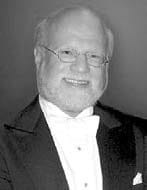
The Santa Monica symphonic strings players know conductor Allen Gross means business when he ascends his makeshift podium in the Grant Elementary School Auditorium.
With a wordless downbeat, the musicians jump into action. Gross directs the other symphonic parts with falsetto vigor, his expression corresponding with the musical phrases. After a few bars, Gross stops and says, “You sound like a professional chamber orchestra.”
The Santa Monica Symphony is in its 14th year under Gross’ direction. Gross was picked from a pool of 140 applicants during a two-year search for a conductor for the symphony. The investment seems to have paid off — the Santa Monica Symphony enjoys regular audiences of 1,200 to 1,500, sometimes soaring to 3,000 and regularly packing the Santa Monica Civic Auditorium.
The symphony is celebrating its 60th anniversary this year. Throughout the history of the symphony in Santa Monica, the ensemble has always kept the community in mind and never charged for admission, which makes it unique among symphonies, professional or otherwise.
Gross’ talent manifests in the Santa Monica Symphony’s accomplishments. One of the most unique attributes of the symphony is the way that volunteer musicians play alongside some of the foremost professional musicians in LA, which enables Gross to maintain a professional sound quality with his mix of paid and unpaid musicians.
By the time Gross was in high school, he knew that he wanted to be a conductor. Part of his conducting aspirations stemmed from an avid interest in composers, alive and dead, he said. Born and raised in New York, Gross completed his undergraduate work at Queens College, before going on to receive his master’s degree in music history from UC Berkeley, and his doctoral master of arts in conducting from Stanford. Gross was trained in piano and cello in his youth, but he found his true talent to be rendering the creative output of others.
A short while after graduating from Queens College, Gross met his wife. They have been married for 35 years and have two adult children: A son in graduate school studying social work, and a daughter who works for the Oxford Press and writes children’s books.
Gross is now a resident of Pasadena and keeps himself busy. Beyond conducting the Santa Monica Symphony, Gross teaches music classes at Occidental College and conducts the Occidental-CalTech symphony. When he isn’t conducting adults, Gross is directing rising musicians in youth ensembles such as the Pasadena Young Musicians Orchestra and the Pasadena Summer Youth Chamber Orchestra.
On Wednesday evenings the string section of the Santa Monica symphony rehearses, usually eight to 10 times before each performance. When a concert draws near, they are joined by the woodwinds. The full symphony practices two rehearsals before the actual concert; professional symphonies have four full rehearsals before concerts.
“When we add our professionals — and our professionals come knowing that the level of the orchestra is already high — they make it a point of pride that they need to be prepared as well,” Gross said.
This coming Sunday the symphony will be performing Weber’s “Oberon” overture, the Mozart Concertante for winds, and Shostakovich’s Symphony No. 5. Gross shared his excitement for the upcoming performance, as well as some of the details of his musical career, with the Daily Press before last Wednesday’s rehearsal.
When did your interest in conducting develop?
“I was already interested in it (conducting) in high school. Why? Good question... I felt that as a pianist, my potential was perhaps a little more limited, but I did have some skills at rendering other people’s work.”
Did you ever have any non-music-related jobs?
“I met my wife in New York, and it was between graduate school, we were both actually working for the New York City welfare department, in between schools I was trying to decide what I really wanted to do, and at that time anybody with a bachelor’s degree in any field could either get a temporary teaching license in New York, or get a job working as a case worker for the New York City welfare department, called the department of social services by that time. And that’s what I did, because I figured I could leave the job there at the office. So that’s what I did for a year and a half.”
How was that? “It was very interesting. By the time I left, I was working with drug addicts actually. It was a very interesting situation, in any case that’s where I was. After that we went to Europe, and I started conducting and doing opera coaching in Germany until 1978. Among the things I did was music director of the Heidelberg castle festival.”
Why did you decide to come back to the states?
“By 1978, I was having second thoughts about staying there, and being interested in teaching as well, I started looking for positions back in the United States, so I got a position at the University of Louisville School of Music directing the orchestra and the opera program.”
Did you originally consider staying in Europe?
“Not sure, I think it was seeing how things would go. The kind of work I was doing was a very old-fashioned and traditional way of learning the craft of conducting. Studying in an opera house, coaching singers, playing, stage rehearsal and getting to conduct a couple of performances every now and then, of no notice whatsoever. That’s the way people used to learn conducting, and still do to some extent today. But we didn’t know how long we were going stay there, the kids were born, and we decided it’s time to come back.”
What’s your favorite thing about conducting?
“One is bringing in front of an audience wonderful music, great music, good music. And the other is working with musicians, and we’re very fortunate in the Santa Monica Symphony that we’re a very unique animal right now, in that we have very skilled and accomplished volunteer musicians who play alongside the best professionals in LA. And it’s no mean accomplishment — they bring a dedication and a verve to their music making that’s greatly rewarded.”
Do you have a least favorite thing about conducting?
“Probably the least favorite thing about conducting has to be having to deal with financial constraints, let’s put it that way. Although again, we’re fairly fortunate with the Santa Monica Symphony because of the mixture of volunteer musicians and professionals. We’re able to program most of what I’d like to do.”
What kind of musical background do most of your volunteer musicians have?
“Of the volunteer musicians, some of them actually have music degrees, others went through school learning how to play, or knowing how to play and playing in orchestras, and have kept up that level while they do other things.”
What distinguishes Santa Monica Symphony from other ensembles you’ve worked with?
“Well I think the thing is having terrific musicians that are giving their time on a volunteer basis and their being able to sit next to the best professionals in LA. My goal as music director is that I believe that the volunteer players can in fact play next to the best players in LA and do well. They just need more rehearsal since they don’t do it every day, well maybe they do — I hope they do — but they don’t earn a living through music every day. So that’s the most unique thing, I think.”
What are your upcoming plans for the symphony?
“Well, we’re finishing the season with... Beethoven’s Ninth Symphony. This coming concert we’re doing a wonderful program with the Shostakovich and the Mozart Concertante which is very interesting because as you may know, I also conduct the Occidental-CalTech Symphony and this weekend we’re doing the more well-known Mozart Concertante — the one for violin and viola and the following week the one for winds here. And that’s kind of nice to be able to do both of them very close together. They’re both wonderful pieces. We’re just formulating plans for next season, we haven’t got that far yet though.”
What do you do the night of a concert before you get on stage?
“The day of a concert is pretty demanding for us all because the only time we get inside Santa Monica Civic is the morning of the concert for dress rehearsal. And that goes until 1 p.m., and then 7:30 p.m. is the downbeat for the performance. So by the time I get back to Pasadena and get back here, I don’t have a lot of time. I tend to take a nap, or just relax. And then just get here about 45 minutes before just to review the scores and review pitfalls, and things I have to pay special attention to.”
What are your thoughts on the role of the symphony in the community?
“I think we provide something very, very important and something that has become increasingly rare, and increasingly difficult to maintain, mainly free concerts of the highest quality. This is something that the symphony has been able to do for 60 years. I hope it will be able to continue to do so because I think for families to attend symphonic concerts is increasingly more expensive or impossible, especially for the under-served population, which we increasingly try to reach from the symphony. And you know, we’ve got to have younger people in the audience to have an audience in the future, and I think the free concert, the idea of free concerts that we give is a very, very important one. I think we have a very important contribution to the Santa Monica community.”
What’s your favorite thing about Santa Monica?
“The symphony!... It’s a wonderful city and a wonderful community and a lot of people are passionately devoted to civic issues. One of the things that appealed to me about Santa Monica is the commitment of a lot of Santa Monica people to art culture and the accessibility of art. And that’s why I think it’s very important giving the free concerts. Again, I hope we will be able to continue it, as it becomes increasingly more difficult to do so, because we have to raise money and there is a common misperception, especially today, if you don’t pay for it — it ain’t worth much. So it’s a problem. It’s an image problem. People come to the symphony and they’re just amazed, they say, ‘Wow this is a free concert, I hadn’t realized the symphony was so good.’ So hopefully we’ll have more of those, and more of those people who will want to give money to maintain the symphony.”
How many people are in the symphony? “When we performed the Mahler Fifth Symphony last year we had 100 people on stage, including me.”
What about for this upcoming performance?
“Probably about 80 or 85.”
How many people are going to be on stage for the Beethoven’s Ninth season finale? “200 to 250 for the chorus, and the orchestra should number around 75, and four soloists of course.”
What’s your favorite piece of music to conduct?
“I would say that my favorite piece of music to conduct is what I’m doing at the present, I think that’s probably so. I don’t keep lists anymore of a favorite piece. I used to think that Beethoven’s Missa Solemnis was the greatest piece of music ever written, a piece of music I’ve never conducted actually. I could just say I think that, for me, Beethoven is the core and center of the essential repertoire probably, the composer I most love dealing with.”
What are you listening to right now? “Quite a number of things. I’m listening to a number of pieces I don’t want to name right now for consideration of next year. And let’s see what else am I listening to... a number of interesting groups, a young woodwinds group from New York that is producing some very interesting stuff. And various, different century things.”
What was your favorite event in Santa Monica this year?
“Probably our second concert, the last one we did in December, when we had a joint concert with the Crossroads Chamber Orchestra. And there was terrific interaction there on another level between enormously talented kids, and community players and the professionals. We had a large orchestra of course, and the enthusiasm and the level of playing, and the back and forth vibe was terrific during that concert.”
How do you feel about the upcoming concert?
“It’s going to be very good, first of all. The orchestra has played Shostakovich’s Fifth before. This was actually 10 years ago, and it’s interesting to see how much further we are as an orchestra, doing this again, even though many people weren’t in the orchestra 10 years ago. The Shostakovich Fifth Symphony is probably one of the most important and most compelling 20th century symphonies. It’s something that’s very dear to all of our hearts, here in the symphony, so it should be very good... The symphonic Concertante for winds features four of our principle woodwind players. And these are people who play in the top orchestras in LA. They have to be, playing in the Santa Monica Symphony as well, and they all know each other, they all love each other, they’re all individually fabulous musicians and ensemble players, so we should all have a blast doing this.”
How does the symphony reach the community?
“Well, I think part of the problem with a low-budget orchestra, of which we are one, and I think the money — most of the money, a great portion of the money is used to produce the concert. That’s the symphony’s main focus,. The downside is that we don’t have a lot of staff or money for publicity or things like that. We’re fortunate to have a terrific publicist, but it’s very hard to spend advertising dollars when we have to do other things, so that’s something that we try and do, and we’ve been trying to publicize the concert, for instance, in the south of Pico area. We try and link up with other organizations to do that, as well as, you know, we rehearse in Grant Elementary School, and I hold open rehearsals a couple times a year for the parents and the kids. I talk beforehand to give them a bit of an idea of what they’re going to hear, to try and develop more and bigger audiences, in terms of raising money, that’s something the board of directors is very concerned with.”
What surprised you most about working with this group? “... Probably the willingness and responsiveness, the way people have been able to grow musically over the years, shall we say, it’s usually difficult for people post-college, especially if they’re nonprofessional, to keep growing musically and technically, and what is interesting is the symphony orchestra has gotten better, the people who have been in the orchestra for six years or more have gotten better as players and as a result, the entire orchestra is a lot better. I wouldn’t say, surprised, I’d sort of hoped that would be the case, but I think it’s the ability of the players to really respond and grow musically.”
Originally published in the Santa Monica Daily Press print edition on March 7, 2005. Read the original PDF.