

An emotional rescue for artist, students alike
By DANIELE HAMAMDJIAN Special to the Daily Press
SUNSET PARK — When photography student Alfred Benjamin fearfully stood in front of Adolf Hitler in 1934, he never could have pictured himself sharing that experience with dozens of Southern California high school students more than a half-century later.
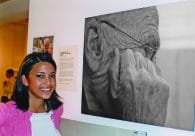
Benjamin, an 88-year-old painter and Holocaust survivor, concluded a series of intimate sessions with students from the Los Angeles County High School for the Arts this week at his Santa Monica home. As Benjamin described his experiences as a young man, the students interpreted his tales by creating images through different art forms.
“I let things come to mind as I never thought before,” said Benjamin, who has lived in Santa Monica for the past 32 years.
Since February, Benjamin has been working with visual arts students as part of a project initiated by the Los Angeles Museum of the Holocaust. The “Annenberg” project invites Holocaust survivors to share their remarkable stories with students, who in turn draw from the survivors’ experiences to create innovative artwork. The program was introduced last October by museum director Rachel Jagoda, in cooperation with the Annenberg Foundation.
Benjamin’s work dates back to the mid- 1930s when he was an apprentice photographer for a portrait studio in his home-town of Hamburg, Germany. Among the bevy of paintings, collages and photographs Benjamin has stored in his house, is a photograph of Hitler speaking to a crowd. He described the dictator as extremely stern while he, mixed in amongst the crowd, was paralyzed with fear.
“When you’re that scared, you build an immune system,” explained the father of two. Shortly after, Benjamin left Germany for London, where he studied photography and met Selma, his wife of 64 years.
For the past four months, Benjamin has been busy transforming his darker days into illuminating and powerful artwork.
As the sessions with students progressed, the experience proved to be mutually beneficial for both the students and himself, strengthening their bond. Benjamin said his artwork has metamorphosed since he began the project. Disturbing emotions that had remained dormant for almost 70 years have resurfaced in the form of art.
Ten years ago, when Benjamin began creating the series of Holocaust collages a door opened for him, and the memories and emotions came rushing through.
Students have not only used their discussions as artistic material, but also have come forward sharing tragedies of their own. The teenagers told stories of their parents leaving the family, and unexpected deaths of friends.
Gianina Ferreyra, a 16-year-old sophomore, got involved in the project because she wanted a closer encounter with the past.
“I wanted to visualize history,” she said. Only a few of the selected students are Jewish. Ferreyra said that even though she wasn’t Jewish, any human being could appreciate the experience of working with Benjamin.
“I don’t just see and click anymore,” said aspiring photographer Samantha Ollstein. The 17-year-old now searches for the meaning behind every picture she takes.
Professor Gerardo Stawsky, manager of education at the Museum of the Holocaust, approached Benjamin with the idea and has been in close contact with him ever since.
“Through this experience, the students have become the victims because of the bond,” Stawsky said.
Stawsky, of Uruguayan origin, is working with educators in Sacramento in hopes of expanding the program into juvenile detention centers. He believes the program fosters tolerance, which is what those types of institutions strive for.
The students’ works are to be shown at different venues including Disney Hall, the Los Angeles Museum of the Holocaust, California State University at Los Angels and participating high schools. The Santa Monica Museum of Art will hopefully be an addition to the list, Stawsky said.
Benjamin was director of the audio visual department at Los Angeles Orthopaedic Hospital for 25 years, creating a photographically-based process of detecting cancerous cells by screening blood and plasma cells. Learn more about Benjamin’s life in Monday’s community profile in the Santa Monica Daily Press.
Originally published in the Santa Monica Daily Press print edition on June 5, 2004. Read the original PDF.