

Lawyer faults police for not conducting live lineup
It was three weeks after being freed from county jail before Olympian Danny Harris let himself cry over what he had endured while wrongly imprisoned.
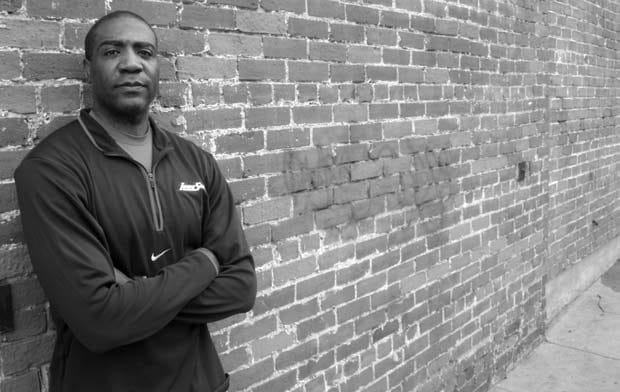
Harris, 39, a tall and muscular track star, was beaten, tied up and sexually abused by fellow inmates during two months in custody for a pair of Santa Monica kidnap-pings that DNA evidence later linked to a different man.
“Today is the first time I’ve cried since I got out of jail,” Harris said during an interview last week at an Ocean Park diner.
“I don’t feel comfortable talking about it, because it’s really hard,” he said. “I never should have been there. It’s been really hard to get back to some normalcy, because my life is not normal anymore. My life is not the same anymore.”
The series of events that landed Harris in custody has left him angry at police and prosecutors, confused over how the system repeatedly failed him and feeling powerless as he attempts to reassemble the pieces of his fractured life.
The ordeal started this past November, after a 75-year-old Santa Monica woman was kidnapped for the second time in two weeks. The kidnapper, armed with a syringe and screwdriver, removed the victim from her Sunset Park home and demanded money, while threatening to kill her and burn down her house.
The kidnapper dropped a black cap as he was chased away from the scene at gunpoint by a neighbor. Another eyewitness down the street saw the kidnapper shed a shirt as he fled the scene. Bloodhounds following the scent of both items ended up at a rehabilitation center for chemical dependency near the intersection of Pico and Lincoln boulevards, where Harris was living.
Armed with a sketch of the kidnapper, police questioned residents of the facility and eventually were led to Harris, a recovering cocaine addict with nearly a year of sobriety. Investigators then assembled what is called a “six pack,” or a photo lineup. The victim identified three people as possibly the man who had kidnapped her: Harris, along with two other men randomly included in the lineup.
Based on that evidence, a judge issued an arrest warrant, and Harris was taken into custody. Prosecutors levied seven felony charges against Harris, who faced a maximum sentence of life, plus 16 years.
“It was a nightmare,” Harris said. “I literally woke up at Santa Monica Jail and pinched myself because I thought it was a dream — but it wasn’t.”
VEERING OFF COURSE Harris is the youngest of six children. He was raised in Compton and moved to Perris, Calif., to live with his grandmother at age 14 after his mother died from congestive heart failure. His father died of a brain aneurysm when Harris was 3.
A standout track star who set state and national records, Harris earned a scholarship to Iowa State, where he played defensive back for the football team and continued to compete on the track. In 1984, at age 18, Harris competed in the Olympics against track greats Carl Lewis and Edwin Moses. He captured the silver medal in the 400-meter hurdles finals.
Harris continued to run and play football, but in 1988 he tore a hamstring a week before the Olympic trials. He missed making the team by just 16/100 of a second. Shortly afterward, he tried free-basing cocaine for the first time.
“When I didn’t make the team in ’88, that was a crushing blow for me,” said Harris, who earlier that year had been offered a position with the Los Angeles Rams that he declined because the pay was less than what he received through corporate track endorsements.
Though he developed a cocaine addiction quickly, Harris continued competing and held on to his lucrative sponsorships. In 1992, he was poised for another Olympic appearance. Then his addiction started taking its toll: Harris tested positive for cocaine and was disqualified from the Olympics.
He struggled on and off with his addiction, but, after failing a second test in 1996, Harris was banned for life from competing in the Olympics.
After working four years as an insurance adjuster and personal trainer in Des Moines, Iowa, Harris moved back to California in 2000 and began work as a track coach at Perris High School.
He fell off the wagon again and spent a year from 2002 to 2003 essentially homeless in Long Beach, often sleeping on the unemployment office’s steps, using cocaine as often as possible, alienating himself from relatives.
Harris contends he never resorted to crime while homeless. He said he worked the occasional odd job, mostly living off of unemployment checks and royalties from training videos he produced in 2000. When he finally ventured north to stay with family, though, Harris took a ring from one of his sisters so he could sell it to buy cocaine. She responded with what substance-abuse counselors call “tough love.”
“Instead of giving me a slap on the wrist, she called the cops,” Harris said. “I underestimated how much she loves me. In hindsight, she did me a favor.”
SOBER IN SANTA MONICA A judge in January of 2004 ordered Harris to complete a rehabilitation program. Harris spent four months at the Salvation Army and three months at a small facility in the Santa Monica Mountains before ending up at the CLARE Foundation in Santa Monica, where he had lived for several months before his arrest.
Harris already had completed his obligation to the courts, but stayed at CLARE voluntarily, and was paying rent while working full-time at Better Body Maker on Santa Monica Boulevard, where he was a personal trainer earning $80 an hour.
Then came the arrest. Police stopped Harris before dawn on Nov. 10 as he was preparing to ride his bike to work. He was handcuffed and taken to jail.
“A plain-clothes car rolled up on me, and I thought I was going to get shot at first,” said Harris, who said more than 10 patrol cars were on scene for the arrest. “I thought, ‘What is this all about?’ and they wouldn’t tell me.”
Knowing he had done no wrong and not realizing he was embarking on a two-month struggle with the criminal court system, Harris said he cooperated with detectives. Detectives spoke with Harris for several hours that day and took a saliva swab from him, knowing DNA might be recovered from the kidnapper’s hat and shirt, according to Santa Monica Police Department Lt. Ray Cooper.
When the DNA tests returned several weeks later, in early December, Harris and his public defender thought they had a clear victory. The hat and shirt both contained the DNA of Alonzo Taylor, a three-strike criminal who had been arrested in East Los Angeles shortly after the second kidnap-ping for allegedly trying to steal a car.
Taylor had a history of burglary arrests. In 1991, he was sentenced to three years and four months in prison for first-degree burglary. In 1994, he was sentenced to 12 years for the same offense, according to records from the California Department of Corrections.
What’s more, Taylor in an earlier burglary had used a syringe as his weapon, as was done in the Santa Monica kidnap-pings, according to Matt Huey, the public defender who represented Harris.
The two men also share similar physical characteristics, which lawyers suggested might explain why Harris was identified in the photographic lineup. Taylor stands at 6 feet 4 inches and weighs 218 pounds. Harris is 6 feet 1 inch tall and weighs 200 pounds, Los Angeles County Sheriff’s Department records show. Both men are black.
THE FIGHT OF HIS LIFE Despite the emergence of a new suspect, prosecutors refused to drop the charges against Harris. Deputy District Attorneys Kelly Fritz and Scott Millington said that although the DNA evidence suggested Taylor was the kid-napper, he might have been conspiring with Harris.
The victim and eyewitnesses saw only one kidnapper, but that person reportedly threatened the victim by saying he had two accomplices who would burn down her house if she didn’t cooperate, prosecutors said.
What’s more, prosecutors argued, Harris could have used the kidnapper’s hat and shirt as a decoy to throw off police. At the time, they did not know whether the DNA recovered from the hat and shirt belonged to a friend or neighbor of Harris’. It was later found Taylor did not live at CLARE or know Harris.
Prosecutors also said evidence was collected from Harris’ room that linked him to the kidnappings. The evidence included a pair of white sneakers, a screwdriver and a set of commemorative coins. The victim said her attacker had threatened her with a screwdriver, had taken a set of coins and was wearing white tennis shoes.
“We have sufficient evidence” to go to trial, Fritz told the court on Dec. 8.
Huey was shocked. “I don’t know what they’re thinking,” he said at the time. “They have evidence that completely exonerates Mr. Harris, and yet they want to proceed with this.”
Huey also criticized the supporting evidence cited by prosecutors. Most people have screwdrivers, he said, adding that Harris was a personal trainer and naturally would own white sneakers. As to the coins, Huey said they belonged to one of four other people sharing Harris’ living space, adding the coin set did not match the one that was taken from the victim’s home.
“At the end of the day, there was absolutely nothing,” Huey said last week. “It’s like walking into your house and scooping up everything, and trying to connect it to a robbery. You could have money lying on your dresser, and they could say, ‘That money belongs to the victim, and this is the fruit of your robbery.’ They were coming up with whatever they could.”
Still, Los Angeles Superior Court Judge Katherine Mader refused to dismiss the case, or reduce Harris’ $1.44 million bail. She cited as her reasons the possibility that Harris might have been working as an accomplice with Taylor, and the positive eyewitness identifications. Though the victim picked three men as possibly the kidnapper from the photographic lineup, two other eyewitnesses had chosen only Harris.
Harris was shattered by the judge’s refusal. In an inmate conference area at the Airport Courthouse near LAX, he yelled at Huey out of frustration, demanding to know why the DNA evidence was not enough to set him free. Huey was outraged too, and reminded Harris he was doing all he could. It was the only time the two men sparred.
In the courtroom, two of Harris’ sisters sobbed quietly, saying they couldn’t stand to see their little brother in a jail-issued jumpsuit, hands bound.
“He didn’t do this,” said Wanda Burns, a 41-year-old nursing assistant and Harris’ older sister. “Danny was clean. He was good. Everyone was proud of him.”
The weeks behind bars wore on Harris. He would later say that when the DNA evidence didn’t exonerate him, he dropped to a new low. The court hearings continued, and his days were spent transferring from a cell downtown into a holding cell, onto a bus and into another holding cell at the Airport Courthouse. Harris would wake as early as 3 a.m. and often not return until 10 p.m.
“I just wanted to get up and scream at that point,” he said. “It was the rest of my life. I couldn’t see myself being in jail for the rest of my life for something I didn’t do. I was really depressed. There were times when I did-n’t know if I was going to make it through the day.”
As Huey prepared for a preliminary hearing, when he hoped to persuade the judge not to proceed with the case, more evidence was discovered sometime in mid December. This time it was a glove found at the scene that investigators believed belonged to the kidnapper. It was sent to the crime lab, where it underwent testing for DNA. None was recovered.
By then, nearly two months had passed. Huey had delayed calling for a live police lineup because he hoped the glove would contain Taylor’s DNA and prosecutors would drop the charges. Had he proceeded with a live lineup before then, there was too big a chance the eyewitnesses would identify Harris out of rote memory, after having identified him in the photo lineup. Now it was the only option left.
On Jan. 5, two days before the preliminary hearing was set to begin, two live police lineups were conducted at the Twin Towers county jail in downtown Los Angeles. In one, Harris stood with five other inmates. In the other, Taylor stood with five different inmates. The victim singled out Taylor.
APOLOGY FROM THE BENCH Two days later the charges were dismissed against Harris. Saying innocent people sometimes get trapped in the legal system, Judge Mader apologized to Harris.
“I know you’ve been in for a while … and I apologize on behalf of the court system for having you in for this length of time,” Judge Mader said at the Jan. 7 hearing.
Harris turned to a group of family and friends sitting in the courtroom, smiled and mouthed the words, “I’m coming home.”
Rather than blame prosecutors or police, Huey faulted the identification process used by investigators. He argued there is too much room for error in photo lineups.
“He is and always was innocent,” Huey said outside the courtroom after the charges were dropped. “It highlights the problem with the photo identification, because when these witnesses got the chance to actually see these people live, the correct person was identified and the innocent person was excluded.
“If there’s sloppiness on the part of law enforcement, that’s the sloppiness,” Huey later added. “It just highlights how dangerous photographic six packs are.”
Asked if any explanation had been offered for how the police hounds ended up at Harris’ room, Huey replied, “Not that I’m aware of — and it’s awfully hard to cross examine a dog.”
Lt. Cooper said last week the investigation into the kidnappings was ongoing and no charges had been filed against Taylor. Cooper declined to discuss the case further or provide an explanation for why Taylor had not been charged.
Santa Monica Police Chief James T. Butts Jr. defended the work done by his department, saying officers were thorough and their police work followed the book. It would have been derelict not to assemble the information and give it to a judge for an arrest warrant, said Butts, adding it would have been negligent not to then file the case with the District Attorney’s Office.
“In this case, all those levels felt it was probable cause,” Butts said. “So you can’t call this a mistake.”
ONE DAY AT A TIME Harris now rents a room in a sober-living apartment complex in Venice. He rode his mountain bike to Joe’s Diner on Main Street last week to share his story, recalling the events of the last few months over a tuna melt and a glass of lemonade.
In spending two months in custody, Harris said, “My whole life was turned upside down. My job was gone. My apartment was gone. My things were taken... I’m in the process now of putting it back together.”
Harris says he is at a loss for strength, and for patience. For help, he meets regularly with a support group for recovering addicts, and he speaks often with his sisters and his addiction sponsor. In the last 10 years, Harris said he has been sober for more than a year four different times.
This time, he wants to make it permanent. He also hopes to get therapy for the abuses he suffered in jail. Harris had never served time before the kidnap-ping arrest, except as a young man when he spent three days in a holding cell for driving 155 miles per hour in a 55 zone, police records show. The recent incarceration, however, placed Harris among some of the most violent criminals in Los Angeles. His approach of trying to stick to himself and not engage the other prisoners didn’t work.
“I was beat up, tied up and really just singled out because I’m not a gangster or a thug,” he said. “I don’t carry myself like that, and I certainly don’t talk like that. I’m just different.”
“I was beat up, tied up and really just singled out because I’m not a gangster or a thug. I don’t carry myself like that, and I certainly don’t talk like that. I’m just different.” — — DANNY HARRIS Olympic silver medalist
Harris has picked up part-time work as a personal trainer back at Better Body Maker and said he is considering filing a lawsuit — or lawsuits — for the way he was treated by the system and by the other inmates. Still, he realizes that success in a civil courtroom would only do so much for him.
Harris also realizes he must work through his anger. Had Taylor’s DNA not been in the police database, Harris thinks he still would be in custody.
“I’m not a violent person, but God, I have never been so angry in my life as I am now,” Harris said. “It’s really hard... For a person like myself, it’s a great excuse to go and get high, and that’s not something I want to do.”
Like many recovering addicts, Harris approaches life one day at a time.
“I don’t know, I don’t even look out beyond this week,” he said. “Sometimes I wake up and I feel like I could do anything. Sometimes I wake up and I feel like my legs have been cut off. I try to keep things as simple as I can and leave things right there.
“I’ve got a long way to go, put it like that,” Harris continued. “I think I’m a long way from being well from this experience — scars heal, though.”
Originally published in the Santa Monica Daily Press print edition on January 31, 2005. Read the original PDF.