

Mixed martial arts begins to take root in Santa Monica
By GERRY SHIH I Special to the Daily Press
CIVIC CENTER As recently as the early 2000s, mixed martial arts (MMA) was considered too brutal for civilized society and, consequently banned in many states. Critics argued that no one would — or should — watch unpadded kicks meeting jawbones or one man furiously pounding the other’s barely protected head while pinning him helplessly on the mat.
Fast forward to 2007, and the popularity of MMA has spread like wildfire all over America, well-heeled Santa Monica certainly being no exception. Tonight, the Total Fighting Alliance (TFA), a local organization that has dominated the MMA scene in Southern California, will host its third event in six months at downtown Civic Auditorium, and organizers are predicting a sellout.
When MMA was legalized in California two years ago, TFA immediately began producing events after becoming the first organization in California to obtain a MMA license.After the first fight was held in Carson, organizers relocated several times across the L.A. area without finding a permanent venue, that is until Santa Monica Civic hosted “Conflict on the Coast” on Feb. 24 to resounding success.
The trendy waterfront community seemed to be a good base that drew large crowds, and after another successful event in April, the Civic Auditorium was adopted as West L.A.’s home for MMA.
“It’s a classic, good looking place,” said TFA organizer Richard Rasmussen. “The people there, and the size of the auditorium just fit with our needs.”
As of Friday, organizers for tonight’s cage fight at Santa Monica Civic had sold more than 2,000 seats inside the 2,042-capacity arena, according to Rasmussen. An added attraction is the super-heavyweight class fight, featuring Santa Monica’s own Cesar de la Torre.
“You got all the way from 7-year-olds with their face painted wearing TFA shirts to my buddy’s 96-year-old great aunt watching our fights,” said Rasmussen. “We don’t have a target audience.”
Truth be told, most of the crowd that shows up are indeed well to do, young or middle-aged professionals — lawyers, doctors and celebrities are well represented in the audience, Rasmussen said.
“They’re not the toothless guys you’d expect,” he added. “They’re all good-looking people.”
The sport has enjoyed a remarkable ascent in recent years, spearheaded by the multi-billion dollar company Ultimate Fighting Championship, which has been known to pull more pay-per-view audiences than most NBA Playoff games broadcast on over-the-air networks. Organizers such as TFA have piggybacked on UFC’s success.
Rasmussen’s fledgling production is still in the red, but he’s hoping to break even after this weekend — the seventh TFA event.
The TFA is still considered the minor leagues compared to the UFC, and the fighters are perhaps dwarfed in terms of experience and martial prowess. Rasmussen’s success, he figured, is based on providing good entertainment at a good value. The worst seats at the Santa Monica Civic Auditorium, available for $30, might demand $700 at an UFC event. “[California State Athletic Commission Executive Officer] Armando Garcia said that we have the best-run show in the state of California,” Rasmussen said.“Better than UFC by far. We treat our fans well and we treat our fighters well.”
BRUTAL, BUT SAFE?
The star of Saturday night’s main event, defending featherweight champ Armando Sanchez, said he enjoyed fighting beneath the stadium seating at the Santa Monica venue and appreciates the large crowds it can consistently draw.
But for all of Rasmussen’s deft promoting, the fights intrinsically hold a more basic allure.
“It’s human nature to watch fights and see two people go at it,” Sanchez said. “The people who are educated in martial arts can appreciate the skill and the technique being employed.”
The fighting can be ugly, without doubt. Bouts are ended when a fighter gives up after absorbing too much punishment, or the referee deems that one fighter can no longer defend himself. Fighters often end up tangled on the ground, until one maneuvers himself to pin the other fighter and pound him into oblivion. Choke holds and sleeper holds are routine. Fighters often learn a variety of deadly styles: Kickboxing, Brazilian Jiu Jitsu, Judo, wrestling, Muy Thai and more.
Admittedly, the fights can be unnerving for the first-time viewer, and Sanchez encouraged people to approach MMA with an open mind.
To a man, the fighters are nearly unanimously in their belief that street fighting, with its literally no-holds barred nature, is infinitely more dangerous than the closely referred cage bouts.
Fighters point out that the MMA matches in fact often end prematurely, before a fighter is truly down and out. Training is usually the worst part, and the 10-minute fight is nothing in comparison to the grueling sparring, or even self-imposed conditioning regimens.
But given the apparent violence, MMA was often reviled as no more than a vicious, organized brawl inside a cage or ring, and MMA athletes have long strived to shake off the stigma as savage brutes.
Sanchez, who currently holds the featherweight title, is a computer technician with a wife and children. He wakes up at 5:30 a.m. to train and teach, and goes to work at 8 a.m., and teaches a self-defense class at Glendale Community College.
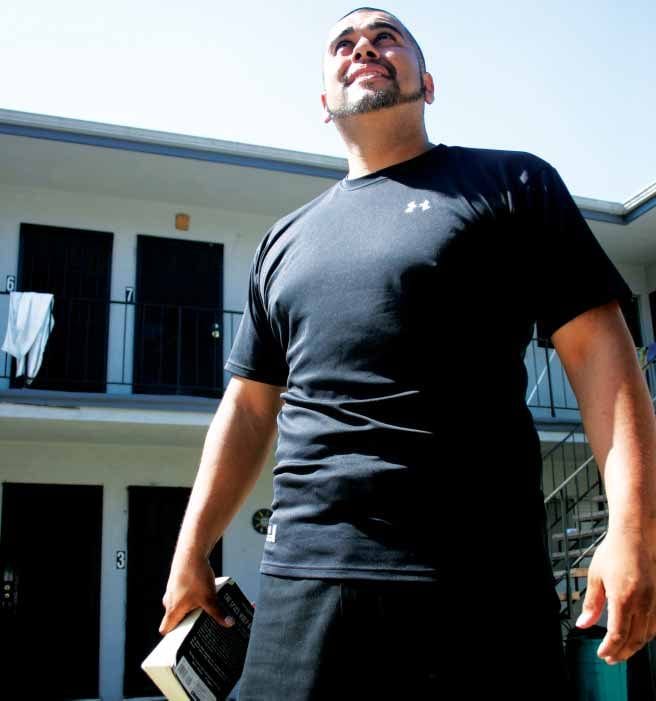
HOMETOWN REPRESENTED De la Torre, who grew up in the Pico Corridors, a working-class neighborhood in east Santa Monica, considers himself more of a martial artist than a cage fighter. Despite a troubled childhood and a very long history of violence, he considers himself an intellectual. A talkative and amiable 25-year-old with a fondness for laughter, he is a voracious reader who studies world religion and astronomy on his own. He owns more than 1,000 books and speaks with the vocabulary of a college post-graduate. Starting when he was 6, he would highlight every word he didn’t know in a book, read it again and look it up in the dictionary.
At five-foot-eleven and 235 pounds, de la Torre is an intimidating presence. He’s worked as a bouncer since he was a 240-pound 14-year old. His chest, arms, and even a kneecap are covered in tattoos.
“When people see me they see a thug or brawler,” he said. “I don’t want to be what they see. You can’t judge a book by its cover.”
De la Torre said he fights for the love of martial arts, and he’s excited about his many local friends coming to watch him, but he doesn’t particularly want to achieve any stardom or work his way into UFC.
The same cannot be said for most of the other fighters, who sometimes work multiple day jobs to pay the rent, and put themselves through the severe training during the hours when most other people are asleep. But before they reach the level of fighting before millions of viewers on national TV, they must claim dominance over the circuit in Santa Monica.
“UFC is where everybody wants to be,” Sanchez said. “But I take it one day at a time, one fight at a time. Everything in life is never totally secure.”
Originally published in the Santa Monica Daily Press print edition on August 11, 2007. Read the original PDF.