

City Council agrees on landmark status; owners vow to fight NORTH OF MONTANA The building has been saved, but the tenants may not be so lucky.
The owners of a post-World War II garden apartment complex on San Vicente Boulevard that was designated as a historic landmark Tuesday said they will fight the designation in court.
Meanwhile, Or Khaim Hashalom, a non-profit religious institution, plans to move forward with evictions at the Teriton Apartments, removing tenants — some of whom have lived there for decades — to make room for Jewish refugees persecuted in the Middle East.
“Every cloud has a silver lining,” said Rosario Perry, the attorney representing Or Khaim Hashalom, alluding to the City Council’s decision Tuesday to landmark the apartment complex near Ocean Avenue. “Now we have plans to provide temporary and immediate housing for people that need it. It’s kind of what rent control really should be — housing for poor people.”
Perry said his clients filed a request in April to get out of the rental market and evict their tenants, something which is legal under the Ellis Act, a state law that provides landlords with the unconditional right to remove tenants in order to get out of the rental business.
For an Ellis eviction, the landlord must remove all tenants in the building and not re-enter the rental market for five years. Most “Ellised” buildings are converted into condos for sale.
Or Khaim Hashalom had originally planned to demolish the 28-unit complex and replace it with a combination of subsidized housing and higher-end condos for refugees. The idea was to use revenues from the sale of the more expensive con-dos to pay for other units on the site.
With the landmark designation, Or Khaim cannot demolish the building, making that plan obsolete.
If they fail to get the landmark designation overturned, Perry said his clients will have no other choice but to evict all tenants and fully subsidize new ones who will have their rent paid for by donations from the public.
“The goal is to get people back on their feet,” Perry said.
Currently, there is nothing in the Ellis Act that would prevent Or Khaim Hashalom from evicting tenants and then replacing them with others as long as the new tenants do not pay any rent, nor provide services in lieu of cash, said Keith Kresge, staff attorney for the Rent Control Board, which monitors Ellis evictions.
As far as donations being used to pay rents, Kresge said that would be fine, but city staff would need to monitor it closely to make sure none of the tenants are contributing, Kresge said.
City Attorney Marsha Moutrie could not be reached for comment.
Under Ellis, tenants must vacate their units within 120 days, while seniors and the disabled have up to one year to leave.
Or Khaim plans to move in new tenants as soon as the first batch of current residents move out. Seniors and the disabled have been offered relocation assistance from Or Khaim, but so far, the group has not gotten any response, Perry said.
LANDMARK OR POLITICAL PLOY?
Opposition to Or Khaim, which is said to be active in the Persian community, surfaced two years ago, shortly after the group purchased the historic apartments for a reported $10.5 million.
In August of last year, representatives from Or Khaim met with tenants at a hotel in Santa Monica to discuss their plans for the site. At that time, representatives said they were losing $500,000 a year on the deal, a tremendous financial hit for a non-profit.
Residents weren’t buying it. One after another, they spoke passionately about the complex they have grown to love and vowed not to leave without a fight.
Many of those same residents showed up in force on Tuesday, as elected officials heard from Perry, who, on behalf of his clients, filed an appeal with the council, challenging the Landmarks Commission’s decision to designate the building.
The commission voted unanimously in November 2006 that the building, designed by architect Stanford Kent in 1949, be landmarked because it met five of the six criteria needed for designation. To be a landmark, a structure only has to meet one of the six criteria.
Residents as old as 86 and as young as 11 spoke about the beauty of the building and how its unique, pinwheel design enables them to connect with one another while also providing each the privacy and security they could only otherwise get by owning a home.
“I’m 86 and it’s nice to have neighbors around who are so close,” said Kit Snedaker, a longtime resident. “The Landmarks Commission … dedicated it to the future and I’m hoping that you will do the same thing.
“There isn’t a building that deserves it more.”
Leo Dasher — who represented the “future” Snedaker was talking about — approached the podium next and told the council to preserve the Teriton because “it is very unique and fun to play in because of its unique architecture and large courtyard in the middle with bushes and staircases to hide behind.”
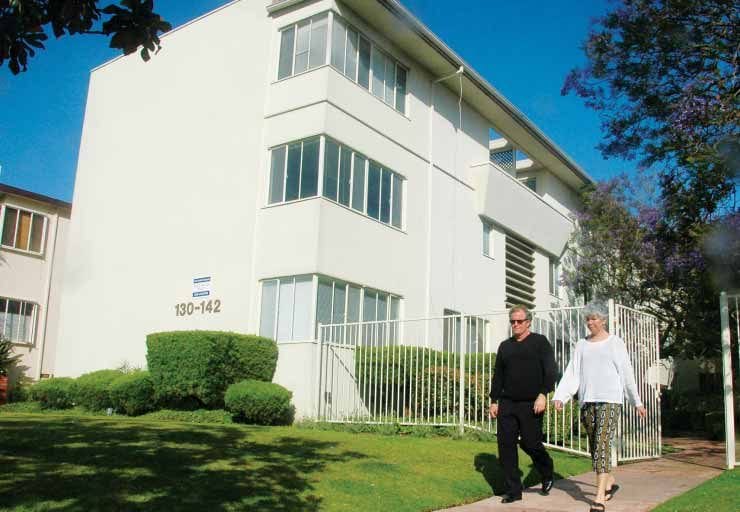
The Teriton is comprised of two, low-rise, high-density buildings centered around an L-shaped courtyard in what is known as vernacular Modern/International architecture. The style is considered just as emblematic of early 20th century Los Angeles as bungalows or Spanish Colonial Revival homes.
The building is situated in a potential historic district known as the San Vicente Courtyard Apartment Historic District. It has been surveyed by City Hall three times over the last 25 years, and at first was deemed not significant on its own, but as part of a historic district, according to city staff reports.
However, during the last survey, the building was found to be individually significant because of a lack of such buildings in the area, and because little is known about the type of building and period of development in Santa Monica.
Representatives for Or Khaim challenged the Landmarks Commission and its findings, calling the city’s Landmarks law nothing more than a political tool that is being used by the council and others to protect rent-controlled apartments from being demolished or remodeled into condos.
Ruthann Lehrer, an architectural historian and member of the commission, defended her colleagues’ decision to support landmark designation and said the law is not being abused for political gain.
“We were very careful in our deliberations and spent a lot of time on this issue, evaluating this building and the criteria, and the council obviously upheld our decision,” Lehrer. “I think the record speaks for itself.”
While Landmarks felt the Teriton met all but one criteria, city staff reviewed the building and decided that it met just two. Staff found that the building was a record of the cultural, social, economic and architectural history of the city, and that it has aesthetic or artistic value.
An architectural historian for Or Khaim argued against the staff’s findings.
“If this building can be landmarked, than any building could be landmarked if it’s 40 years old,” Perry said. “This pin-wheel design doesn’t even look like a pin-wheel. It looks like a convoluted Swastika to me.”
Or Khaim is expected to file a lawsuit in the coming weeks.
Originally published in the Santa Monica Daily Press print edition on June 14, 2007. Read the original PDF.