

Garage approval came before historic district
When Shirley Bly proposed building a garage underneath her Third Street home in her quiet Ocean Park neighborhood, she never thought it would come this.
After being opposed by her neighbors and denied by the city’s Landmarks Commission, Bly’s plans are scheduled to go in front of the city council tonight.
Opponents of her plan are troubled because Bly’s home is located in the Third Street Historic District — a preserved neighborhood of homes on Second Street and Third Street between Ocean Park Boulevard and Beach Street.
They say if Bly is allowed to build underneath the front of her home, other homeowners might follow suit.
“It would set a precedent for other homes in the neighborhood that don’t have parking to seek the same type of thing,” said Beatrice Nemlaha, a Third Street Historic District resident.
“The bottom line is that it’s the wrong project,” Nemlaha said. “There have been nine major projects proposed in the history of the district and this is the first to ever be denied.”
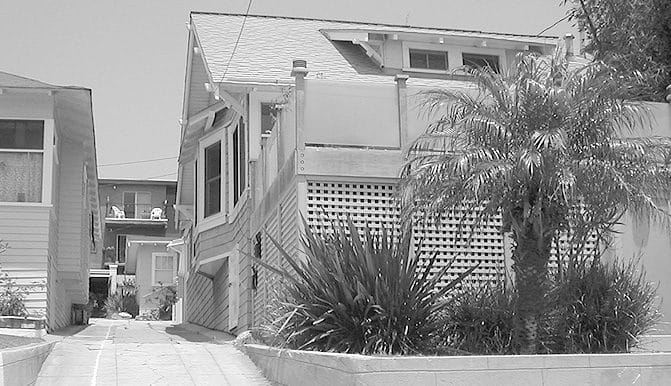
Bly’s home sits above a small hill and the proposed garage would be located about three and a half-feet underground.
Bly said other homes in Ocean Park look just like hers and they have double-door garages underneath their front exteriors. In fact, she has constructed an entire book of photographs illustrating that fact.
Initially, she proposed building an even larger garage under her home and received approval from the city to do so more than a decade ago. She didn’t pursue the project then.
Then in 1990 the Third Street Historic District was approved. Bly said she was given assurances by those who wanted to create the district that she would still be able to build a garage if the historic district was approved.
“But it’s going under the house, not under the ground.” — said Bly, a local real estate agent. Small garage on Third Street becomes big issue
“It’s being called a subterranean garage by those who oppose it,”
“They told me that my garage could still be done if it looks right,” she said.
But when she tried proposing the same project this year, the city asked her to scale down her plans. She complied and the new plans were approved by the city and passed along to her neighbors — a common practice when substantial construction projects are proposed in the historic district.
At first glance, the neighbors approved of what Bly wanted to build. But after they called a second meeting to get more detailed information, including a city staff report that opposed the project, they changed their minds and advised the Landmarks Commission to deny the project.
“I feel its an abridgment of our property rights by our neighbors,” said Bly. “This whole process has cost us $30,000 up to this point, and probably another $5,000-to-$7,000 by next week.”
Some homeowners that have recently organized to fight possible historic district designations north of Montana Avenue have seized upon Bly’s situation as an example of the problems historic districts create.
Calling themselves “Homeowners for Voluntary Preservation,” the recently-formed committee has begun circulating a petition in an effort to allow homeowners a choice as to whether their homes should be classified as landmarks, or “structures of merit.” The group needs 6,000 signatures to place the measure on the November ballot.
Committee members believe the current ordinance imposes restrictions on private property and constitutes an unwarranted intrusion of personal freedoms.
“I do think (Bly’s situation) presents an opportunity to people who are interested in historic districts to see how they play out in the real world,” said Tom Larmore, a local land use attorney and founder of the voluntary preservation group.
Larmore represents Bly in an unrelated legal matter, but said that Bly has had no involvement in the voluntary preservation movement.
But to landmark and historic district supporters, Larmore is pushing homeowner’s panic button and trying to scare up support for his cause.
“Tom Larmore has a political agenda and I believe he is trying to exercise that again in this case,” said Roger Genser, a Landmarks Commissioner. “He’s deliberately fanning the flames here and making accusations regardless whether or not those allegations are true.”
Originally published in the Santa Monica Daily Press print edition on June 11, 2002. Read the original PDF.