

By SARA MILSTEIN Special to the Daily Press
To some, pools are used for swimming, tattoos are considered an oddity, and punk rock music is nothing but noise pollution. For Bart Saric, they are a way of life.
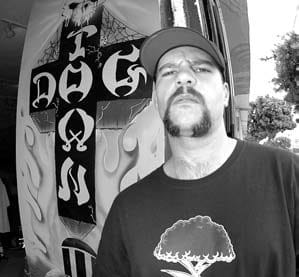
Ever since his childhood in Santa Monica, Saric, 34, has strongly felt the influence of the Santa Monica Bay area’s skate and surf legends of the 1970s and 80s. In part, his upbringing has inspired his career as a commercial and freelance artist, graphics designer, animator and videographer.
Saric’s family settled in Santa Monica when he was 5 years old after having lived in Australia, Canada, New Jersey and New York while pursuing his father’s education and acting career. After graduating from Santa Monica High School in 1988, Saric took classes at SMC and UCLA Extension, where he pursued his interest in anthropology and fine arts. He soon realized that only real, hands-on experience would train him for the kind of life he envisioned.
First a removed observer and then an active participant, Saric always seemed to gravitate to the counter-culture. He is not a rebel without a cause, however. His passion is his art, and his vision is in sharing it in various forms, whether it’s “inked” on someone’s shoulder, silk-screened on a T-shirt or animated on a hit TV show.
Through hands-on experience and personal practice, Saric is a self-taught artist who has been influenced by master painter Francisco Grippa and countless other inspirations of art —including such legends as H.R Giger, Ridley Scott, Berni Wrightson, Stanley Kubrick, Dali, Michael Whelan, Frank Frazetta and Akira Kurosawa.
Saric got his first paying professional job at 15 years old, designing an album cover for an artist named Lola LaMode. He has worked as a designer for Dogtown, Fleshwound Films, Quiksilver, 151, 1984, Hosoi Skateboards, Z-Cult Skateboards, Old Star and Rip City.
One of Saric’s latest projects, a DVD called “Skinned Alive,” uncovers the professional skateboarding and tattooing subculture that continues to flourish in Southern California. Filmed in a documentary style under the B Productions label, the DVD explores the link between skateboarding and the tattoo and punk rock cultures through interviews with some of the biggest legends on the scene. The footage is candid, descriptive and full of visual representation of what the underground skate and tattoo culture is all about. The in-your-face camera style and vivid graphics reflect the unfettered and unaffected lifestyle of the film’s subjects, including two-time world street skate-boarding champion Eric Dressen.
Working on the DVD for two years with his production partner, Tom Allen, Saric held a premiere last fall and joked last week that he is will waiting for a bad review.
Unlike many of his indie film counterparts, Saric avoids the mainstream. He and his co-producer do not dream of Sundance or Cannes, but instead of drained pools that make the best skate ramps. His efforts to distribute Skinned Alive are wholehearted, however, and he maintains his Web site, www.b-artwork.com, where he sells his DVD and other artwork. Saric also works to pinpoint music venues, tattoo shops, and skateboard parks and stores to sell his work to those who truly appreciate it.
Saric lives in Topanga Canyon with his wife Acacia and son, Odin, who is nearly 2 years old. He often drives the short distance to Santa Monica and Venice to visit old friends and fellow skaters who, as he suggested, will never completely fade from his life.
The Daily Press caught up with Bart Saric at Over Under Sports Grill to hear his story about Santa Monica’s skate and tattoo cultures.
How did you first become involved in the skating, tattooing culture?
“I got into skating and punk rock around the same time, in ’83... I was always in that world, but I was never an active participant in those worlds, but I always wanted to be because of my art … (the older skateboarders) were such good guys to me, and showed skating and tattoos as forms of art.
“I became rebellious as a kid, and skate-boarding and punk rock definitely nurtured it in a way that a child would not have the capacity of doing in this day and age because the numbers are too big and there just isn’t enough open space. There were no parameters set up. It was way more wide open.”
How did living in Santa Monica move you in the direction of that particular counter-culture?
“This area was so empty. The whole Promenade, Venice — it was a whole other world. I enjoyed that space in my childhood. Back then, they didn’t even have a name for it. Now they call it ‘extreme sports.’ Now, Santa Monica is a lot more bling-bling and has lost a sense of seniority to the real community I grew up with... There’s amazing people in this city, and there’s amazing history in this city.”
What made you decide to work on your own? “When I work for myself, I end up walking in different paths every now and then. I figured, if I was going to have to go through all the headaches, it would be a lot more fun doing it on my own. Not just as far as creative control, but there was more that I wanted to do. I definitely felt caged like a wild animal.”
What interested you about animation? “I got into animation by accident. I go under ‘B-Productions,’ and I’ve been doing a lot of color... it wasn’t something I went to school for, but I had the skills for certain tasks that they needed done like layouts and color and all that. I worked on Futurama and for Sony and things like that.
“I tried school, but it just wasn’t for me. I just never got my questions answered. I’m just one of those people who works better hands-on, and I think that’s where I’ve really learned: from jobs and being out in the world. Animation has taught me a lot about not waging the importance of things. There is a lot I’ve learned from the failures.”
How is Skinned Alive different from or similar to the Dogtown and Z-Boys film that recently came out?
“Lords of Dogtown is ‘based,’ this ‘is.’ I think we pinpointed the characters that made a difference. The group that I have really personify that subculture. I think the Dogtown documentary left a lot of important people out. There’s so much history missing out of it.”
How would you define the link between their movement and the one you’re a part of?
“Days of Dogtown transitioned into the ’80s, the no-rules culture. Our time was like taking it to another level, like squaring it. The tattoo-skate relationship all came from music, aside from the tribal angle and modern culture.”
What were the events leading up to and following the making of Skinned Alive?
“In 2001, we came out with ‘Dayz in the Life,’ which was like a documentary without the questions, just pictorials. It basically showed life — like going to work, skate-boarding and going to get tattoos at night.
“The movie was shot mostly in Southern California. Half of the guys in Skinned Alive I knew, and the other half just came into the mix because of the crossovers with the other characters. All the skateboarders are pretty much legends from the ’80s or the ’90s. All the tattoo artists are either friends or tattoo legends that were with the first real skateboard guys in the late ’70s, early ’80s.
“Tom Allen came up with the idea for making a video about the skateboard-tattoo relationship. He said ‘I’ve got a name for it: Skinned Alive. Let’s just do a whole bit with in-depth interviews.’ Once he said that, it made me think about all the guys that have made an impact on that whole punk rock, skateboard, rebel culture in the early ’80s. The ’80s were more of a rebellion, I think.
“We started taping the Skinned Alive DVD in 2002 and released it in December 2004. It was my part-time job for two years. Most of it was getting the film and interviews I needed and then distributing it to magazines, stores, skateparks, shows and to the general public straight off my Web site — a real grass-roots way of doing things. Most of my promotion is just through word of mouth. We try and avoid the mainstream.”
What is the goal of the project? “The ultimate goal of the DVD is to convey a more realistic image through the actual participants, the actual culture, and what it’s really all about. The public does-n’t usually see athletes, all they see are the tattoos.”
What do you think of the new skatepark at Memorial Park?
“There isn’t enough legal, free stuff for kids today. There should be a Mecca for skaters. The new skate park is awesome, though. It’s classic. It’s unfortunate that there’s an $80 fee because it leaves some people out. But the whole thing was a long time coming.
“The skatepark is an important institution for the community and its cultural history, right now... Hopefully they’ve built something that’s going to last.”
Do you have any tattoos? “On my arm I’ve got my family name. I needed a starting point that I knew would never change. I’ve got my son’s name here, under my wing (points to his underarm) … and a portrait of my parents will go here (above Odin’s name). It’s kind of a family arm.”
What is your philosophy of life? “I just try and harmonize. I know that negativity feeds on negativity and positivity feeds on positivity. I just try and live off of that positive energy. That’s my bottom line.”
Are you religious? “I’m religious in my actions, as far as my art and surfing and skateboarding and music. The fruits of life compel me to paint my mind, or whatever I’m living. I was fortunate to have the freedom from my parents to kind of explore what I want on my own.
“If there are any thanks, they go out to my parents, my wife, my son, my real family and true friends, and anyone that has supported, helped or comforted me... support independence.
“I tried Buddhism, I went to Catholic church as a kid, and my dad took me to meditate. I definitely believe in the higher elements, each has something special to offer, but I’m just not sold on anything.
“I’m totally still exploring my spirituality. There’s a lot of unknown, so the things that I can relate to, and the things that I think are real are the things that I’ve seen. That’s what I like about (skating and art) — they’re still so honest to me. They’re direct and they don’t let me down. They tell me I’m wrong when I’m wrong, and they keep me up when I’m right. I go through a discomfort when I haven’t been in the water (surfing) for a while. It’s something that keeps me in check as a person. It’s just another one of those insane things that keeps me sane. It’s all a matter of falling down and getting back up. That’s what I’ve learned so much about working in the community and playing in the community — that whole cycle. That’s the history and the Santa Monica that I know.”
Originally published in the Santa Monica Daily Press print edition on July 11, 2005. Read the original PDF.