

“I spent every Sunday morning watching spring training with my grandfather,” he said. “Baseball is like in our blood — we played whatever sport was in season, but for some reason, baseball was one of those things I loved.”
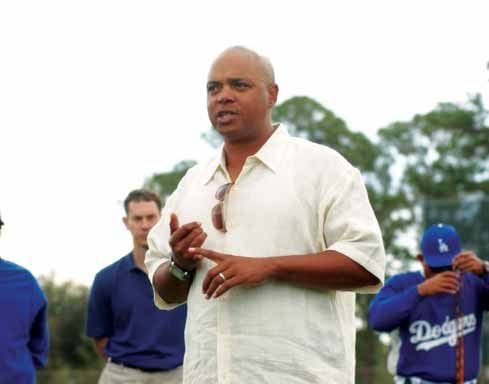
He might not be in the uniform emblazoned with the words “Los Angeles” across his chest, but Watson is still a member of the team as the developer of the players in the Dodgers’ farm system.
Along one side of his office is a large board with the names of approximately 185 players in the minor leagues, divided into teams — Las Vegas, Jacksonville, Inland Empire, Great Lakes, Ogden, Gulf Coast League and Dominican Summer League. The players names are highlighted in a different color — red for left-handed pitchers, blue for switch hitters and gray for right-handed position players.
On the far left column are the players on the major league roster. The board has-n’t been updated to take out potential free agents, Watson pointed out.
His job throughout the year is to evaluate every single player with the support of the minor league coaching staff. Watson works with the players, addressing their shortcomings, providing tips and assessing what needs to get done in order to make the next step.
In the competitive world of professional baseball, the minor leagues can be a tough place.
Watson spends 15 straight days on the road and 15 straight days in Los Angeles before heading out on the road again. He tries to see each affiliate four times a year. Watson lives in Arizona with his family.
“It’s a collective effort,”Watson said of the organization. “It’s not one person who flips the magical switch — it takes a lot of collective work and we all put it in together, making sure we’re working on the same page and get the kids better at the minor league level.”
Originally published in the Santa Monica Daily Press print edition on October 8, 2007. Read the original PDF.