

Some officials wonder if Bayside district has seen better days
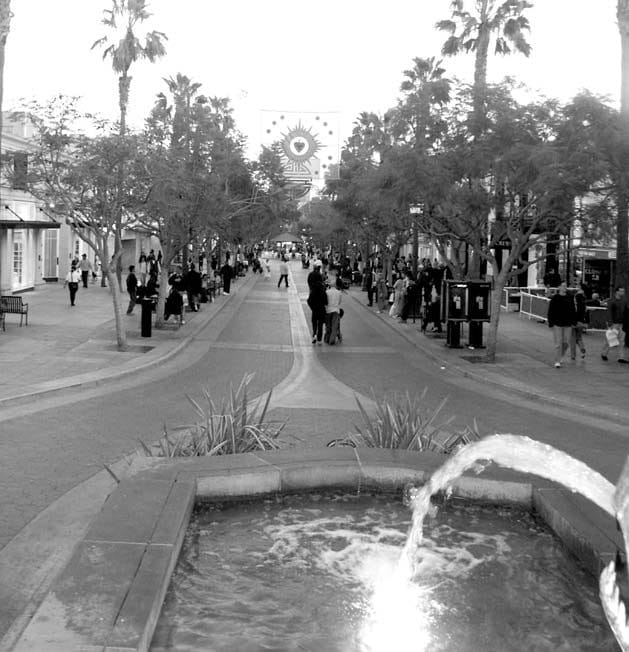
It’s a warm afternoon on the Third Street Promenade and a common scene is unfolding. A group of homeless have occupied the central benches between Arizona and Broadway. Bodies and litter are strewn about like confetti.
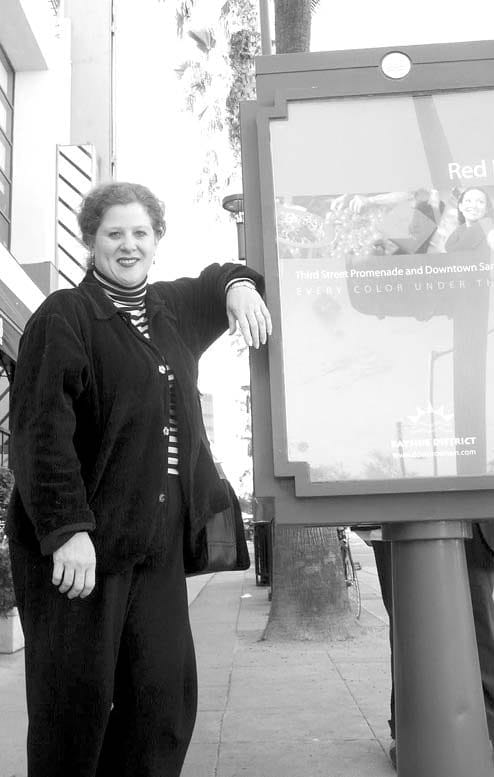
On her way to lunch, Kathleen Rawson, executive director the Bayside District Corporation — a non-profit organization that brings together city officials and business owners — witnesses the mayhem and quickly picks up her cell phone to get a maintenance crew to clean up the mess.
Minutes later at the restaurant, Rawson presses the flesh with the owner, briefly continuing their conversation from earlier that afternoon about expanding the business’ operation on the Promenade, hinting the deal could possibly avert yet another Starbuck’s Café.
And throughout the week, Rawson will talk with reporters from publications and television stations in the Los Angeles area, trying to convey the message that despite recent concerns, the Promenade is still alive and kicking.
“It’s really hard to summarize what I do,” she says. “A lot of people don’t understand what Bayside does, or even what I do for that matter.”
Rawson wears three hats — maintenance supervisor, business manager and spokeswoman. Many city officials and downtown business owners will concede that she has come to embody the modern-day scope and mission of Bayside.
“The problem we have right now — I mean our original goals have been met beyond our wildest dreams — is now we have a street that has become so successful that it’s a victim of its own success,” said Santa Monica City Councilman Herb Katz and also a longtime Bayside member. “The main problem now is dealing with the overly inflated high rents that have resulted from it.”
Bayside’s historic mission, which is to bridge public and private concerns about downtown business in a non-partisan atmosphere, may be unraveling. Some say unrest between city officials, downtown landlords and business owners may soon boil over into lawsuits. against the city in an effort to protect their property rights.
Late last year, citing high rents as unfairly forcing out small, locally-owned businesses and restaurants along Third Street, the city council enacted an ordinance that temporarily forbids any space along the Promenade occupied by a restaurant to be leased by any other type of business.
Dozens of restaurants have been forced off the Promenade in recent years, with retail chain stores taking their place. City officials are worried that the Promenade is transforming into another suburban shopping mall. As a result, more regulations on property owners are looming.
A task force is currently being formed to study the problem and make recommendations to the city council on possible solutions. The task force, much to the dismay of property owners, is comprised of all city officials except for one business representative, who has not yet been selected.
Critics say the city has gone too far by trampling on private ownership and constitutional rights, filling Bayside with political appointees and alienating business owners and landlords in the process. Essentially, the city is trying to regulate “The future of Bayside is whatever the hell the city lets it be, and I don’t think the city will ever let it be what it is designed to do,” said Ernest Kaplan, founding chairman of Bayside and a Promenade landlord who owns 1351 Third Street, the location of Bayside’s office and the now closed Teasers restaurant. “This ain’t gonna last as long as the Roman Empire. It needs a benevolent despot, someone to control things impartially, but the city will never let Bayside be that (entity).”
“This ain’t gonna last as long as the Roman Empire. It needs a benevolent despot, someone to control things impartially, but the city will never let Bayside be that (entity).” — — KATHLEEN RAWSON Bayside District Corp. executive director — ERNEST KAPLAN Promenade landlord
Rawson, however, does not foresee Bayside taking on that role. To her, the organization is a support network for all downtown business — a conduit through which the city and local entrepreneurs can work together.
“We have an opportunity now to expand what’s happening on the Promenade to the side streets. Finally, there is life on Second and Fourth streets too,” said Rawson. “These changes need to be fostered. If we don’t seize this now, people will get bored and they won’t come back. And that’s the worst thing we could do.”
But people keep returning, regardless of the Promenade’s lack of dining establishments. Even during the recent economic slowdown it is estimated that 20,000 people pass through downtown Santa Monica each day. A recent poll revealed that nearly 80 percent of residents visit downtown at least once a week. The downtown core has become one of the city’s largest revenue sources, bringing in millions of dollars in sales and property taxes.
“It made me so mad when the LA Business Journal said Santa Monicans avoid the Promenade like San Franciscans avoid the wharf,” Rawson said. “Our residents do come downtown, they do shop at home and they are proud of their city.”
More than 37 years ago, Third Street was like any other commercial district in America. Small local retailers and restaurants intermingled with nationwide chains like JC Penny and Sears.
But then the Pedestrian Mall Act of 1965 provided an incentive to close the street to automobile traffic and provided $7.5 million to build six parking structures, expand sidewalks, and install planters and fountains.
However, consumers didn’t embrace the concept. Often times planters prevented people from accessing storefronts and the fountains became public baths for the city’s homeless population.
“It was very seedy,” said Rawson. “It wasn’t even safe during the day,” Katz said.
The Pedestrian Mall Act of 1965 ended up a complete failure everywhere it was attempted. When Santa Monica Place opened around 1981, Third Street was in its economic death throws, and all the remaining life on the street was vacuumed up, along with any remaining successful stores.
What happened next varies depending on who’s telling the story.
According to former councilman and mayor Denny Zane, his group, the Santa Monicans for Renters Rights, won a 5-2 majority on the city council with a campaign pledge to stabilize rents and revitalize Third Street, and the Santa Monica Pier. Essentially, he said, SMRR could force through any changes they wanted.
According to Katz and Kaplan, a truce was struck between politicians, business owners, and landlords to re-take control of their downtown.
In either version, around 1984, a two-year public input process on Third Street was begun so residents could help shape the city’s commercial core. The Third Street Development Corporation, the precursor to Bayside, was created as a public-private partnership to oversee redevelopment of the area and to foster the long-term viability of the district.
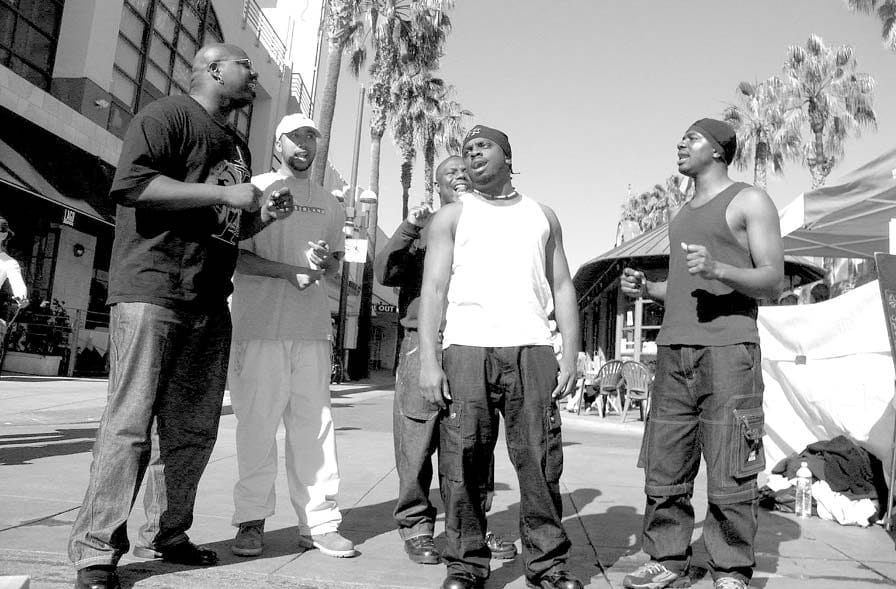
To officials the idea was simple: Give the street a feeling of life and the rest will follow. Every concept was drawn directly from that principle. Outdoor dinning was created to give the street a European ambiance. Street carts were added to blend indoor and outdoor shopping. Fountains were given spigots and shooting water displays. And most importantly, street musicians and artists were drawn in and heavily regulated.
“Street performers are an absolute necessity for the success of the Promenade,” said Rawson. “The city has spent a lot of time and money developing a strict street performance ordinance.”
The concept was groundbreaking because it was untested. At the time, business was regulated by government; not partners with it. Analysts and many business owners gave the project very low odds of success.
“The Promenade confounded all of the models of business around the world at the time,” said Zane.
In 1986, the city moved forward with a $13 million project to build more parking downtown and replace all the planters, fountains and benches with its present-day inception.
When the street opened two years later, throngs of people showed up for the opening and stayed throughout the coming years.
“The street was brand new but many of the shops had to catch up,” said Rawson. “They still looked like small town America.”
The public was invited to vote on art sculptures that would adorn the Promenade and conceptual drawings were placed in stores along the street for people to vote.
“We think a lot of kids voted because we ended up with dinosaurs as our theme,” said Rawson. “It doesn’t really fit with the city, but they have become an icon for us.”
About the same time four movie theaters were planning to open mega-plexes in the far corners of the city. Seeing a chance to create more foot traffic on the Promenade, the city council nixed theater owners’ plans and changed zoning laws so that movie theaters could only be built downtown.
“We knew they would be good generators and we knew we wanted them all spaced out to keep traffic from bunching up in one area,” said Zane. “Movie theaters became the centerpiece and catalyst of revitalization.”
Not long after, restaurants and cafes moved in to take advantage of the after-movie crowds. And after that, retailers moved in to take advantage of the after-dinner crowds.
Once the people started coming in droves, the city council and Bayside wanted to prevent the Promenade from becoming dominated by either movie houses or restaurants — the two prevailing economic forces at the time.
By 1991, ordinances were created to cap the number of restaurant seats allowed in the city to 1,700 and it set specific percentages of restaurant concentration on each block. Both laws are still on the books today. However, until recently, city officials never thought to limit the number of retailers on each block.
“Slowly retailers who moved in found the space was one of the most profitable of any store in the chain.” said Zane. “News began to spread and nationwide retailers began moving in not just to make money but to create a showcase store. At first it was about making money, but then it become almost like showing off.”
As retailers vied for the limited space on Third Street, rents began to skyrocket and force small businesses and restaurants off the Promenade. That is now the problem the city and Bayside must address.
Nationwide retailers bought up many smaller stores, combining them into larger spaces. This trend compounded rent pressures by further limiting the number of store fronts, increasing demand even higher.
“When we limited movie theaters and restaurants, nobody even thought to address retailers,” said Zane. “At that time, there was no real interest in moving onto the Promenade.”
“When we limited movie theaters and restaurants, nobody even thought to address retailers.” — — DENNY ZANE Former Santa Monica mayor
As restaurants moved off the main drag to cheaper spaces on the side streets, city officials saw their central theme of pedestrian foot traffic being threatened. If outdoor dinning all but disappeared, would the after-movie crowds stick around, they asked.
“Remember, this whole thing was jump-started by the movie theaters moving in. The restaurants followed them, and the retailers were the last on the scene,” said Zane. “Now there is a lot of competition for movie audiences and the attraction these theaters had were the restaurants and cafes. Without that mix those theaters would be in jeopardy and the entire Promenade along with them. There could be this whole reverse domino effect.”
Most officials with the city and at Bayside cite ordinances that control restaurant saturation, place a ceiling on the number of theater seats allowed, and regulate street performers as ample precedents for attempting to control retail development today.
“There has always been tinkering with (the Promenade),” said Rawson. “We have been actively managing business downtown for decades.”
However, Kaplan — who defends the city’s ordinances that controls business along the Promenade — says the latest effort to control who landlords rent to is unconstitutional. Kaplan also thinks that because the latest effort to control Promenade business is coming from city, unlike the previous ordinances which were agreed to by both businesses and Santa Monica officials through the work of Bayside.
Now that Bayside has been corrupted, he says, there can be no agreement; only a directive from City Hall on how business can be conducted downtown.
“This latest ordinance is based on what the city wants,” said Kaplan. “They came in and said ‘do what we say or we’ll make you do what we say’ and sure enough when the landlords resisted they’re trying to tie our hands.”
Rawson understands landlord’s frustrations toward the city council.
“There have been so many more years of depressed times than boom times. People think that property owners are trying to turn a quick buck, but these are the people who have been through it all,” she said. “Yeah, the city invested $13 million into fixing up the Promenade and making it what it is today, but by our estimates there has also been nearly $500 million of private tenant improvements made as well.”
“There have been so many more years of depressed times than boom times. People think that property owners are trying to turn a quick buck, but these are the people who have been through it all.”
Golden days to come?
Most officials agree that if the proper mix of retail, restaurants and entertainment on the Promenade is maintained it can’t fail. What they couldn’t agree upon were the exact dates of the “golden days,” when the Promenade was as close to perfection as possible.
To Zane the best time was just before a large retail conglomerate bought up about eight properties along the street, he said.
“Around 1995, a handful of national chains moved in, replacing local retailers and restaurants,” he said. “That’s when the whole switch to corporate retail and largely catering to a tourist, instead of local, market occurred.”
For Kaplan, the golden years were from 1984 when the idea was first being created until 1987 when he says the city council began politicizing Bayside.
“Looking back, those were the years of more progress than not,” he said. “At the end of my reign I kept having to teach new appointees the history of how the Promenade came to be. Honestly, I think some of them woke up one morning with it and thought it had always existed.”
Rawson, on the other hand, looks to the future. She admits the Promenade has had some good days, but she says the golden ones are still around the corner.
“If this place was empty I would say we need to go through a whole redo of the entire idea. I would say something really drastic has to be done,” she said. “But it’s not empty. People are still coming. All we are doing is taking out another insurance policy to make sure the mix stays the same and the Promenade remains successful.”
Originally published in the Santa Monica Daily Press print edition on February 4, 2002. Read the original PDF.