

Preservationists worry suit could shelf project
By KEVIN HERERRA Daily Press Staff Writer
PACIFIC COAST HIGHWAY — With nearby residents threatening to block the creation of a public beach club at the old Marion Davies Estate, supporters of the project are mobilizing.
A group of Santa Monicans calling itself “Friends of 415” have created a Web site (www.friend-sof415.org) to educate the community about the beach club and to drum up support for its completion, which is being threatened by the Palisades Beach Property Owners Association.
The homeowners have threatened to sue if City Hall does not enter into a contract that dictates how the property is used and managed.
If a lawsuit is filed, there is concern by supporters that the project will be put on hold, jeopardizing the $28 million in funding donated by the Annenberg Foundation for the restoration and reuse of the historic, but earthquake-battered facility.
A spokesman for Annenberg could not say whether or not a lawsuit would trigger the foundation to pull its grant, but a significant delay due to a court case could have an impact on funding that would, without a doubt, put pressure on elected officials to make up the difference in construction costs.
“This gift is a finite gift,” said Leonard Aube, managing director of the Los Angeles office of the foundation. “With construction costs being what they are today, with core materials rising by double digits, if there were to be a significant delay that would have a major impact on available funds... there isn’t the option of going to another source, unless the city can come up with something.”
Preservationists are hoping to rally supporters to attend Wednesday’s Planning Commission meeting, when the project is expected to be discussed and approved.
“The biggest threat to the community realizing this dream of a public beach club are delays. The longer the project is delayed, the more costs go up,” said Friends of 415 co-founder Joel Brand, past president of the Santa Monica Conservancy. Brand is circulating a petition in support of the beach club on the Friends’ Web site.
“The money for this project represents the biggest gift to the community for public use ever in Santa Monica,” said Brand, “and this is in jeopardy because of this small group of neighbors who are not satisfied with mitigation being made. These are things the public was willing to give up for them, and they’re still not satisfied.”
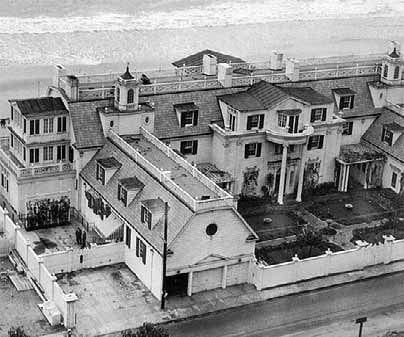
The 5.5-acre beachfront estate was built by William Randolph Hearst in the late 1920s for actress and mistress Marion Davies. It was designed by architect Julia Morgan, who created Hearst Castle in San Simeon. The estate had 100 rooms, guesthouses, tennis courts, an elaborately decorated swimming pool and dog kennel.
The property was sold in the 1940s to a private party and converted to a hotel and beach club. The state purchased the property in 1960. Under an agreement with the state, City Hall leased it to a private beach club — the Sand & Sea Club — and later operated it as a seasonal public beach facility.
Damaged in the 1994 Northridge earthquake, all structures except the beach cafe have been “red-tagged,” or designated as unsafe to occupy.
Following an extensive community planning process, in 1999 the council approved a re-use plan that determined the site’s potential as an important public resource. But the property sat vacant and dilapidated because there was no money available to renovate it — until it was announced last year that the Annenberg Foundation planned to contribute.
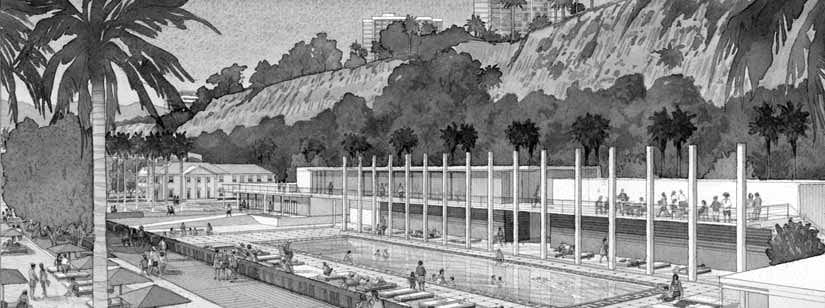
If approved as is, the beach club design would preserve and restore the original swimming pool, which was constructed of Italian marble tiles with inlaid designs. The north house also would be rehabilitated along with the interior design, including hand-painted bathroom tile, the marble fireplace, cabinets and a crystal chandelier.
New facilities would include an entry pavilion, an event house and pool house.
Palisades property owners said they are not opposed to a public beach club, but they are concerned with the one being proposed by City Hall.
Homeowners said redeveloping the estate, complete with a banquet hall, expanded pool house and other facilities, is not only a violation of Proposition S, which limits construction on the beach, but also would attract more traffic, creating the potential for deadly car accidents on an already dangerous stretch of PCH.
There have been several meetings between property owners, the Annenberg Foundation and city staff to see if a deal could be worked out. Most of the conditions set out by residents have been met, a lawyer representing the property owners said.
But negotiations have stalled because residents are seeking a legally-binding agreement that would force the City Council to operate the club in the same manner as when it was opened, meaning in lean budget years council members could not cut security staff or let the club fall into disrepair.
“It’s really a simple manner,” said William Delvac, an attorney at Latham and Watkins, who is representing the homeowners association. “We are seeking a binding agreement that any private developer would be willing to enter into. This is to be sure that the city will live up to the conditions set out, so in the future there will be no surprises.
“Litigation can be avoided,” Delvac added. “All the city has to do is commit in writing.”
City Attorney Marsha Moutrie has advised against any such agreement that would bind City Hall indefinitely. Generally speaking, Moutrie believes that local government should have flexibility in managing its properties.
Delvac said his clients also are prepared to sue if a traffic light is not installed on PCH at the entrance to the proposed beach club.
Chuck Levey, president of the Palisades Beach Road Property Owners Association, said he is concerned that without a street light, many people leaving the club will be killed, as he has seen several deadly accidents on PCH during the many years he has lived near there.
City Hall doesn’t have the authority to construct a traffic light at that location. California’s Department of Transportation, Caltrans, is the agency responsible.
A spokesman for Caltrans said city staff has submitted a request for the traffic signal, along with a study demonstrating need. The study was sent back to City Hall for clarification.
Barbara Stinchfield, director of community and cultural services at City Hall, said city staff is “working aggressively” on getting the traffic light installed.
If the Planning Commission approves the project, the design will go before the Landmarks Commission for review and then to the council for final approval.
There are plans to have the beach club open no later than January of 2009, but City Hall was granted an extension by Annenberg until September 2009 to offer some flexibility in case “unforeseen circumstances arise,” Stinchfield said.
“The foundation has been so supportive in every sense of the word, indicated by a second round of funding offered just a few months ago,” Stinchfield said. “I think they understand that doing something as visible and as public as this is not simple. We have dealt with frustration from neighbors before … but because this is a highly visible project funded by a grant, it makes it more urgent to deliver.”
Originally published in the Santa Monica Daily Press print edition on April 4, 2006. Read the original PDF.