

Iraq: Day 3?”
By KELLY HAYES-RAITT Special to the Daily Press
(Santa Monica resident Kelly Hayes- Raitt returned from Baghdad last month. This the third installment of a daily journal she kept while traveling through Iraq. Look for the next installment in the Daily Press next Friday.) I got married today. Before the Gulf War, Iraqi soldiers were encouraged to marry and impregnate their new wives. Consequently, there are a lot of widowed mothers struggling in post-war Iraq.
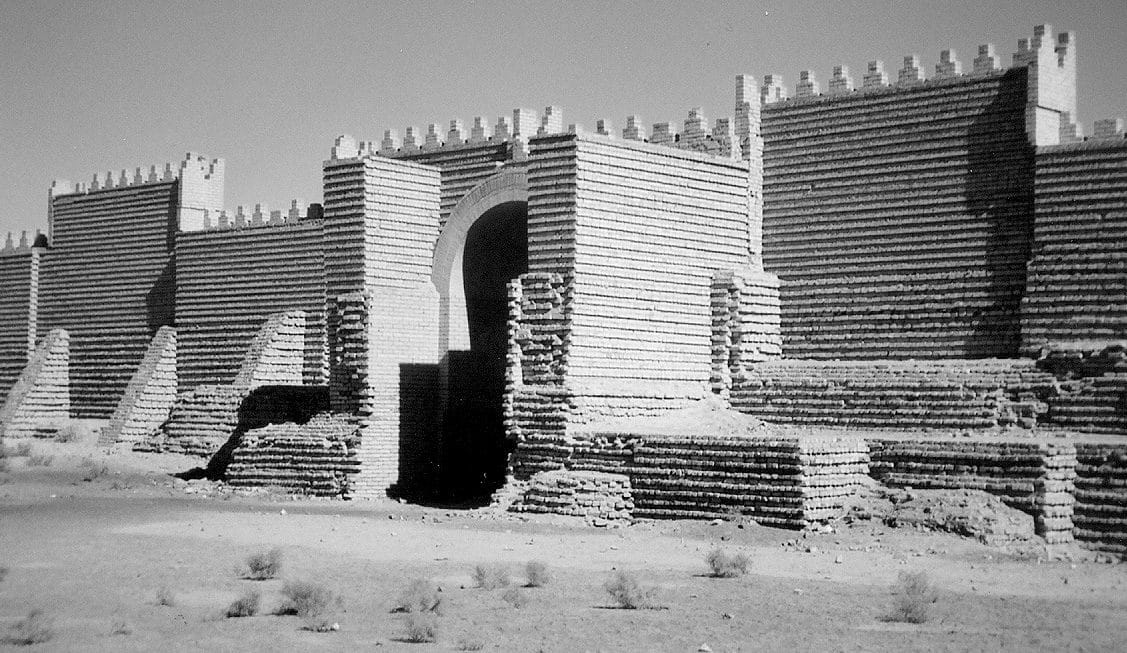
Yet, here I am touring a very pre-war Babylon. The walled fortress was built 22 centuries ago — a city straight out of my early catechism days, a city that until today had seemed more mythical than real. Fingering its weathered yellow bricks, transversing its worn pathways, standing in the shadow of the blindingly blue gate of Ishtar, I realize that Saddam Hussein’s nearby palace puts this ancient fortress at Ground Zero. In an instant, an errant bomb could reduce 21 centuries of history to rubble.
The destruction of the Tower of Babel in 482 BC is one of the few biblical stories I remember: Its destruction scattered people to the far corners of the world, mutating their language while maintaining an ancient common thread. It’s a childhood story that took root deep inside me and continues to challenge me to find common ground with those that seem so foreign.
Our translator on this trip is a 44-year-old Iraqi woman who is married to a Japanese man, lives in Dallas and has four children and two sushi restaurants. Amira has arranged for us to visit her mother, brothers and sisters in Babylon. She has nine remaining siblings; a brother is still missing from the mid ’80s war with Iran and another brother died during the Gulf War.
Her family, like all Iraqis we have met, are warm and welcoming. I find it remarkable that we have encountered no anti- American sentiment. In what I consider an extraordinary show of tolerance, people automatically separate us from our government; perhaps it’s because they feel their own government does not reflect them. The hardest part of this trip is looking people in the eye, accepting their hospitality, allowing their easy friendship, knowing that my country may be bombing their country within weeks. How can I continually allow myself to get close to these people knowing my heart will break when I’m home in my cozy living room watching CNN’s coverage of “Air Raids on Immediately we are embraced by Amira’s family and ushered into the dining room that is decked out with a meal lavish enough to feed twice our group. I feel honored and guilty: 16 of the 26 million Iraqis rely solely on monthly government rations. Even the richest of families spend three-quarters of their income on food. In spite of these hardships, the Iraqis I meet are generous, resilient and joyous.
Some rituals transcend language: Eating. Flirting. Falling in love. Getting married and complaining about the size of the stone on the ring.
Ascertaining that I am the only single woman in our group, Amira’s sisters immediately set about setting me up as the bride to their older, widowed brother with hilariously assertive gestures and enthusiastic, high-pitched “la-la-la-la-las.” As is common in war-time, we transcend the flirting and falling in love and move straight to the marriage ceremony. War-time or not, I refuse to forgo a wedding ring; Amira’s sister produces wedding earrings, straight from a J.C. Penny box. My make-shift wedding takes place in the dining room; fake roses adorned with birthday candles complete my trousseau.
He speaks only Arabic; I speak only English. He pantomimes a proposal; I order him to peel my wedding apple. With only Amira to translate through hysterical laughs, the entire family gets in on the act, clapping and clowning, laughing so hard we cry.
Now connected to this fun-loving family by our side-splitting antics, I realize on the road back to Baghdad what they surely know: Initial war scenarios involve isolating Baghdad, which also serves to cut off outlying areas — like Babylon — from Baghdad’s stockpiles of food and medical supplies. In the early stages of a new war, an estimated 500,000 people will need trauma care, overwhelming the already overburdened medical system. How many of them will be people I’ve met?
Leaving Babylon, I cry so hard, I laugh. (Kelly Hayes-Raitt, a commissioner on the Santa Monica Commission on the Status of Women, will speak on Saturday about her experiences in Iraq and what she learned on how the possible war will affect women and children there.
Saturday also is International Women’s Day, which will be recognized by women around the world by protesting the unilateral U.S. bombing of Iraq.
The event will be held between 4 p.m. and 6 p.m. at a private home on San Vicente Boulevard in Santa Monica Photos from the trip may be previewed at www.communitycampaigns.com/iraq.
For more information, call (310) 581-4421.)
Originally published in the Santa Monica Daily Press print edition on March 7, 2003. Read the original PDF.