

SMC putting wigglers to work in the name of recycling
SMC — The academic world that is Santa Monica College is home to thousands of worms, and not just the variety who read books.
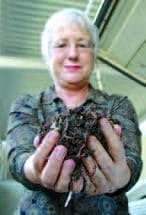
“Red wigglers,” as they are commonly called, arrived at SMC in November of 2001, as part of SMC’s recycling program. Kept in a white veritech machine near the bookstore, the 600,000 worms can process up to 150 pounds of food waste each day, creating an odorless fertilizer.
“They eat food, cardboard, wood, bone,” said Madeline Brodie, SMC’s recycling program coordinator. “We feed them anything that was once living.”
Brodie explained that a living plant can be put inside the machine and the worms wouldn’t consume it — not until the plant was deceased and began to decompose.
The veritech machine is a white metal structure, resembling a large freezer. It measures 19 feet long, seven feet wide and five feet tall. Fully automated and temperature-controlled, the machine shreds food waste and dumps it into the mass of worms, which eat it.
Three hundred pounds of worms were initially placed inside the veritech machine. They have since doubled in number. The worms have maintained a level population since that growth spurt — approximately 1,000 red wigglers per every pound of moist dirt.
Excess scraps, used in preparing food at SMC’s cafeteria, are ground and laid on top of the worms. The vermi-compost, or worm poop, is harvested hydraulically at the bottom of the veritech machine. The worms, preferring moist dirt, stay on top.
The $80,000 veritech machine was paid for with $30,000 in college funds, $25,000 from the Esper A. Petersen Foundation and $25,000 in grants through City Hall. It costs $40 in electricity per month to operate. One SMC grounds-keeper spends two hours per day handling scraps and fertilizer. Students also help operate the machine.
Tom Corpus, SMC’s grounds supervisor, said the fertilizer produced is helpful because it acts as a repellent for white flies, a nuisance to landscaping.
Although the veri-composting contributes to SMC’s recycling program, it is a small component, accounting for 1 percent of the college’s diverted waste. Last year, the project created 2.7 tons of fertilizer.
“It is an educational tool, and we have further to go,” Corpus said.
SMC, which has one of the top recycling programs for community colleges in California, has been diverting much of its waste since the early 1990s, officials said. The college, which recycled 75 percent of its waste as of 2001, far exceeded state mandates requiring it to recycle 25 percent of its waste by 2002 and 50 percent by 2004.
Last year, the college generated 10,616 pounds of garbage, recycling 9,024 pounds, or 85 percent. SMC officials said they are striving to ultimately become 100 percent waste-free.
Originally published in the Santa Monica Daily Press print edition on July 30, 2005. Read the original PDF.