

After years of circling the waters, Bubba Gump Shrimp Co. has finally anchored in Santa Monica
SM PIER — After six years of waiting, Bubba Gump Shrimp Co. has finally opened its doors to the public.
“We’re very excited, it’s been a long road,” said Scott Barnett, president and CEO of Bubba Gump Shrimp Co. “It’s a tremendous location, and in the restaurant business, it’s all about location, location, location.”
Bubba Gump first set its sights on Santa Monica in 1999. But because of a bitter legal dispute between City Hall and Naia Sheffield, the owner of the previous restaurant, the Boathouse — anchored on the west end of the pier for 50 years — Bubba Gump Shrimp Co. treaded in the turbulent waters waiting for a resolution.
Sheffield claimed she was unfairly kicked off the pier to make way for Bubba Gump, but officials argued that Bubba Gump’s business plan was better.
The movie-themed chain restaurant expects to bring in more revenue for City Hall and help establish a family-friendly environment on the pier.
Bubba Gump’s 25-year lease with City Hall started in July 2001, and the restaurant had plans to open in the spring of 2003. But the lawsuit, as well as bureaucratic red tape in the building approval process, slowed down the plans.
As a result, the old, dilapidated building sat abandoned, City Hall lost out on years of rent, and Bubba Gump lost out on sales revenue. City Hall should be able to recoup its losses quickly as Bubba Gump is paying about double what the Boathouse was paying in rent. Bubba Gump started paying rent when it got its building permit in September 2004.
Bubba Gump pays more than $10,000 in base rent a month, or 2.5 percent of the restaurant’s food, beverage and retail gross sales, whichever is greater. The Boathouse paid $5,429 in monthly rent, $168 for annual promotional fees and 8 percent of its gross revenues in excess of $688,088 in annual sales.
Barnett expects the Santa Monica location — the 19th in the chain — to generate about $7 million annually in sales, which is the average for most of its individual restaurants.
The company has put a considerable amount of time, effort and money into the Santa Monica location. Construction costs have exceeded $5 million, Barnett said.
“We knew it was going to be an expensive project and an expensive process,” he said, adding that the restaurant just received a certificate of occupancy from City Hall on Tuesday after a year of construction. “There was a lot of high risk involved.”
A COMPETITIVE EDGE Barnett said Santa Monica was a natural fit for the chain because it dovetails with the 1994 movie “Forrest Gump,” in which the character, played by Tom Hanks, ends up at the Santa Monica Pier on his cross-country run.
Since it first got involved in the Santa Monica market, Bubba Gump has opened a half dozen locations.
There are Bubba Gump Shrimp Co. restaurants throughout the country and the islands, with the most recent one opening in Cancun this past summer. The first restaurant opened in Monterey, Calif., in 1996. Since then, the chain has opened on average one new restaurant a year.
“Our plan is to opportunistically grow the concept and the company as sites become available,” Barnett said, adding all of the restaurants have been renovated from previous establishments. “You are not going to see a Bubba Gump on every street corner, nor do we want that.”
Other Bubba Gump Shrimp Cos. can be found in Minneapolis; Daytona Beach; Miami; Chicago; Breckenridge, Colo.; New Orleans; Charleston, S.C.; Hawaii; New York; Japan; the Philippines; as well as Long Beach and San Francisco, on Pier 39.
Barnett said the New York location, situated in Times Square, is the highest grossing Bubba Gump, with about $16 million in annual revenues.
The Miami restaurant just reopened after Hurricane Wilma swept through South Florida. The New Orleans and Cancun locations are still closed as a result of hurricanes, Barnett said.
San Clemente, Calif.-based Bubba Gump Shrimp Co. plans to open restaurants in Orlando’s City Walk and another in Mexico, possibly Cabo San Lucas, in the next two years.
Barnett said he’s keenly aware of his competition in each market and it appears that a majority of Bubba Gump locations stand on their own.
“Where we compete, we take a fair share of the business,” he said.
That’s certainly the case on Pier 39 in San Francisco, where Bubba Gump is one of 13 restaurants, including the Hard Rock Cafe, another themed, chain restaurant. That location, which opened in 1997, brings in more than $10 million a year in revenue, Barnett said.
“It’s been one of our top producers all along,” said Kathy Paver, senior vice president of marketing for Pier 39, which is privately owned. “We felt confident in them because they were established, and it’s definitely exceeded our expectations.”
Paver added that she considers the restaurant, which attracts both locals and tourists, a destination for many who come to Pier 39.
“It’s more or less an attraction for the town,” she said. “They are good advertisers, calling out their destination, and they are a good partner because they do a lot of travel conventions and work with tour operators.”
WELCOME TO THE NEIGHBORHOOD Santa Monica officials are hopeful that Bubba Gump will re-engergize the pier, not only in family clientele, but also as an eating destination. Bubba Gump will compete with a handful of restaurants, including the high-end Lobster, as well as a Mexican restaurant, Marisol, and Rusty’s Surf Ranch, another seafood eatery.
“Bubba Gump is sort of an anchor restaurant for the pier,” said Ben Franz- Knight, executive director of the Pier Restoration Corp., which manages the pier with City Hall. “There is already response from the tenants here, and I think it will really raise the bar on food service.”
The PRC in the past decade has attempted to bring back the family orientation on the pier, starting with Pacific Park opening in the mid-1990s. During the 1940s and ’50s, the main attraction was a gambling boat stationed off the pier. And through the 1970s and ’80s, the pier still lacked a family attraction.
“This restaurant marks a significant shift of the pier,” Franz-Knight said. “Bubba Gump crystallizes that vision of (a family environment).”
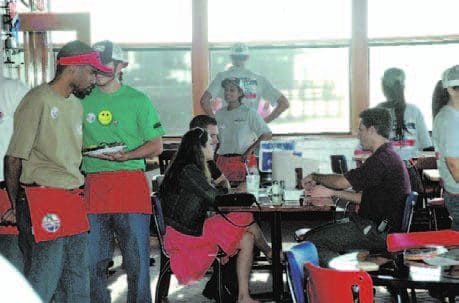
To introduce the Santa Monica location, a VIP party was held on Friday night, complete with red carpet arrivals that included celebrities, local sports stars and dignitaries.
Bubba Gump is donating 50 percent of the sales generated Saturday, Nov. 5, to the Santa Monica/Malibu Unified School District Equity Fund.
Donating to the community is typical for the company. Barnett said Bubba Gump raised $20,000 on its first day for a local charity when it opened in New York, and $15,000 was raised for the aquarium in Long Beach on its opening day.
“The proof is in the pudding; if we’re not a good member of the community, then you’ll know it, but that’s not going to be the case,” Barnett said.
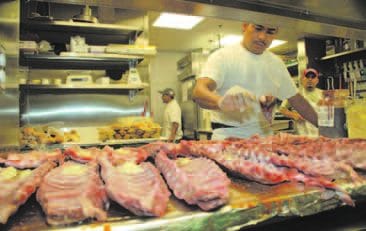
TO SILVERWARE Bubba Gump Shrimp Co. attempts to capture the charm that made “Forrest Gump” a hit, featuring the down-home décor reminiscent of the movie’s setting in Alabama. Film memorabilia and still photos decorate the walls, along with reproductions of script pages, storyboards and costumes, in an attempt to create a fun, family atmosphere. Scrawled “Gumpisms” grace the varnished table-tops inside, and guests can try on the plaster casts of Forrest’s running shoes at the famed bus bench in front of each restaurant location. Menu selections include references to the fare described in the film, including a myriad of ways to eat shrimp; the “bucket of boat trash,” which includes fried shrimp, slipper lobster tails and more; the “Run Across America” sampler plate; and other seafood selections. The average menu price is $13.
When Paramount Pictures debuted the film, Viacom Consumer Products, the studio’s licensing division, approached Rusty Pelican Restaurants Inc., which Barnett headed. That was when Barnett and his executive team put seafood restaurant expertise to work and developed the concept for Bubba Gump Shrimp Co., the first and only restaurant chain based on a motion picture.
“It’s very fun, very festive, and kids love it,” Paver said of the Pier 39 Bubba Gump. “They do a very good job executing.”
THE BACKSTORY OF BUBBA GUMP’S SANTA MONICA DEBUT City Hall, which owns the pier and the buildings on it, ended its month-to-month lease with the Boathouse in 2001. But Sheffield wouldn’t leave, claiming the PRC offered the Boathouse a long-term lease in 1993 but then reneged on the deal.
It wasn’t until June of 1998 that Sheffield was informed by the PRC that it was looking for other businesses to lease the space, and the Boathouse would be included in that selection process.
The PRC solicited bids from other restaurants — a process Sheffield claims she was left out of intentionally. In an attempt to be part of the selection process, Sheffield provided a proposal that included a $2 million renovation to the restaurant.
After a series of proposals and a detailed approval process, Bubba Gump won out with city officials over Sheffield’s proposal to change her aging restaurant into an American Indian motorcycle-themed Route 66 establishment. Dozens of companies submitted requests for proposals to open a restaurant on the pier.
But city officials were adamant that the next restaurant on the pier be “family oriented,” and a motorcycle theme wouldn’t meet that goal. The PRC looked at many aspects of the proposals it reviewed, including how much money the new restaurant could make for the city, as well as what was on the menu.
In 2001, Sheffield filed suit against City Hall and the PRC in U.S. District Court and federal court, claiming breach of contract, violation of her right to due process and unlawful takings. She also claimed that the PRC violated the state’s open meeting laws and that the city intentionally misrepresented the lease agreement. She asked for $50 million in lost future revenues in the restaurant her grandfather had started five decades before. She also attempted to launch a national smear campaign against Paramount, an investor in Bubba Gump, for helping to shut her restaurant down.
Meanwhile, a Santa Monica Superior Court judge granted City Hall the authority to evict Sheffield from the property, which happened in April of 2002. And the courts eventually sided with City Hall by tossing out the lawsuit.
The PRC has been criticized by many, including former Santa Monica Mayor Mike Feinstein, that it has engaged in behind-the-scenes political maneuvering for years. A controversial series of nondecisions by which the city refused to honor its own mandate to change the membership of the PRC may have been one reason for the Boathouse’s demise. Others cited a less-than-desirable clientele, poor menu selection and food service, and an aging building as other reasons the Boathouse sunk.
Several members remained on the PRC board since the 1980s, until they were finally replaced in 2001. But they were kept on long enough by some elected officials to ink the Bubba Gump deal and give the Boathouse the boot.
“It is a very sad situation,” City Councilman Kevin McKeown told the Daily Press in 2002. “I argued along with Mike (Feinstein) to keep the restaurant there.”
And while McKeown doesn’t support corporate chains replacing longtime businesses in Santa Monica, it’s become a reality.
“I don’t want to speak out against Bubba Gump specifically, they are a part of our community now, and we need to accept that and work with them,” he said in 2002.
The selection of Bubba Gump Shrimp seemed to go against the PRC’s own leasing guidelines, which were approved a few years ago. The guidelines specifically state that preference should be given to tenants on the pier that are locally owned businesses. The guidelines say chain restaurants are not wanted.
Despite some community apprehension to chain outlets, it appears that most people have accepted Bubba Gump, especially the crowd at Friday night’s VIP party.
“It’s desperately needed here; you have high-end and very low-end restaurants here. It’s a perfect meeting ground,” said Paul Dimitruk, a Santa Monica resident who attended Friday’s event.
“It’s in a great location.”

Originally published in the Santa Monica Daily Press print edition on November 5, 2005. Read the original PDF.