

With the creation of a business district, sales have staggered upwards
Graying automotive repair shops and graffiti are giving way to lively restaurants and retailers along Pico Boulevard.
And with that transformation, sales figures for the city’s longest and least cohesive business district have grown steadily as well.
Since the Pico Boulevard Business Improvement District was first formed in 1999, sales tax figures from shops along Pico have grown steadily. Between 2000 and 200, sales at Pico shops increased by 5 percent, city sales tax returns show.
City sales tax data released Wednesday shows third quarter sales from June to September 2002 increased by 7 percent when compared to the same period last year.
“The reason for that reasonable strength, is that Pico — unlike other areas of the city — is not dependent on the tourism trade,” said Mark Richter, economic development director for Santa Monica. “It’s a more resident-service market.”
Richter believes Pico’s sales have steadily grown because businesses serve the neighborhood and have good relations with nearby residents. The creation of a business district has helped businesses get their message out to residents and attract new patrons.
“I think its success points to a continuing need to provide amenities and services that are attractive to the local population, and to do that in a way that is respectful of the adjacent districts,” Richter said. “And that is what we have been trying to do with Pico.”
Bordered by the Santa Monica Freeway to the east and the Pacific Ocean to the west, the 3.5 miles of Pico Boulevard that make up the district are a hodge-podge.
Anchored on its western-end by two ocean resorts, Shutters by the Beach and Casa Del Mar, the boulevard quickly switches to a video rental store and a bowling alley near the civic center. It again changes, this time to student-serving businesses like bars and book stores, by Santa Monica College.
A Trader Joe’s dominates its eastern edge, near the traffic-clogged freeway on-ramp, where a scurry of local and regionally renown businesses have begun sprouting nearby.
McCabe’s Guitar Shop and the UnUrban Cafe have become cultural institutions regionally for their concerts and poetry readings.
“This part of Santa Monica is the last corner of mom and pop shops,” said Pamela Stollings, vice-chair of the business district and owner of the UnUrban Cafe. “And people are finding more comfort in that.”
5E8,“So much of Los Angeles to me looks like a strip mall,” she added. “Here everybody still has their individuality.”
And the eastern edge of the district may also be the only place in Santa Monica where one can buy a $2 bottle of red wine at Trader Joe’s and walk across the street and have a $200 dinner at Valentino’s Italian Restaurant.
It’s that diversity of stores that will help lead to a thriving business corridor, city officials said.
“We’re really pleased to see it improving,” said Gwen Pentecost, an economic analyst with the city who works closely with the Pico business district.
“The story of Pico is the unique business that comes in works hard and turns it around,” she said. “And that’s what they are doing, they are turning it around.”
But some say Pico’s growth is lopsided. Little activity exists between businesses near the beach and those close to the freeway. Indeed, the district’s board is dominated by businesses from the eastern edge of Pico and hotels officials have shown little interest in participating.
“Some of the best businesses on Pico are on the east end of Pico,” said Jim Stebbinger, president of the business district and a Trader Joe’s employee. “I’m glad it’s a mini region that’s helping Pico, but I’m concerned about the rest of Pico. We are have to spread that growth out”
Stebbinger said figures indicating Pico’s sales are growing can be misleading. He said Trader Joe’s accounts for much of the sales on the eastern end and the hotels account for much of the rest.
It seems some employees would agree. When told sales figures showed steady growth at shops along Pico, an UnUrban worker chuckled. “I don’t know where that’s happening,” he said. “But it certainly isn’t here. We’ve been dead compared to last year.”
Stebbinger said Pico most recently has been marked by a string of vacant storefronts, rather than sidewalks bustling with shoppers.
“What I’ve been noticing is the number of businesses leaving Pico,” he said. “It’s definitely a mixed bag.”
Business along Pico Boulevard are assessed a fee for being in the business improvement district. Depending on the size of the business, those fees fluctuate between $100 and $1,000 annually. All told, the district collects about $65,000 a year for improving the business corridor.
In 2001 money was spent on a survey that found nearby residents had no idea which shops are along Pico Boulevard, officials said.
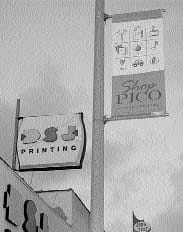
The group launched an advertising campaign that included street light banners, sending 10,000 mailers to businesses and nearby residents, and distributing a free directory of business found along Pico Boulevard.
According to city officials, the outreach is paying off but they question how long sales can continue to grow.
“I think it does in part reflect the fairly recent formation of a business improvement district, and a concerted effort of merchants along Pico to market and promotoe themselves and largely traget Santa Monica residents,” Richter said.
“Certainly five percent (growth) is not sustainable over a long period of time,” he added. “And there is still and economic downturn going on, so we will be interested to see the trend over the next couple of quarters.”
“This part of Santa Monica is the last corner of mom and pop shops. And people are finding more comfort in that. So much of Los Angeles to me looks like a strip mall. Here everybody still has their individuality.” — Pamela Stollings, UnUrban Cafe owner
Originally published in the Santa Monica Daily Press print edition on January 14, 2003. Read the original PDF.