

Advocates hope book will snap stereotypes
By WINTER JOHNSON Special to the Daily Press
The often anonymous and forgotten faces of the local homeless population have been captured, along with their stories and images, courtesy of an organization that helped them get off the street.
In celebration of its 40th anniversary, the Ocean Park Community Center (OPCC) embarked on a book project entitled “40 Lives: From Homelessness to Hope.” It details the success stories of 40 people who have overcome the challenges of homelessness, substance abuse and alcoholism.
Established in 1963, OPCC is a network of shelters and services for low-income and homeless youth, adults and families, battered women and their children, and people living with mental illness, according to officials. OPCC has eight projects within its facilities that serve 12,000 individuals a year.
In addition to providing emergency services such as food, clothing, showers and bus tokens, the agency’s programs are designed to provide long-term care. The services include case management, mental health counseling, transitional housing and permanent housing with supportive services.
There are between 1,200 and 2,000 people living on the streets in Santa Monica. Homeless men and women are often portrayed as public nuisances, a mentality that the editorial staff of “40 Lives” wanted to counter.
“The book does humanize these marginalized people,” said Jamie Diamond, lead editor of the book and a writer for The New York Times. “It makes them seem less ‘other’ and more ‘us.’”
The stories provide a background on each of the interviewed subjects — where they are from, how they became homeless, and their encounters with OPCC. Each portrayal gives specific details about the person’s life, including drug use, abuse, alcoholism, and even where they went to the bathroom. Threaded throughout each story is a marked sense of gratitude for the programs and people in OPCC.
“Please make sure to say that there were two women at OPCC who literally saved my life,” said Claire Sullivan. “They were kind, caring, understanding and helped me maneuver through everything it takes to get the things you need to build up your life again.”
“I prayed to the good Lord to put me some place where I could stay for longer than five minutes at a time, some place where I fitted in,” remarked Muriel Bouffard. “They haven’t kicked me out yet.”
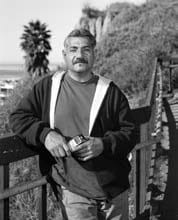
The photography also reflects the specificity of the writing. Through the process, photographer William Short would take a photo and then consult with the subject. Each individual is within a medium of their own choosing, or one that reflects their interests, Short said.
Mary Phillips’ picture was taken with her standing in front of lifeguard tower 22 on Santa Monica Beach — where she used to sleep. Isaiah Ortiz, a formerly homeless man who got his first job in 20 years as a janitor at OPCC, is now an outreach counselor for OPCC. He is pictured standing with the beach in the background, one of the many places he searches for homeless individuals.
Short’s goal was to capture subject photographs that would reflect an image differing from the stereotypical portrayal of a homeless man or woman.
“I always said that if a I did a project on homeless people, I wanted to approach it from a different angle, and not victimize them a second time,” Short said. “I wanted them to have dignity, confront the viewer, and come across in a self-assured way.
“The way that most people interact with the homeless is seeing someone on the street with their hand out, but we wanted to show a different side of who these people were,” added Short, who has volunteered his photographic skills for OPCC for 10 years, doing work for their newsletters, events and Christmas family portraits. “Each person was looking directly into the camera, which was very confrontational.”
OPCC officials thought it worthwhile to talk to a few of the volunteers, showing that homeless individuals and the organization’s staff alike have been affected by OPCC’s programs.
Volunteers and program graduates were not the only ones who spoke of gratitude. The book’s staff emerged with a story to tell as well, of how working on the book changed their outlook on their own lives.
“This project confirmed to me that I need to do more community-oriented things,” said Billy Johnson Jr., contributing writer and music director for Yahoo! Music. “Just participating in this project told me that ‘yes, I have more responsibility to be involved in the community.’ It was compelling.”
The OPCC Public Relations Committee began the project in 2003, and published it this past May. At the groundbreaking ceremony of OPCC’s new facility on May 26, the book was presented to the public. Photos from “40 Lives” were on display, and speakers included individuals who were once homeless and received support from their participation in the shelter.
Plans for “40 Lives” have not stopped with its publication. All proceeds from the book are going to OPCC, and the book is currently available on the OPCC Web site. In continuation of the fundraising effort, the OPCC public relations committee has plans for dramatic readings and photography exhibitions with the prints from the book. All proceeds from the events benefit OPCC.
“It’s a cliché to say, ‘It’s inspirational,’ but it really is,” Short said. “A project like this is so valuable, and it has so much to say about the human condition.”

Originally published in the Santa Monica Daily Press print edition on July 30, 2005. Read the original PDF.