

By JAYA GUPTA Special to the Daily Press
Often a place where smog taints every breath and the only greenery to be seen comes from the shrubs that grow along the side of the freeway, Los Angeles is largely considered a Shakespearean-sized ecological tragedy.
LA-based artist Charles Long, however, sees something different. Living and working in Frogtown near the formidable Los Angeles River, Long discovered a striking juxtaposition of nature and urbanization — he river, easily mistaken for a dump site, s home to both drug addicts and 125 different species of birds.
Grasses and shrubs grow out of furniture discarded in the river. Life sprawls amidst the waste of human society. Whereas most of the time, urbanization comes at the unfortunate expense of nature, Long’s oft-abstract exhibit of installations, photographs and a video at the Shoshana Wayne Gallery in Bergamot Station operates off the aesthetic notion that even in a wasteland, nature manages to resurrect itself.
“As an artist, I feel that I first need to see,” Long said. “Grasses growing out of a mattress is a completely natural situation, albeit very perverted. I wanted to show this combination of cultural debris entangled in the natural world. It is sadly beautiful.”
Long’s exhibit hangs in limbo — stopping short of simply declaring that nature manages to triumph over urban devastation while also refusing to hail ominous phrases of environmental decline.
Long’s two installations — “And Then So Clear” and “Duk Koo Kim” — are clearly the forefronts of the exhibition. Both are abstract reworkings of metal, found objects, plaster and other mediums. Made from a reformed shopping cart lodged in the plaster mold of a life-size human and set atop a clump of vine-like pieces of metal allowed to rust green, “Duk Koo Kim” towers over 20 feet. The shopping cart may resemble wings protruding from the back of a man set atop an entanglement of epiphytes encapsulating part of a car bumper and a trolley cart.
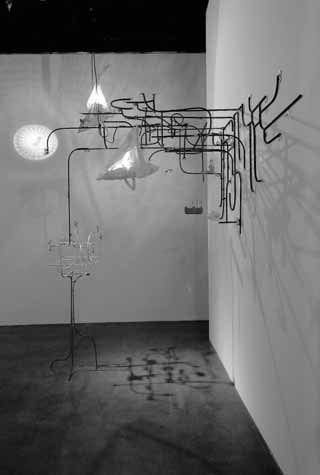
“And Then So Clear” is even more beguiling with its tangle of black textured metal bolted to the wall from which various found objects like Styrofoam and paper are suspended. It is meant to represent the river and the debris which pollutes it. Another tangle of silver metal rods connected to magnifying glasses is the base of the installation. Long suggests the magnifying glasses are based on the concept that culture needs to take a closer look.
“The things that I see — shopping carts drowned in the river with grasses and plants growing from them — I don’t know what they mean,” he said. “As humans we don’t have a choice in being able to think but we do have a choice in what and how we think. We need to look at the way we are living and reevalute it.”
Photographs of the LA River in various states of calm and unrest, plagued by different degrees of pollution, all pervaded by the combination of the urban and the natural, are another facet of Long’s exhibition.
One of the most striking images was of a single dollar bill ensnared in a tuft of dead grass. At a glance, the images appear wholly ordinary as the artist uses no artificial or photographic tricks to manipulate the image. The resonance of every image is the result of the veracity of the subject matter.
“The photo with the dollar was one of the first images I took,” he said. “Everything is reduced to an economical value yet nature doesn’t care about the dollar bill or the toy. The photos have the ability to transform, therein lies their power.”
Long’s exhibition at the Shoshana Wayne Gallery at Bergamot Station runs through Jan. 28. Bergamot Station, the converted warehouse complex which houses the largest concentration of art galleries in Santa Monica, is located at 2525 Michigan Avenue.
Once a historic light rail stop, the seven-acre Bergamot Station provides a central area for visitors to see art. In addition to the galleries, Bergamot Station has a custom framing shop, fine art paper store, art jewelry boutiques and design and architecture consultants. Admission and parking are free and the complex is open 9 a.m. to 4 p.m. on Monday, 9 a.m. to 5 p.m. Tuesday through Friday, and 10 a.m. to 5 p.m. on Saturday. For more information call (310) 453-7535.
Originally published in the Santa Monica Daily Press print edition on January 13, 2006. Read the original PDF.