

Homelessness up 28 percent over ’99
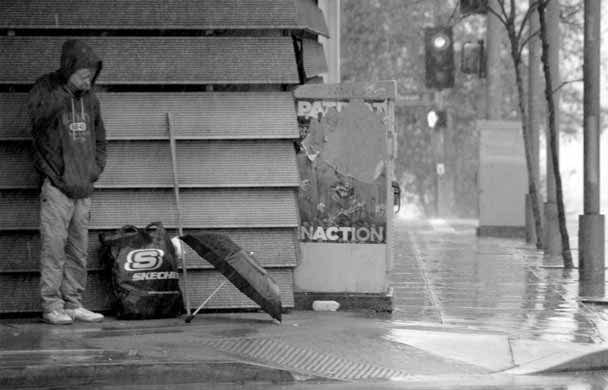
CITYWIDE — The majority of Santa Monica’s homeless are white men who are most likely war veterans, mentally ill or chronic substance abusers.
That’s according to a census conducted by the Los Angeles Homeless Services Authority (LAHSA), which found the number of Santa Monica’s down and out has increased by 28 percent since 1999.
The census was conducted more than a year ago, but detailed, demographic information specific to cities was withheld until last week, after City Hall requested it be released.
The new data, which includes the race, gender and age of each homeless person counted, sheds more light on who needs services here and how elected officials can better provide them.
It also supports measures taken by the City Council over the last two years to better address the chronically homeless, who represent a large percentage of those living on city streets, officials at City Hall said.
METHODOLOGY AND RESULTS The census was conducted in January of 2005 by LAHSA with the help of Applied Survey Research. Volunteers of the effort walked census tracts and physically counted those living on the streets and those in shelters. A statistical projection was used for the census tracts not counted, along with a telephone survey to identify locations of the “hidden” homeless, or homeless people living on private property.
The result was a Los Angeles County homeless population of 88,345.
In Santa Monica, there are approximately 1,991 people sleeping on the streets or in shelters on any given night. Individuals represent 91 percent of that figure, while families make up 9 percent, according to the census.
The most detailed information on race, age and other factors was provided only for regions known as county “service planning areas,” or SPAs. SPA 5 includes Santa Monica as well as Culver City, Inglewood and El Segundo, and reaches north to the Ventura County line.
In SPA 5, there is a total of 6,860 homeless people. More than half is considered chronic, the second highest rate in any area. Chronic homeless are those who are disabled and have been continuously homeless for longer than one year, or have been homeless intermittently more than four times in three years.
“We’re doing well, but we haven’t won anything yet. We are just getting started.”
“The numbers really aren’t revolutionary or surprising at all, but what this (census) really underlines is that the council was right … a year ago when it increased staffing in this area,” — said City Councilman Bobby Shriver. “So now we have a good thing going, and we just need to continue to work not only in providing services here, but also on creating a regional solution to solve this problem because this isn’t just about Santa Monica. This is a county-wide issue
Just over a quarter of those counted in SPA 5 are veterans; 63 percent are men and 22 percent are women. Nearly a third are African American, while 49 percent are white and 9 percent Latino.
“I think often when people talk about the homeless, they speak of them as this homogeneous group of people,” said John Maceri, executive director of the Santa Monica-based Ocean Park Community Center, which provides counseling, meals, hot showers and other services to low-income and homeless youth, adults and families. “But what these numbers show is that we are dealing with a diverse population that mirrors the community. The difference is these people are suffering from persistent, untreated mental illness, high levels of addiction or incidents of domestic violence and sexual assault. Some lost their jobs, while others lost loved ones. There is no one size fits all. To use the stereotype that all are drug addicted or mentally ill and don’t want to work is simply not true.”
MORE HOMELESS THAN BEFORE The census also shows that the number of people without a permanent home in Santa Monica has increased by 28 percent since 1999. City officials said the rise could have been caused by a number of factors, including a sharp rise in housing prices and rents, a fluctuation in the economy as well as an overall increase in the homeless population nationwide. The Southern California region is home to 12 percent of the nation’s homeless, city officials said.
The increase also could be attributed to the success Santa Monica has had in helping the homeless and the reputation it has built for being a homeless-friendly city.
“Some folks do come to Santa Monica because of the services we provide,” said Stacy Rowe, the director of the city’s homeless services unit. “People come here because the weather is nice and because they may feel safer here. We also have a good public transportation system, and because the city is relatively small, it is easy for them to get around.”
A REGIONAL PLAN The census, without a doubt, shows that homelessness is not concentrated in one area, but rather spread throughout the entire region, said Ed Edelman, Santa Monica’s homeless czar and a former Los Angeles County supervisor.
Edelman hopes to use the census as ammunition in his effort to unite cities and redesign the structure of LAHSA so that it includes more municipalities. LAHSA distributes funding to homeless service providers within the city and county of Los Angeles.
“Santa Monica is doing its part whereas other cities … keep the problem under the rug,” Edelman said. “We can’t do it alone. There has to be a regional approach to solve this. There are those who say it isn’t their problem, but they are already paying taxes for support services. They are already involved.”
Shriver said the census could support a plan he is sponsoring, which would take buildings at the Veterans Administration property on the Westside and convert them into housing for the chronically homeless. Because such a large number are veterans, Shriver said it makes sense to use the VA as a housing resource as well as a service provider.
WHO’S BEEN HELPED? City Hall has served more than 5,000 unduplicated adults since June of 2001, according to a city staff report. Providers have placed roughly 1,300 in permanent housing, close to 1,500 in transitional housing and just more than 1,800 in emergency shelters. More than 1,800 people have received jobs as well.
“This census really shows that we are headed in the right direction as we have tailored our programs in the last year, and a half to specifically help those who are living on the streets and who are mentally ill,” Rowe said. “We have made an effort to get out into the streets and follow up with those who are chronic. We think we are showing a lot of promise and are looking forward to continuing our effort.”
Originally published in the Santa Monica Daily Press print edition on March 8, 2006. Read the original PDF.