

By PAM WIGHT Special to the Daily Press
Samohi English teacher Meredith Louria wanted to find out how to improve Santa Monica’s schools. So, naturally, she went to Russia.
Despite its notoriously turbulent (and according to some, not entirely successful) transition to democracy, Russia actually ranks 14th internationally in education while the United States lags behind at 27th, according to the State Department.
Twenty-three years ago, Louria spent her first year of teaching in France on a Fulbright Scholarship and has since held the notion that by looking internationally to other educational systems, we may find solutions to some of our own problems here in American schools.
“Russia had such an amazing history of education and strength of education,” Louria said. “If you go back to Sputnik … the whole space race started because Russia put a man in space first and (President John F.) Kennedy wanted the United States to catch up.
“So I didn’t go there just to bring some of my expertise to them, I also went there to look at what they’re doing that’s worked so well.”
The State Department’s Bureau of Educational and Cultural Affairs offers an award called the United States-Eurasia Awards for Excellence in Teaching. Winners are offered the opportunity to participate in a three-week-long exchange program.
In October of 2004, 36 award winners were dispersed to 10 different countries — nine to Russia — each having been distinguished teachers and recognized in their fields.
“They were looking for people who have an award status and who are interested in working on the global level,” Louria said. “Also, we had to demonstrate that we’d keep an ongoing project with them when we return.”
One of those projects Louria arranged was for Russian students to join Santa Monica students in an essay contest about the importance of ecology, presented by the Santa Monica-based environmental group Heal the Bay.
“My host teacher, Nadya Streuva, is very interested in saving the environment,” Louria said. “So I brought back the Russian students’ essays and they will be on display at the Santa Monica Aquarium along with the local students’ essays. People here can go see them. And on Earth Day this year, some of my students and some of Nadya’s students will do a video conference on the environment.”
Louria also did a presentation for the Santa Monica school board upon her return and is currently co-writing an article with Streuva.
But Russian schools are not without their problems; problems similar to those facing American schools.
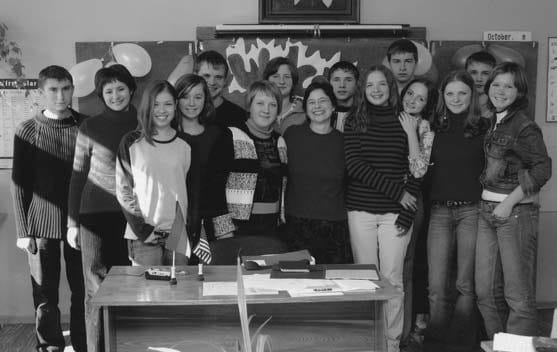
“They asked me about smoking, in particular, which they have a big problem with,” Louria said. “And about drugs, which they have a smaller problem with, and ditching. But what they don’t have is an ethnic mix — at least in the region where I was. They were mostly white and Christian. Very little diversity. I showed them pictures of my students and, of course, the first thing you notice about Samohi is the diversity. So I think that [lack of diversity] may eliminate certain issues, but I don’t think it accounts for all of the differences. There’s just a very different role that education plays in Russian society.”
Louria, who double majored in English and French for her B.A. degree at Mount Holyoke College in Massachusetts, originally wanted to teach French at the university level. But when she took a leave to try high school after returning from France, she never wanted to do anything else.
Now, after 23 years of teaching, the passion and dedication to her job are still evident in Louria’s voice.
“What I really loved about teaching high school was that I could still share all my passion for literature, but I could also form relationships because I’d have the students for a full year and, sometimes, I’d have them again,” she said. “I loved that part.”
Louria spoke to the Daily Press about teaching and her Russian experience from her Santa Monica High School classroom.
Where in Russia did the State Department send you?
It’s pronounced “Voronish” in English. It’s spelled V-o-r-o-n-e-z-h. It’s about 550 km south of Moscow. It’s a big city of about 1 million people, so it’s urban, although it’s not as big as Los Angeles. But it wasn’t like I was in some country village.
I went to five different K-11 schools — two were private, three were public. And then I went to two universities. The town has a lot of universities in it. They’re all public universities, but they specialize in different things. I went to the teachers’ college and to the literature part of the university and spoke to teachers there.
Each of us nine Americans who went to Russia went to a completely different part of Russia. And as you may know, Russia is one-and-a-half times the size of the U.S., so we were really spread out. The Russian population took as much advantage of us as they could, by having us see as much and be seen as much as possible There’s a great divide in Russia between those who have made a lot of money in the new capitalist system and those who haven’t. The social services people — doctors, teachers, etc. — have not made money. So these are very educated, very sophisticated people who don’t have the money that would allow them to travel to England, let alone the United States. Now there’s a whole other class of business people who do. I met people who had traveled to the U.S. and had money to send their children to programs in the U.S.
So it is opening up, but for the typical person working in the social services, they won’t be able to travel because of money. So the schools are so hungry for people to come to them and the materials they get are mostly from England. So they’re very hungry for American material. Most of us traveling, including myself, took two suitcases to Russia — one for our clothes and the other one for materials. I took books, workbooks, posters, magazines, etc.
Do you speak Russian? No, I do not. And that was not a requirement. And of all of the Americans who went, only one knew a little Russian. None of us were fluent in Russian. The people who I worked with over there were teachers of English in Russia. And their English was amazing.
I have this bias — maybe because of my own experience — that you only get fluent when you go and live in the country (where they speak the language.). So even though I’d had eight years of French prior to going to France, it was that year in France that made me fluent. But these teachers had never been outside of Russia and their English was extraordinary, both in pronunciation and in currency. They listen to tons of media in English that’s now available. I mean, their education system is just so good in foreign language.
So what did you actually do on a daily basis there?
The days were really full. Most days I taught two lessons — one in the morning and one in the afternoon. And those could be anything from beginning English with little children to 11th graders. In Russia, they leave for university after what we would call the 11th grade year, so their 11th graders are their top class. We looked at literature in depth and the lessons. It rarely was just the one class there in the room. Other classes would come in to hear it or there were at least other teachers who came in to observe and take notes. So there was always a little bit bigger audience than just the classroom.
Then, at other times, I would observe. I would be taken to classrooms that knew I was coming and had prepared something. I had a wonderful presentation that students did for me about Russian literature and Russian culture, as well as a performance of Shakespeare for me, knowing I was a literature teacher. So they were also showing off what they do.
I got tours of all the schools, the city’s monuments, libraries, universities. When I went to the institutes of higher education, I gave lectures and did question-and-answer sessions, which I also did at some of the schools with groups of students. I was interviewed by both student journalists and professional journalists. And then in the evening, we tried to see something of culture by going to the theater or ballet or opera, classical music concerts or we were invited to people’s homes so I could experience the life of a Russian.
So what did you figure out about their educational system that you think contributes to their success?
Well, there were some very interesting differences. One is that their schools are physically smaller and there are a lot more of them. So within each small neighborhood there is a school and a student would be at that school all 11 years of his or her schooling.
So while we start with small elementary schools, bigger intermediate schools and then bring everyone together at high school, their schools all go from first through 11th grade. There’s no division.
They showed me pictures of a ceremony on the first day of school where the 11th graders — the top class — escort the first graders who are just entering school to their classrooms. They just spend some time with them introducing them to the school, taking them on a tour.
There really is this sense that your school is like a second home. Most kids are at their school for 11 years, the families know the school people really well. The school has two psychologists — we would call them counselors — who stay with the same group of kids for 11 years. Because it’s such a small school, the teachers all teach multiple grade levels. So the teachers will have had the students many years.
Do you think that is part of the reason for Russia’s educational success?
I think it definitely helps because it’s much more intimate. For instance, I was surprised how many students’ families wanted to have us over to their homes. And then I realized that these are students whom my host Nadya has known for several years, whose families she’s known also.
The other thing is they don’t divide the subjects the way we do, so there’s just science, for instance. They don’t say, “OK, this is biology, this is chemistry.” I went into a science class of, I think, 3rd or 4th graders who were doing a little chemistry experiment, and they had me do it with them. And when I came back here and I described to my students what experiment I did and they said, “Oh, we did that in 10th grade.”
I’m not saying the 3rd graders understood it like a 10th graders would, but there’s not this sense that you only teach certain things at certain grade levels. They teach math and they teach it in a holistic way. A colleague in the math department here said it’s the same way in Canada. They don’t separate algebra into a separate course, or geometry into a separate course.
Another example is I went to a ceremony when I was there for the birthday of the school — October 14, the day the school was founded. The classes ended early that day and it was voluntary to go to the ceremony. It was full. It wasn’t just students from the school, it was alumni, people who had graduated and came back to celebrate it. There was a father and son team that got up and sang a song they wrote about the school. It’s just such a different feeling than we have here. The schools here feel so institutional.
What did you hope to accomplish by going to Russia? I hoped to give students and teachers there a view of what Americans are like beyond the media because the media they get is mostly about the war in Iraq or about pop stars and basketball stars. So they asked me lots of questions about myself, my family, my school, so I really wanted to represent America and I also wanted to learn — to see what makes their schools so effective and their education system so good.
They have very high literacy rates and high rates of students going on to higher education, and sometimes we think that just because the Russian economy isn’t as strong as ours that somehow the whole country should be poor in thought — that’s just not true. They value education and they’re well educated. A city of 1 million people support more nightly performances of culture than in a city like L.A. of 8 million.
Theater is very expensive here. It costs a fortune to go to the opera in L.A. I went to the opera in Russia and there are not the fancy costumes and lighting and stuff, but it was wonderful. People of all walks of life and ages came. I was very interested to see what Russia is like now and what their culture is like. They watch a lot of MTV.
What made you become interested in teaching? I would say the inspiration of my mother. She was an English professor at Santa Monica College. She loved teaching. She’d come home and tell interesting stories about her classroom or students, she always seemed excited about what she was doing, and she was always reading something new. She always took us to lots of plays and cultural events when we were young.
I remember reading out loud while she cooked dinner. It just seemed like a wonderful world, and then I thought I’d be interested in the university level, but realized after both being a TA at that level and trying to go further you don’t feel the same connection with your students I have one former high school student whom I taught, maybe 15 years ago, who is in my book club now that I run outside of school, and I’ve just kept in touch with a lot of really great people.
For a long time, I actually thought I’d be a French teacher because my favorite teacher in high school had been my French teacher. I loved him, I loved French. I loved everything about France, and I double majored in college in English and French, and then I applied for the Fulbright Scholarship to France so I thought I might be a French teacher.
But, ultimately, especially on a high school level, you’re more creative and you’ve got more diversity of what you can do if you’re an English teacher.
Can you give an example of a memorable moment as a teacher?
One time I went into an ice cream parlor here in Santa Monica with one of my children, who was quite young at the time, and the girl behind the counter looked familiar. I said, ‘Do I know you?’ and we got to talking and she said, ‘Oh yeah, you were my 10th grade teacher.’ And all of a sudden it came back to me that this was the girl that sat in the back of the classroom, scowling at me the whole time, got an ‘F,’ never did her work, always came in late. She said to me, ‘I remember loving your class. You were such a good teacher.’ And I thought to myself, my gosh, you never know the influence you have. You never know because for many teenagers, they’re going through painful periods in their lives. And they’re having a hard time and it’s not about you, you can’t take it personally, you just have to keep being the teacher you want to be and you never know in what way you affect someone.
What are your biggest challenges overall in today’s teaching climate?
Personally, the most trying thing is the financial state of the schools. Two things, actually for me, that make me wonder if I was starting my career now if I would stay. Those two things are that in the 23 years I’ve been teaching the financial situation has gotten worse and worse. And I’m not talking about my pay. I’m not talking about that at all. I’m talking about the budget, the money available for schools which mainly translates into class size. Because what I can do effectively with 20 to 25 kids I just can’t do when there are 36 kids. Thirty-six kids in the classroom becomes crowd control. And it’s a terrible shame on us.
Anyway, the other really big frustration for me is the testing, the national and state testing. I feel it is absolutely not doing any good to individual students, it takes up a huge amount of financial resources as well as time, and if you took the money and time they took up on testing and put it into good instruction, you could teach good things. But instead, these kids get tested way too much in ways that aren’t helpful to them. They aren’t helpful to the schools or the families.
In what other ways do the budget cuts affect education?
Well, Santa Monica is a very generous community and through their bonds we’ve been able to keep a lot of the arts and music programs. Both as a parent and a teacher, my experience has shown me there is nothing like the arts and music program to teach kids about discipline, teamwork, follow through. There’s absolutely no question in my mind that education in arts and music benefits the core classes like English, math, science, and it teaches the habits and skills of working well together.
Most schools have not been as fortunate as Santa Monica schools. And even Santa Monica has suffered cuts. For example, my daughter’s been in the music program since fourth grade. They used to go play at away games but they can’t do that anymore. That may not sound like a big thing, but it’s indicative of the trend and some people think of that as frills, but it’s not. My anecdotal experience — and studies would back me up on this — students who are involved in music, athletics and arts absolutely do better in school overall.
Do you have a philosophy for teaching? Basically, that you’re teaching people. I mean, I teach literature, I teach writing, I teach grammar, but really I teach people. That’s what keeps me going.
Do you have any secrets to running an effective classroom?
I think they’re pretty well known. To be very organized, to have exciting and interesting things going on, to be enthusiastic about what you’re doing, to be very clear about your expectations, to be very fair about how you implement those expectations, to be very transparent about what you expect and what you’re going to do and treating students with respect — they’re all well known.
I’ve taught the “Scarlet Letter” I don’t know how many times. But there’s something new every time. There’s a well-known playwright, Suzan-Lori Parks, who did a modern version of it set in an African- American community, and today we acted out a few scenes and the kids were great and we had such a good time with it. So I just feel that there’s always something fun to be done with it.
Do you like living in Santa Monica?
I love it. I’ve lived here for three years. I’d taught at Samohi for 12 years, so I already felt a part of the community — and my mom lived here. We were finally able to afford to move here three years ago.
Originally published in the Santa Monica Daily Press print edition on January 10, 2005. Read the original PDF.