

the mean streets
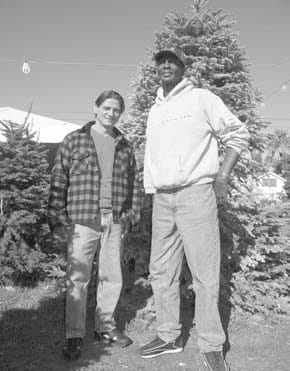
MAIN STREET — Convicted felons Freddie Baca and Robert Mickles never dreamed they would be spending the holiday season selling Christmas trees in Santa Monica — they figured they’d end up dead or in jail again.
But with the help of a foundation dedicated to providing a structured educational and living environment for ex-felons, Baca and Mickles are reformed criminals who have turned their lives around.
“It was inevitable that we were going to end up in prison again,” said Baca, 42, who was facing an eight-year prison sentence for possession of heroin more than six years ago. Prior to that, Baca had spent four years in the California prison system for robbery and heroin possession.
“I didn’t (care) about anything,” Baca recalled. “All I cared about was shooting dope and robbing people... You really become a disgusting human being.”
More concerned about not going back to prison than being rehabilitated, Baca in 1999 applied to Delancey Street, which provides an alternative to incarceration. He was lucky enough to be accepted — one out of 10 criminals get into the program, Baca said.
“I had no intentions of getting help,” he added, saying when he got to the residence on Vermont Avenue in Los Angeles, he found an unique environment, completely run by ex-convicts. “But unbeknownst to me, these people weren’t messing around. My first impression was, ‘Where are all the drug addicts?’ They just didn’t carry themselves that way.”
Baca and Mickels are just two of 2,500 residents of Delancey Street, a foundation based in San Francisco that has spread across the country since its inception in 1971. Selling Christmas trees in nine locations throughout Los Angeles is just one of the programs of Delancey Street. The income generated by Christmas tree lots, a commercial Christmas tree decorating business, a professional moving company, catering and restaurants — all operated by Delancey Street residents — allows the foundation to provide ex-felons training in a variety of business schools.
A vision of Mimi Silbert, a former professor of UC Berkeley who was studying the condition of prisons and realized there was a serious failure in rehabilitation throughout the system, Delancey Street began with four residents, a $1,000 loan, and a dream to develop a new model to turn around the lives of substance abusers, former felons, and others who have hit rock bottom.
The foundation operates with no professionals, no government funding, and at no charge to the clients. It has addressed generations of poverty, illiteracy, lack of job skills, hard-core substance abusers, homelessness, repeat felons, gang members, teen pregnancies, perpetrators and victims of every kind of abuse. The average client has been in prison for seven years and has been addicted to drugs for 15 years, Baca said. He added that Delancey Street is recognized by the court system as the tough-est alternative to prison.
In addition to selling 17,000 Christmas trees each year, the ex-convicts now operate one of the largest independent moving companies in California, a three-star restaurant on San Francisco’s waterfront, a catering business in Hollywood and a commercial tree decorating business that recently decorated LA’s City Hall and the mayor’s office.
“Santa Monica has been extremely supportive and helped us along the way,” — Baca said
Delancey Street first came on scene in Santa Monica after city officials granted the foundation a five-year lease on an apartment building in the Mid-City neighborhood. Christmas trees have been sold at the corner of Main and Pacific streets for six years.
After an average of four years — with a minimum stay of two years — residents gain an academic education, three marketable skills, accountability and responsibility, dignity and integrity. More than 14,000 people have graduated into society as successful taxpaying citizens, leading productive lives. They can choose to study professions such as culinary arts, real estate, business administration and construction, to name a few, according to Baca.
Using the principle of “each one, teach one,” the residents take responsibility for each other’s welfare and hold each other accountable for achieving the highest possible standards in everything they do.
“It’s imperative for us because we have never had a job or a career that we learn the concept of self-reliance,” Baca said. “You come to Delancey Street and I don’t care who you are, you are going to stand on your own two feet.”
When clients first come to Delancey Street, they start at the bottom and are mentored by veterans of the program. They begin to work their way up the ladder in terms of jobs, then they get their education in whatever vocation they choose. Many of them go on to college, Baca said. He recently graduated from San Francisco State with a bachelor’s degree in urban studies.
Mickles, a 52-year-old who oversees the Santa Monica Christmas tree lot, said he spent 15 years of his life in prison and never knew what responsibility was.
“I’ve never done anything long term in my life, “ he said, adding he’s been at Delancey Street for more than five years and doesn’t plan on leaving anytime soon. “I haven’t stopped growing. My stay is infinite.”
Mickles said he feels fortunate to have been accepted into the program. Facing another prison sentence for theft, he wrote to his sister and then to Delancey Street’s founder, hoping he could get out of the system.
“For some reason, they had compassion and accepted me,” he said. “I got there and it took me 14 months to come out of the fog.
“It’s such a great feeling helping people,” Mickles said. “I just feel so good waking up in the morning.”
Baca has given Delancey Street a 10-year commitment.
“It changes who you are. It’s very much like an extended family,” he said. “It’s done with a lot of love and compassion.”
Originally published in the Santa Monica Daily Press print edition on December 24, 2004. Read the original PDF.