

Officials want historic artwork included in new Main Library building
By MELISSA PRICE Special to the Daily Press
City officials are re-energizing a 20-year effort to bring back a $5 million mural that used to hang in Santa Monica’s former Main Library but now sits in storage at the Smithsonian American Art Museum.
With a $52 million library renovation planned, officials want the Stanton Macdonald-Wright murals back from the Washington D.C.-based museum so the artwork can be put on display.
However, even if Smithsonian officials agreed to give back the art today, the museum’s own renovation efforts may make finding it the biggest challenge.
The murals were donated to the Smithsonian by the Santa Monica City Council after the Main Library was rebuilt in 1966 because the new building, located at 1343 6th St., could not accommodate the massive work. Santa Monica lost the ownership rights to the murals when they were donated.
“At the time, things like that were not given any importance,” said city landmarks commission member Roger Genser. “It has only taken on significance in recent years. ”
In 1935, Macdonald-Wright unveiled the mural sequence entitled “Technical and Imaginative Pursuits of Early Man,” and dedicated it to Santa Monica and to his father.
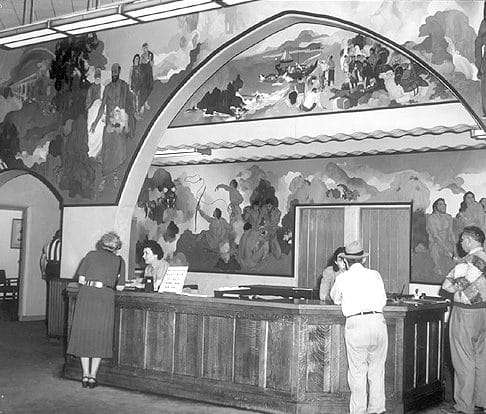
Chronicling the development of invention and imagination throughout history, the 2,000 square feet of fabric covers pine panels that snaked between the windows and wrapped around the doorways of the old library building.
The city raised $1,035 for the sequence which contains huge pieces, some spanning 10 feet long and six feet wide.
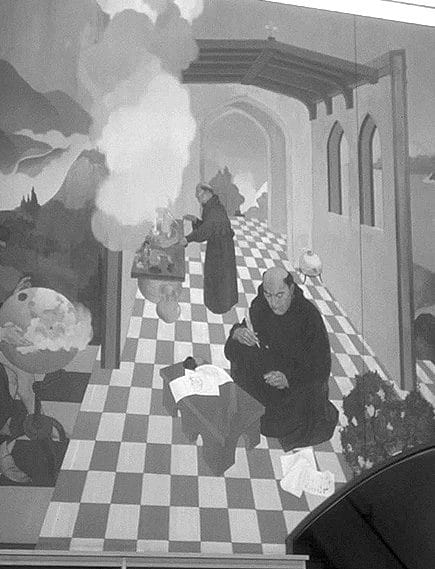
Macdonald-Wright described the subject of the soft, green and blue earth-toned murals as “depicting two streams of human development: one technical, the other imaginative.”
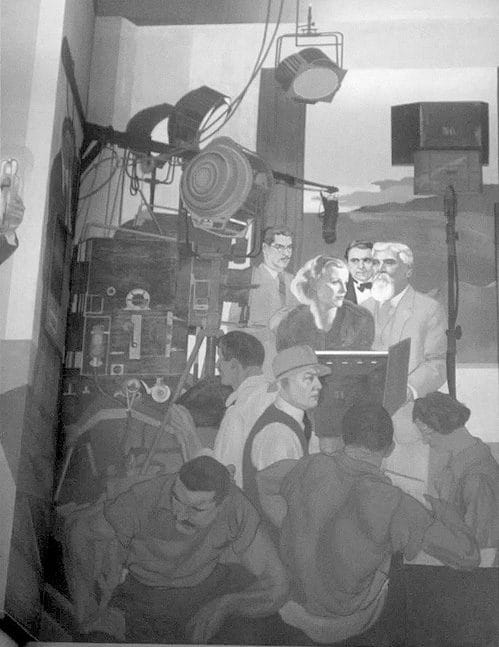
The sequence is designed to flow in a circle with the streams of history culminating in a panel depicting the filming of a movie. Placed at the entrance of the library, the panel displayed Macdonald- Wright’s belief that movies held the greatest potential for artistic expression.
“It was the most exciting cultural activity happening at the time,” said Virginia Mecklenburg, senior curator at the Smithsonian American Art Museum.
The city has since recognized the historical and artistic value of the work. Several attempts have been made over the years to return the murals to Santa Monica, including possibly featuring them at the airport.
“This is the most appropriate, timely and easiest way to accommodate the murals because we are building a new building,” Genser said.
The movement has been a bi-partisan effort involving members of Congress, the city council and the community.
“This is good — it preserved the art — and negative — it is the property of the Federal government,” said assistant city librarian Greg Mullen.
But it likely will take a lot of digging to get them returned to Santa Monica.
The murals are in storage as the Smithsonian completes its own renovation, and the “logistics of getting to them at this point are insurmountable,” Mecklenburg said.
At most, the city only can obtain a long-term lease of the work.
The panels are “heavy and awkward and take up a huge amount of wall space,” which has limited the Smithsonian in where it can show them, Mecklenburg said.
However, the museum has a “major commitment to getting art out of storage areas and on view whenever possible,” Mecklenberg added.
Eight of the 38 panels were shown last year at the Los Angeles County Museum of Art.
Macdonald-Wright, who grew up in Santa Monica, helped establish modern art in Southern California by working, teaching and organizing art exhibits in the area.
Many outstanding Santa Monica personages of the day found their way into portraits in the murals. The sequence features actor Lee Carrillo, director Frank Tuttle, W.H. Carter, who was the mayor at the time, and young starlet, Gloria Stewart, who played the adult character Rose in the movie “Titanic.” Macdonald- Wright even includes a self-portrait as a troubadour playing a lyre — ala Hitchcock.
“Some of the most important art in America was done in this period,” Genser said.
A new home The new library’s design team was faced with a daunting task when they began thinking about how to accommodate the murals. They had to design room in a contemporary building to exhibit a historical mural of enormous size and extraordinary color.
To further complicate the job, the panels are not available for viewing and few photographs were taken.
“The information we have is sketchy. They were not good at documentation at that time,” said Lauren Friedman, project manager for the new library building. “We are definitely going to build the space, but we won’t know for sure whether we will get the murals.”
Artists and architects have had to rely on black and white photographs, the Los Angles County Museum of Art exhibit, and descriptions by people who have seen the murals in person.
Moore Ruble Yudell, a local architectural firm which is designing the new building, worked with the project design team to create a new home for the mural.
The panels will be placed on outside walls of the second floor reading area, which will make the work accessible to everyone in the building.
To avoid concerns over vandalism and theft of the multi-million dollar murals, the artwork will be placed 10-11 feet above the floor.
“You can see (his Asian) influence in the way he handles landscapes. He has taken motifs from Japanese and Chinese scrolls. There is a Zen quality to his imagery.”
“It will be high enough so they will be out of reach,” Mullen said.
The murals also must be displayed in order.
“There is a logic to it because they are telling a story so we have to keep it in groups to make sense,” Mullen said.
The design team also had to consider lighting, pest control, air conditioning, and humidity concerns.
The city must complete a facilities report once the building is complete to demonstrate the library’s suitability to house the artwork.
“It is a standard requirement for any museum loan,” said Laura Baptiste, public affairs officer at the Smithsonian.
The design has to function without the murals equally well.
“It may just be open space which works fine,” Friedman said. “The challenge was to have it work either way.”
Friedman believes the planned display may actually better exhibit the murals.
“In the old library, the murals really were the room,” Friedman said. “In some ways, they can be better appreciated in this context.”
If and when the city leases the artwork, some pieces may require renovation.
“That’s the one big question,” Mullen said. “We haven’t had a chance to look at them.”
Despite the difficulties, the consensus is that the new library is an ideal forum for the work.
“It is a great example of the city’s history while directly related to the history of the library,” Friedman said.
“It is a great example of the city’s history while directly related to the history of the library.” — — VIRGINIA MECKLENBURG Smithsonian American Art Museum — LAUREN FRIEDMAN Project manager for the new library building
A library also reflects the central meaning of Macdonald-Wright’s murals, historians say.
“A library is the place where all these ideas come together,” Mecklenburg said. “All corners of the world come together. It is a center of learning and growth and a source for civilization to advance.” as well as images, such as a steel worker and a coal miner, that reflect his perception of modern civilization.
The mural’s subject was typical of murals created during the era.
“There was a tradition of putting murals in libraries, and using universal themes of civilization and history was fairly standard,” said Ilene Susan Fort, curator of American art at the Los Angeles County Museum of Art.
Yet Macdonald-Wright was able to incorporate his unique perspective on color. The series also was unusual in the fusing of Eastern and Western images and ideas. It reflected his own philosophical attempts to reconcile Eastern and Western thought.
“He tried to recapitulate and articulate what he had come to believe the best way he knew how, which was painting,” said Virginia Mecklenburg, senior curator at the Smithsonian American Art Museum. “You could tell this is a man who read a lot. He thought a lot about man — where he’d been and where he was.”
A California artist Raised by an indulgent mother and amateur painter/hotel manager father, Macdonald-Wright was allowed to indulge his aptitude for art and trouble.
Under the tutelage of elder brother Willard, Macdonald-Wright, who grew up in Santa Monica, led a reckless youth, hanging out in brothels and getting expelled from two private schools. As a teenager, he tried to stow away to Japan, but was caught in Hawaii and hauled back home. After short stints in a department store and medical office, he received his father’s blessing to pursue art full time.
At 17, he married a wealthy woman 10 years his senior after a two-week courtship. They left for Paris, where he met Morgan Russell. The two artists studied with color theorist Percyval Tudor-Hart and developed their Synchromism theory. In Paris, Macdonald-Wright also began hyphenating his middle and last name, claiming the affectation was necessary to avoid confusion with Frank Lloyd Wright.
Synchromism was the first American avant garde movement recognized internationally. It used color to define planes, operating on the theory that blue tone colors recede and yellow tone shades stand out. The artists compared color to music in that certain colors evoked different moods. They believed that the distance between notes in a chord is like the difference between colors on palette wheel, and a painting could be almost scientifically created.
Synchromism was not very popular at its unveiling.
“People are uncomfortable with abstraction until they get over the hurdle of expecting a painting to show you something in the world,” said Mecklenburg said.
When Macdonald-Wright’s marriage soured and the money was spent, he left for New York where he lived with his brother. The pair succumbed to an opium addiction, but Macdonald-Wright still managed to create and exhibit work. Their mother, who financially supported her two sons in their creative endeavors, cut them off in disgust after visiting them.
During the late 1900s, MacDonald- Wright moved away from Synchromism, opium and New York, and returned to Santa Monica. He took great pains to establish modern art in Southern California over the course of his career. He organized exhibitions including the first modern art exhibit in Southern California in 1920. He established artists’ groups such as the Independent Artists of Los Angeles and the Modern Art Workers. He also taught at Chauinard Art Institute and UCLA, and directed the Los Angeles Art Student’s League. In addition, he directed the local Works Project Administration’s Federal Art Project in the 1930s, which was a Federal program to establish art in public spaces.
Macdonald-Wright also created murals in petrachrome. Borrowing from Renaissance and cubist methods of mixing stone and sand with color, the process created a faux marble effect.
The Santa Monica City Hall features a petrachrome mural entitled “The History of Santa Monica and the Bay District.”
Macdonald-Wright also was fascinated with Asia. He taught oriental art and aesthetics at UCLA and was a Fulbright exchange student in Japan. He studied Buddhism and Taoism, and traditional Chinese theater.
“You can see this influence in the way he handles landscapes,” Mecklenburg said. “He has taken motifs from Japanese and Chinese scrolls. There is a Zen quality to his imagery,” she added.
Macdonald-Wright’s brother, who as a Los Angeles Times literary critic had become famous for his scorn for Santa Monica, reinvented himself as well. He wrote mystery stories that were made into 27 movies.
Originally published in the Santa Monica Daily Press print edition on July 13, 2002. Read the original PDF.